
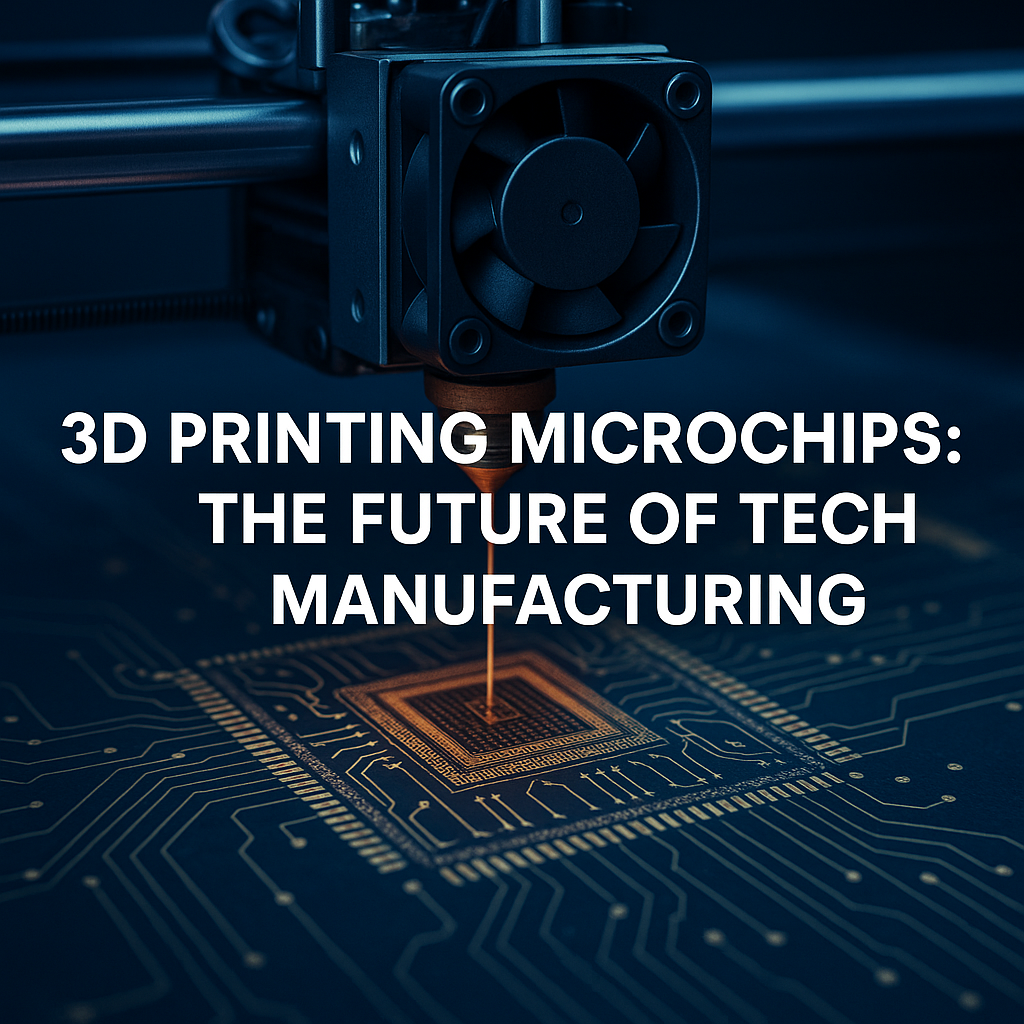
The technology industry is standing at the threshold of another manufacturing revolution. Over the past decade, 3D printing has evolved from producing simple plastic prototypes to creating complex industrial components, medical devices, and even human tissue. Now, one of the most ambitious frontiers is microchip manufacturing — a shift that could redefine the way electronic devices are designed, built, and distributed.
From smartphones and AI servers to electric cars and IoT devices, microchips are the heartbeat of modern technology. Yet, traditional semiconductor manufacturing is an incredibly complex, expensive, and resource-intensive process. 3D printing offers the potential to streamline production, reduce costs, and open the door to unprecedented levels of customization.
In this article, we will explore how 3D printing is transforming microchip manufacturing, its potential benefits, challenges, and what this means for the future of technology.
The Current Microchip Manufacturing Process
Before diving into the revolution, it’s important to understand how microchips are made today.
Conventional semiconductor manufacturing relies on photolithography, a process in which light is used to etch extremely small patterns on silicon wafers. Each wafer can hold hundreds of chips, which are then cut, tested, and packaged. This process requires:
- Massive fabrication plants (“fabs”) that cost billions of dollars to build.
- Extreme precision machinery capable of producing features smaller than a virus.
- Months of production time, from wafer creation to final chip packaging.
The barriers to entry are enormous, which is why only a few companies (like TSMC, Intel, and Samsung) dominate the global chip market. But what if producing microchips didn’t require billion-dollar facilities? That’s where 3D printing comes in.
How 3D Printing Could Disrupt Chip Manufacturing
3D printing — also known as additive manufacturing — builds objects layer by layer from digital models. When applied to microchips, this technique could enable direct, on-demand fabrication without the need for massive photolithography machines.
Some promising approaches include:
- Nano 3D Printing – Using advanced printers that deposit conductive and semiconductive materials at the nanometer scale.
- Multi-Material Printing – Combining insulating, conductive, and semiconductive layers in a single manufacturing process.
- Direct Ink Writing (DIW) – A precise extrusion method for depositing functional materials like graphene or silver nanowires.
If perfected, these methods could allow chip manufacturers — or even small startups — to design and print chips in days instead of months.
Key Benefits of 3D-Printed Microchips
1. Lower Manufacturing Costs
Traditional fabs cost up to $20 billion to build and maintain. 3D printing requires significantly less upfront investment, reducing the barrier to entry for new companies.
2. Faster Prototyping
Chip designers could iterate prototypes quickly, testing designs in hours rather than waiting for long fab cycles. This could accelerate innovation across industries.
3. Customization & On-Demand Production
Imagine a wearable medical device with a custom chip tailored to a patient’s needs. 3D printing makes low-volume, highly customized production economically viable.
4. Decentralized Manufacturing
Instead of relying on a handful of mega-factories in Asia, companies could produce chips locally, reducing supply chain vulnerabilities like those seen during the COVID-19 pandemic.
5. Sustainability
3D printing generates less waste than subtractive manufacturing, uses fewer toxic chemicals, and could allow for easier recycling of chip components.
Challenges to Overcome
While the promise of 3D-printed microchips is exciting, several hurdles remain:
- Resolution Limits – Printing at the scale of nanometers is extremely challenging. Current 3D printers for electronics are still far from matching the transistor density of cutting-edge chips.
- Material Performance – Ensuring printed semiconductors match the electrical and thermal performance of silicon remains a major obstacle.
- Mass Production Speed – While great for prototypes or small batches, 3D printing must dramatically speed up to compete with high-volume fabs.
- Industry Standards – The semiconductor industry relies on strict design rules. 3D printing will need to meet these standards for widespread adoption.
Recent Breakthroughs in 3D-Printed Electronics
Several companies and research labs are already making strides in this area:
- Optomec is developing additive manufacturing systems capable of printing conductive pathways for microelectronics.
- Nano Dimension specializes in multi-material 3D printing for circuit boards and is researching chip-level printing.
- University of Nottingham researchers are exploring methods to print fully functional electronic devices using multiple materials in a single build.
While these technologies are still in the early stages, they signal a clear industry shift toward more flexible manufacturing methods.
Impact on the Tech Industry
If 3D printing becomes a viable way to manufacture microchips, the effects on the tech industry would be profound:
- Shorter Innovation Cycles – Startups could launch products faster without waiting for traditional fabs.
- Resilient Supply Chains – Decentralized production would reduce the risk of global chip shortages.
- Lower Costs for Emerging Markets – Affordable chips could drive tech adoption in regions currently priced out of the market.
- New Product Possibilities – Highly specialized chips could enable devices we can’t yet imagine.
The Road Ahead
Industry experts believe it could take 5 to 10 years before 3D-printed microchips match the performance of traditionally manufactured ones. However, hybrid approaches — combining 3D-printed interconnects with conventional silicon cores — may emerge sooner.
Governments and corporations are investing heavily in semiconductor R&D. As the race for chip sovereignty heats up, 3D printing could become a critical tool for achieving manufacturing independence.
Conclusion
The dream of printing microchips may sound futuristic, but the technology is advancing rapidly. As 3D printing continues to push boundaries in materials science, manufacturing speed, and nanoscale precision, the idea of designing and producing chips on demand could soon move from research labs into mainstream production.When that day comes, the entire technology industry will be transformed — making innovation faster, more sustainable, and more accessible than ever before.