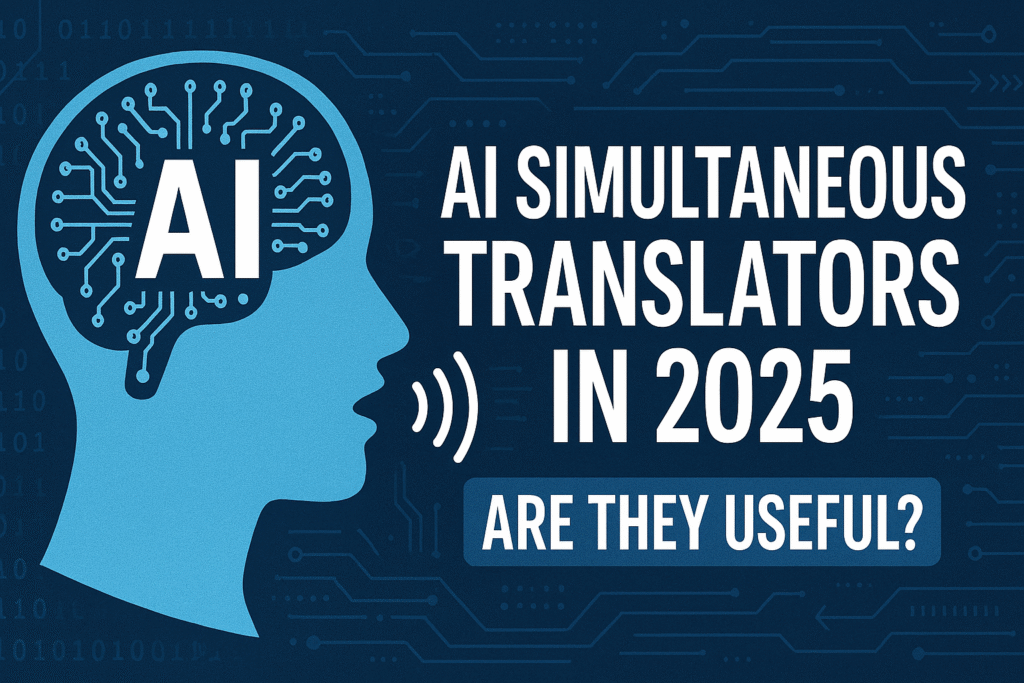
In the rapidly evolving landscape of artificial intelligence, one of the most fascinating and practical innovations is AI-powered simultaneous translation. In 2025, these systems have become more prevalent, more accurate, and more indispensable than ever before. From global business meetings to tourism, education, and healthcare, AI simultaneous translators are reshaping how we communicate across languages.
But the big question remains: Are AI simultaneous translators actually useful in 2025? Let’s explore how far the technology has come, where it stands today, and whether it’s truly delivering on its promise.
The Evolution of AI Translation Technology
Simultaneous translation—interpreting speech in real time—has traditionally been a task for highly trained human professionals. However, the rise of artificial intelligence has introduced automated simultaneous translation systems that rely on machine learning, natural language processing (NLP), and neural networks.
Key milestones before 2025:
- 2020–2023: Tech giants like Google, Microsoft, and Meta introduced real-time translation features in mobile devices and conferencing platforms.
- 2024: Apple and Samsung began integrating AI translation into wearables like smart glasses and earbuds.
- 2025: AI simultaneous translators are now widely available in smartphones, smart assistants, and enterprise-level communication platforms.
Thanks to improvements in AI models, latency has decreased, accuracy has improved, and contextual understanding has significantly evolved.
How AI Simultaneous Translators Work in 2025
Today’s AI translators are no longer just translating words; they are interpreting context, intent, and tone. Here’s how they operate:
- Speech Recognition (ASR) – Captures and converts spoken language into text in real time.
- Natural Language Processing (NLP) – Analyzes the grammar, context, and intent of the text.
- Machine Translation (MT) – Translates the input to the target language using neural models.
- Text-to-Speech (TTS) – Converts the translated text back into spoken language.
Modern AI translators are capable of handling slang, idioms, and cultural nuances that previously tripped up older models.
Use Cases: Where AI Simultaneous Translators Shine
1. International Business
Global companies are using AI translators for meetings, presentations, and conferences. Platforms like Zoom, Microsoft Teams, and Google Meet offer built-in real-time translation, enabling seamless collaboration between multilingual teams.
2. Travel and Tourism
Wearable AI translators—such as smart earbuds and AR glasses—help travelers understand directions, restaurant menus, and local customs without needing to know the native language.
3. Education
Online courses and global classrooms benefit from real-time language translation, allowing students from different parts of the world to access the same content simultaneously.
4. Healthcare
Hospitals and clinics, especially in multicultural areas, use AI translators to communicate with patients who speak different languages, improving care and reducing misunderstandings.
5. Customer Service
AI chatbots and call centers now include real-time translation features, ensuring that language barriers don’t affect customer satisfaction.
Benefits of AI Simultaneous Translators in 2025
Real-Time Performance
AI translators now operate with minimal delay—often under one second—making conversations feel natural.
High Accuracy
Translation engines have trained on massive multilingual datasets, allowing them to produce highly accurate and contextually appropriate translations.
Cost-Effective
Hiring professional interpreters for every interaction is expensive. AI offers a budget-friendly alternative for everyday and business use.
Scalability
One AI translator can serve thousands of users simultaneously, making it ideal for large-scale applications like conferences or public announcements.
Limitations and Challenges
Despite their usefulness, AI simultaneous translators are not perfect.
Contextual Ambiguities
Some languages have nuances and double meanings that are still difficult for AI to interpret accurately.
Tone and Emotion
While AI is improving in understanding tone, it can still misinterpret sarcasm, humor, or emotional cues.
Security Concerns
In sensitive environments like government or legal contexts, data privacy and accuracy are critical, and AI systems may not always be secure enough.
Low-Resource Languages
AI translation is still weaker for rare or indigenous languages that lack large training datasets.
Human vs. AI Translators: Will Machines Replace Humans?
While AI translators have become incredibly capable in 2025, human translators are still essential in high-stakes environments. Legal trials, medical diagnoses, literary translations, and cultural consultations still require a human touch for precision and cultural sensitivity.
However, AI is complementing, not replacing, human translators—often acting as the first line of interpretation in real-time settings, with humans refining and verifying output as needed.
Top AI Simultaneous Translation Tools in 2025
- Google Interpreter Mode – Now integrated with Google Pixel Buds and smart glasses.
- Microsoft Azure Speech Translator – Popular in enterprise environments.
- Meta’s SeamlessM4T – A multilingual, multimodal AI model delivering audio and text translations.
- iTranslate & Pocketalk – Portable devices ideal for travel.
- Zoom AI Companion & Teams Translator – Built into popular video conferencing platforms.
The Future of AI Translation Beyond 2025
Looking ahead, we can expect:
- Emotionally aware translators that adapt tone and style based on the speaker’s emotions.
- Multimodal translators integrating gestures, facial expressions, and audio cues.
- Deeper integration with AR/VR for immersive multilingual experiences.
- Crowdsourced language models that expand coverage to underrepresented languages.
Conclusion: Are AI Simultaneous Translators Useful in 2025?
Absolutely. In 2025, AI simultaneous translators are not only useful—they’re revolutionary tools reshaping communication across borders. They have matured into reliable, real-time aids for business, education, healthcare, and travel. While they still face limitations in nuance and low-resource languages, their benefits far outweigh their drawbacks.
Whether you’re a frequent traveler, an international business owner, or just curious about new tech, AI simultaneous translators in 2025 are worth using and watching closely as they evolve.