Artificial intelligence (AI) has rapidly transformed the way we interact with technology. From personalized recommendations to voice assistants and advanced image recognition, AI is at the core of modern digital experiences. Yet, as AI becomes more powerful, concerns around privacy and data protection have grown louder. Companies like Google, Meta, and Microsoft often rely on massive amounts of user data to fuel their AI models—raising questions about how personal information is collected, processed, and stored.
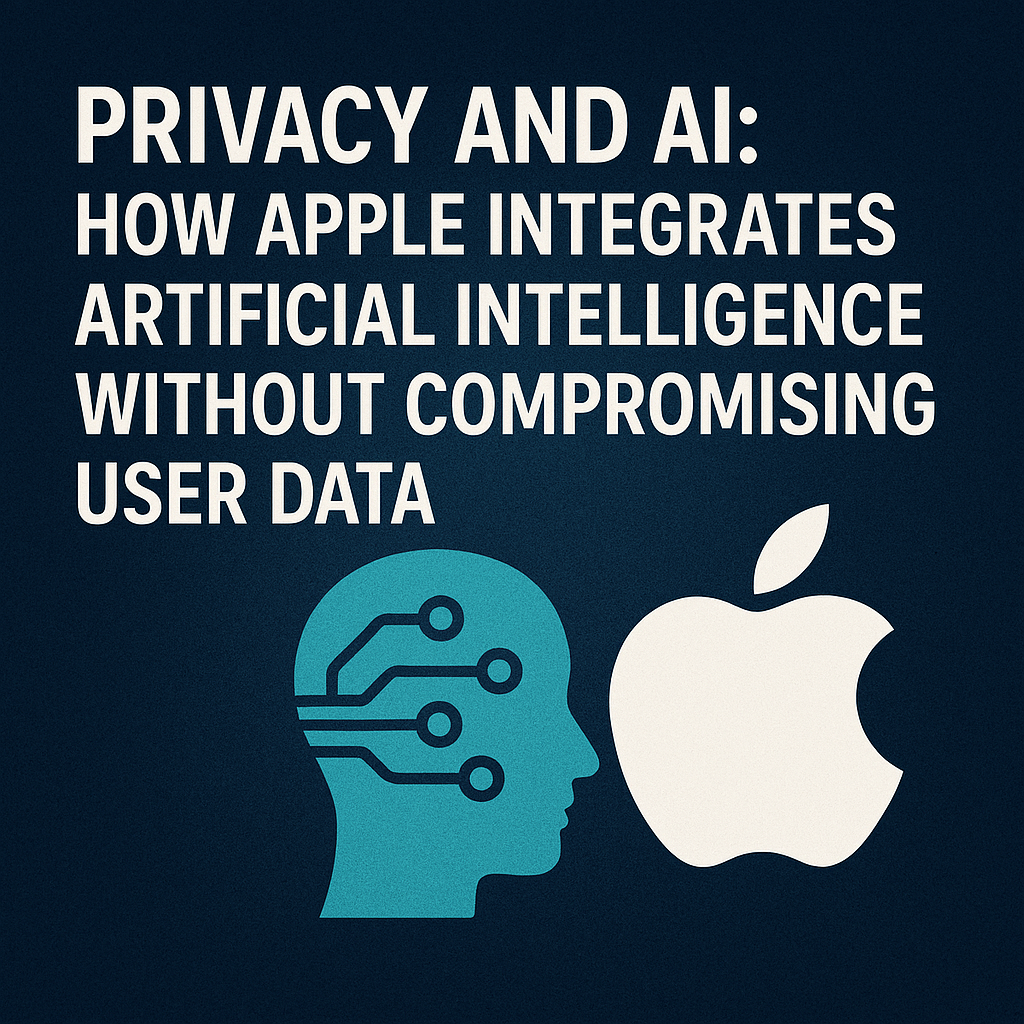
Apple, however, has positioned itself differently. The company’s long-standing emphasis on user privacy has influenced its approach to artificial intelligence. Rather than building AI systems that depend on large-scale cloud data collection, Apple has invested heavily in on-device AI, federated learning, and privacy-preserving technologies. The result is an AI ecosystem that enhances user experiences without sacrificing privacy.
In this article, we’ll explore Apple’s philosophy on privacy, the technologies that make its AI different, real-world applications, and the future of private AI.
Apple’s Privacy-First Philosophy
Unlike many competitors, Apple treats privacy as a fundamental right, not just a feature. Tim Cook, Apple’s CEO, has consistently highlighted the company’s commitment to protecting user data, often contrasting Apple’s business model with companies that profit from targeted advertising.
Instead of monetizing personal information, Apple generates revenue primarily through hardware and services. This business model gives the company the freedom to limit how much user data is shared or collected in the first place.
Apple’s privacy principles can be summarized as:
- Minimization of Data Collection – Collect only what is absolutely necessary.
- On-Device Processing – Keep sensitive data on the user’s device whenever possible.
- Transparency – Inform users about what data is collected and how it’s used.
- User Control – Allow users to opt out or manage permissions easily.
These values directly shape how Apple integrates artificial intelligence into its ecosystem.
The Role of On-Device AI
The key difference between Apple’s AI and many others lies in where the processing happens. While Google or Amazon often rely on sending user data to powerful servers, Apple prefers to process data locally on iPhones, iPads, Macs, and even Apple Watches.
This on-device approach has several advantages:
- Privacy Protection: Sensitive information, like voice recordings or photos, doesn’t need to leave the device.
- Speed and Responsiveness: On-device AI reduces latency, making features like Siri or Face ID faster.
- Offline Functionality: AI features can work even without an internet connection.
For example, the iPhone’s Face ID uses a neural engine within the device to process facial recognition securely. The mathematical model of a face is stored in the device’s secure enclave, never uploaded to Apple’s servers. Similarly, predictive text suggestions and autocorrect rely on machine learning models that adapt to the user’s behavior without transmitting personal typing data.
Federated Learning: AI Without Centralized Data
Another cornerstone of Apple’s AI strategy is federated learning. This technique allows AI models to improve collectively without requiring Apple to store or analyze individual user data centrally.
Here’s how it works:
- Each device processes data locally and trains the model.
- Only the model updates—not raw data—are sent to Apple’s servers.
- These updates are aggregated with those from millions of other devices.
- The improved model is redistributed to all users.
This system enables Apple to enhance features like autocorrect, Siri understanding, and predictive text while ensuring that private data, such as personal messages or browsing history, stays on the device.
Real-World Examples of Apple’s Private AI
Apple has already deployed privacy-preserving AI across its ecosystem in impactful ways:
- Siri – Recent updates allow Siri to handle many requests offline, such as setting timers, controlling music, or launching apps, thanks to on-device AI.
- Photos App – Features like object recognition, face grouping, and Memories creation are powered by machine learning but run entirely on-device.
- Apple Watch Health Features – AI detects irregular heart rhythms or tracks sleep patterns locally, with sensitive health data encrypted and stored securely.
- iOS Mail and Safari – Mail Privacy Protection hides IP addresses and Safari’s Intelligent Tracking Prevention uses AI to block cross-site tracking without sharing browsing data.
- Accessibility Tools – Features like Live Captions or VoiceOver leverage AI to help users with disabilities while safeguarding personal information.
Balancing AI Advancement and User Privacy
One of the biggest challenges in AI development is balancing performance with privacy. Cloud-based AI can leverage massive computational power and datasets, often outperforming on-device systems in complexity. Apple’s strategy, therefore, focuses on finding innovative ways to maximize efficiency within device constraints.
The Apple Neural Engine (ANE), first introduced in the iPhone X, was specifically designed to accelerate AI workloads locally. Each generation of Apple silicon, including the M-series chips for Mac, includes more powerful neural engines to handle advanced tasks without relying on external servers.
This hardware-software integration allows Apple to push the boundaries of AI while keeping sensitive user data under lock and key.
How Apple Stands Out from Competitors
When comparing Apple to other tech giants, the differences are clear:
- Google and Meta: Rely heavily on user data for ad targeting, often processing personal information in the cloud.
- Microsoft: Offers strong enterprise security but still integrates cloud AI for many consumer features.
- Apple: Focuses on decentralization, processing AI tasks locally and minimizing data collection.
This strategy has helped Apple differentiate itself in a market where data exploitation is a common concern. In fact, many consumers now associate Apple with trust, making privacy not just an ethical stance but also a competitive advantage.
The Future of Private AI at Apple
Looking ahead, Apple is likely to double down on its privacy-centric AI strategy. Possible future developments include:
- More Offline Siri Capabilities: Expanding Siri’s ability to perform complex tasks without cloud support.
- Advanced Health AI: On-device health diagnostics powered by the Apple Watch and iPhone sensors.
- Personalized AI Assistants: Federated learning could allow deeper personalization without compromising data security.
- Private Generative AI: With generative models becoming mainstream, Apple may explore ways to integrate text, image, or voice generation directly on devices.
As hardware continues to evolve, the line between cloud and on-device AI will blur, but Apple’s core principle will likely remain unchanged: privacy first.
Conclusion
Artificial intelligence is shaping the future of technology, but it also poses critical questions about privacy. Apple has carved a unique path by proving that powerful AI does not have to come at the expense of user data security.
Through on-device processing, federated learning, and its dedicated neural engines, Apple continues to deliver innovative AI features while keeping user information safe. For consumers increasingly wary of how their data is used, Apple’s approach offers a model for how the industry can innovate responsibly.
In a world where data is often called “the new oil,” Apple shows that it is possible to build cutting-edge AI systems without exploiting personal information—a balance that may define the next era of technology.