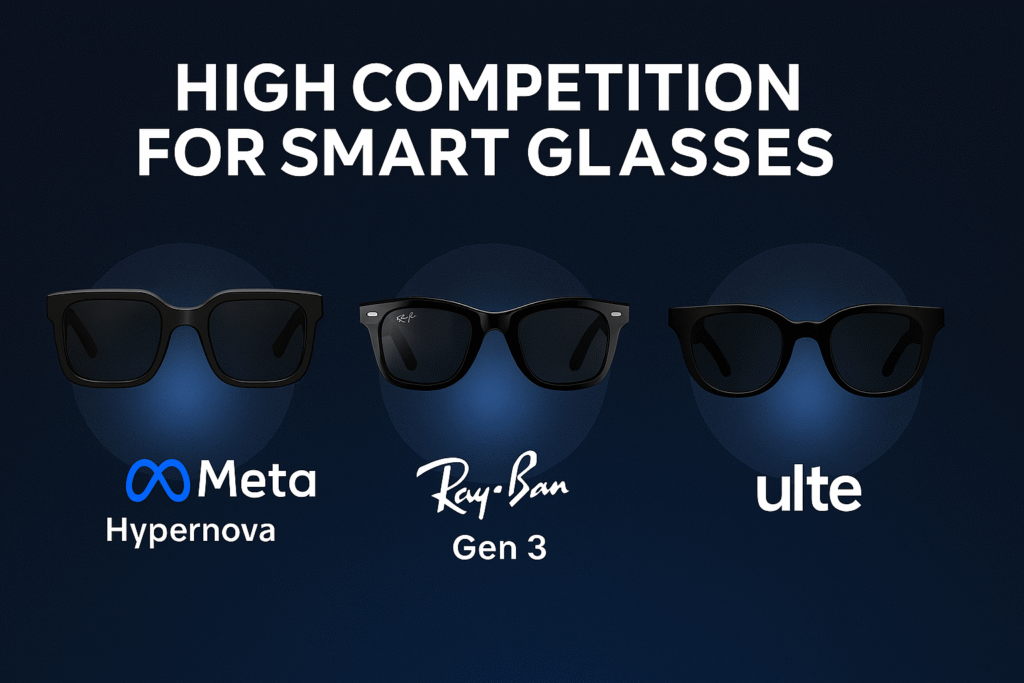
The smart glasses market is entering one of its most competitive phases. What once seemed like futuristic eyewear for niche users is now transforming into a mainstream battle between some of the world’s most influential tech brands. At the center of this rivalry are three standout players: Meta’s Hypernova, the latest Ray-Ban Meta Smart Glasses Gen 3, and the rising contender Ulte, a company aiming to disrupt the market with its innovative take on augmented reality.
In this article, we’ll dive deep into the design, features, usability, and market strategies of these smart glasses. By the end, you’ll see how each product positions itself in this high-stakes technology race, and which might ultimately shape the future of wearable augmented reality.
The Current Landscape of Smart Glasses
Smart glasses are no longer a futuristic concept. With advancements in AR (augmented reality), AI integration, miniaturized processors, and edge computing, wearable technology has matured to the point where companies can deliver lightweight, stylish, and functional devices.
The market is driven by two major trends:
- Everyday usability – People don’t want bulky or awkward-looking devices. They want glasses that look like regular eyewear but are infused with technology.
- Immersive experiences – From navigation and translation to AI-assisted photography and real-time information overlays, users expect meaningful functionality.
This makes the competition between Meta, Ray-Ban, and Ulte particularly intense, as each brand targets different aspects of consumer needs.
Meta Hypernova: Pioneering the Future of AR
Meta, formerly Facebook, has long invested in augmented reality. With the Hypernova smart glasses, Meta positions itself as a leader not just in hardware but also in the broader metaverse ecosystem.
Key Features
- Advanced AR overlays: Real-time navigation, notifications, and contextual information displayed directly in the field of view.
- AI integration: Tightly coupled with Meta’s AI assistant, offering voice commands and predictive actions.
- Mixed-reality potential: Hypernova serves as a bridge between daily functionality and immersive metaverse experiences.
- Enterprise edge: Tailored apps for productivity, collaboration, and training.
Design and Comfort
Unlike previous bulky AR prototypes, Hypernova boasts a slim profile. Meta has reportedly partnered with optical manufacturers to keep the form factor sleek while embedding micro-LED displays.
Market Strategy
Meta’s bet is clear: the Hypernova is not just eyewear—it’s a gateway into its digital universe. If Meta succeeds, these glasses won’t just compete with other wearables but with entire ecosystems, including Apple’s Vision Pro.
Ray-Ban Meta Smart Glasses Gen 3: Style Meets Function
Ray-Ban, in partnership with Meta, has refined its formula with the third generation of its smart glasses. Unlike the Hypernova, which leans toward advanced AR, Ray-Ban’s glasses prioritize style and everyday convenience.
Key Features
- Photo and video capture: Hands-free, high-resolution recording for social media creators.
- Audio immersion: Discreet open-ear speakers deliver surprisingly strong audio while keeping ears open.
- Seamless connectivity: Quick integration with smartphones and Meta platforms.
- Lighter build: Gen 3 is more comfortable for long wear, maintaining Ray-Ban’s iconic fashion-first design.
Why It Stands Out
The Gen 3 glasses are not about futuristic AR but about blending lifestyle with subtle tech. They target influencers, digital nomads, and tech-savvy professionals who value fashion as much as functionality.
Market Strategy
Ray-Ban and Meta understand that not everyone wants immersive AR right now. Many just want stylish glasses that can capture, share, and enhance daily life. This gives the Gen 3 a wide appeal, particularly for younger audiences on TikTok, Instagram, and Facebook.
Ulte: The Challenger on the Rise
While Meta and Ray-Ban dominate headlines, Ulte is emerging as a dark horse. The company has made bold claims about redefining what smart glasses can achieve.
Key Features
- True AR immersion: Ulte integrates a wide field-of-view projection that overlays digital elements seamlessly in the real world.
- Gesture-based interaction: Instead of relying solely on voice, Ulte supports hand gestures for intuitive control.
- Lightweight build: Designed with titanium frames and advanced battery systems to balance comfort with power.
- Developer-friendly ecosystem: Open SDKs attract AR app developers, giving Ulte flexibility and innovation potential.
Market Positioning
Ulte positions itself as a disruptor—not as stylish as Ray-Ban nor as ecosystem-driven as Meta, but as a technology-first brand. This appeals to early adopters, developers, and tech enthusiasts looking for the next leap in AR capabilities.
Head-to-Head Comparison
| Feature / Device | Meta Hypernova | Ray-Ban Gen 3 | Ulte |
| AR Capability | Advanced overlays, metaverse integration | Minimal, focuses on lifestyle | Wide FOV AR immersion |
| Design | Sleek but slightly futuristic | Iconic Ray-Ban frames | Lightweight, modern |
| Target Audience | Professionals, metaverse users | Lifestyle & content creators | Early adopters, developers |
| Interaction | Voice + AI assistant | Touch + voice | Gesture + voice |
| Market Strategy | Ecosystem & enterprise | Fashion + everyday users | Innovation & disruption |
Market Challenges
Despite the excitement, smart glasses face hurdles:
- Privacy concerns – Cameras in glasses raise questions about surveillance and consent.
- Battery limitations – Balancing lightweight designs with long usage remains difficult.
- Adoption curve – Many users still see smart glasses as experimental rather than essential.
- Pricing pressure – With premium components, affordability becomes a barrier.
Who Will Win the Smart Glasses Race?
It may not be about a single winner. Instead, different devices will dominate different niches:
- Meta Hypernova could lead in enterprise and immersive AR.
- Ray-Ban Gen 3 might remain the go-to for everyday users and lifestyle integration.
- Ulte has the chance to capture early adopters and carve out a developer-friendly niche.
Ultimately, the winner may depend on ecosystem support. Just as smartphones evolved with app stores, smart glasses will thrive when developers, content creators, and brands commit to building on these platforms.
Final Thoughts
The competition among Meta Hypernova, Ray-Ban Gen 3, and Ulte reflects the broader shift in wearable technology. These aren’t just gadgets—they’re gateways to how we’ll interact with information, media, and even reality itself in the next decade.
While Meta pushes for an immersive metaverse, Ray-Ban keeps smart glasses stylish and accessible, and Ulte brings bold innovation to the table. One thing is certain: the age of smart glasses has truly begun, and the race to dominate it is only heating up.