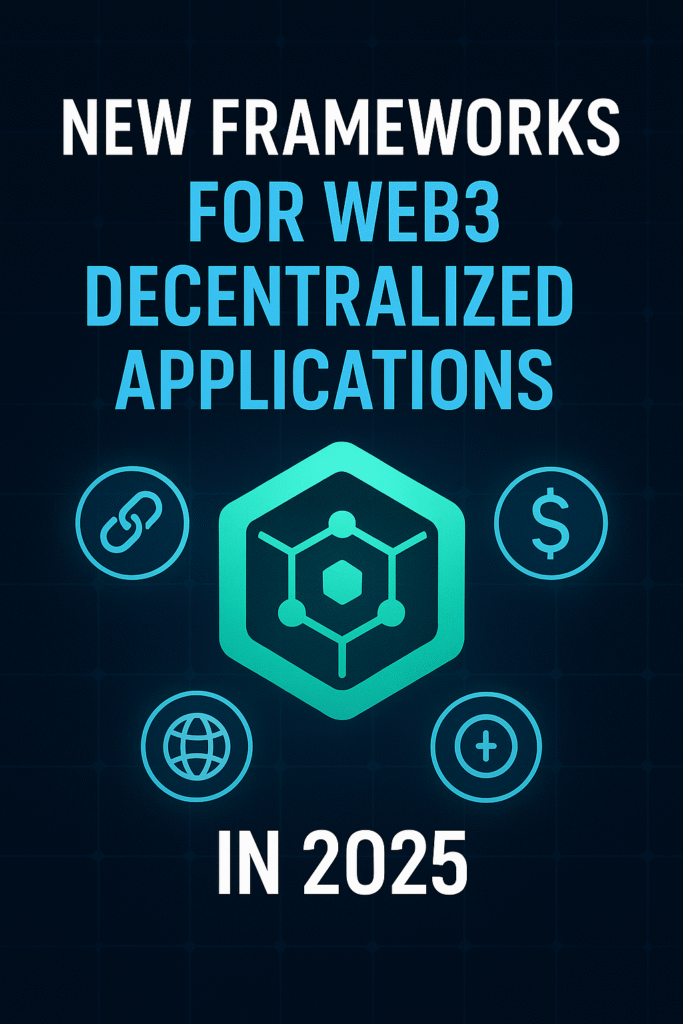
The Web3 revolution continues to reshape the digital landscape, moving the internet away from centralized control and toward a decentralized, transparent, and user-owned model. Since the early days of Ethereum and smart contracts, developers have faced both exciting opportunities and significant challenges in building decentralized applications (DApps). As we enter 2025, new frameworks are emerging that simplify development, improve scalability, and bridge the gap between blockchain technology and mainstream adoption.
In this article, we will explore the latest frameworks for Web3 DApp development in 2025, their features, and how they are transforming the way developers create decentralized ecosystems.
Why New Frameworks Are Crucial for Web3 Development
While Web3 offers unique advantages such as ownership, transparency, and censorship resistance, building decentralized applications has traditionally been complex. Developers often encounter challenges such as:
- Steep learning curves with blockchain-specific languages like Solidity and Rust.
- Scalability issues, with networks becoming congested during high usage.
- Poor user experience, where wallets, gas fees, and private key management intimidate new users.
- Fragmented tooling, requiring developers to combine multiple libraries, APIs, and SDKs.
To address these challenges, new Web3 frameworks have been created with a focus on developer-friendliness, interoperability, and performance. These frameworks act as the backbone of modern DApp development, enabling teams to build faster and more efficiently.
Key Features of Modern Web3 Frameworks in 2025
Before diving into the specific frameworks, let’s look at the defining characteristics that set 2025’s Web3 frameworks apart from their predecessors:
- Cross-Chain Compatibility – Instead of building solely on Ethereum or Solana, developers can now create applications that interact seamlessly across multiple chains.
- Zero-Knowledge (ZK) Integrations – Many frameworks now support ZK-rollups and proofs to improve scalability and privacy.
- Modular Design – Developers can pick and choose modules for identity, payments, governance, and data storage.
- AI-Assisted Development – Frameworks increasingly integrate AI tools to automate contract auditing, bug detection, and optimization.
- Web2-to-Web3 Bridges – APIs and SDKs that make it easy for Web2 developers to transition into blockchain ecosystems.
- User-Friendly Onboarding – Abstraction of wallets, gas fees, and private keys to make DApps accessible to everyday users.
Top Web3 Frameworks for DApps in 2025
Here are some of the most promising frameworks dominating the decentralized application landscape in 2025:
1. Foundry 2.0
Originally popular in 2022, Foundry has evolved significantly. The 2025 version provides developers with an end-to-end toolkit for Ethereum-compatible smart contracts.
- Key Features:
- Enhanced Solidity and Vyper support.
- AI-driven contract testing and debugging.
- Modular plugin ecosystem for oracles, DeFi, and NFTs.
- Enhanced Solidity and Vyper support.
- Why It Matters: Foundry 2.0 has become a standard among Ethereum developers due to its speed, lightweight design, and security-first approach.
2. Cosmos SDK+ (2025 Edition)
The Cosmos ecosystem has grown into a hub for interoperable blockchains, and its 2025 SDK update expands its capabilities.
- Key Features:
- Out-of-the-box cross-chain messaging with IBC 3.0.
- ZK-proof modules for private transactions.
- Enhanced governance modules for DAOs.
- Out-of-the-box cross-chain messaging with IBC 3.0.
- Why It Matters: Cosmos SDK+ makes it easy to launch application-specific blockchains, giving developers more control over scalability and features.
3. Thirdweb v3
Thirdweb has become one of the most accessible platforms for building Web3 apps, with a focus on lowering barriers to entry for developers.
- Key Features:
- No-code and low-code solutions for NFTs, DAOs, and DeFi apps.
- Cross-chain deployment in one click.
- Built-in walletless onboarding for new users.
- No-code and low-code solutions for NFTs, DAOs, and DeFi apps.
- Why It Matters: By removing technical complexity, Thirdweb v3 allows Web2 developers and startups to easily transition into Web3.
4. Aptos Move Studio
Aptos, known for its Move programming language, has released a robust framework in 2025 for scalable and secure applications.
- Key Features:
- Move-based smart contract templates.
- Built-in libraries for DeFi, gaming, and payments.
- Parallel transaction execution for high throughput.
- Move-based smart contract templates.
- Why It Matters: Aptos Move Studio provides enterprise-grade scalability, making it ideal for mass-market applications.
5. Polygon Supernets Framework
Polygon has become a key scaling solution for Ethereum, and in 2025, its Supernets Framework makes it possible for developers to launch custom blockchains optimized for specific use cases.
- Key Features:
- ZK-rollup and optimistic rollup support.
- Configurable gas models.
- Tools for integrating with DeFi, NFTs, and gaming ecosystems.
- ZK-rollup and optimistic rollup support.
- Why It Matters: Developers gain the ability to design blockchains tailored to their application, striking the right balance between decentralization and performance.
6. Substrate 4.0
Polkadot’s Substrate framework has long been a powerhouse, and its 2025 update makes it more flexible than ever.
- Key Features:
- AI-assisted runtime development.
- Full support for cross-consensus messaging.
- Pre-built governance and staking modules.
- AI-assisted runtime development.
- Why It Matters: Substrate 4.0 allows developers to customize blockchains while benefiting from Polkadot’s robust ecosystem.
7. Chainlink Functions Framework
Chainlink, the leading oracle network, launched its new framework in 2025 to make data integration and hybrid smart contracts more accessible.
- Key Features:
- Plug-and-play data feeds from APIs and IoT devices.
- Support for off-chain computation with verifiable results.
- AI data pipelines for real-time analytics.
- Plug-and-play data feeds from APIs and IoT devices.
- Why It Matters: By connecting blockchains with real-world data, Chainlink Functions opens the door to more advanced DeFi, supply chain, and gaming apps.
Trends Driving Web3 Framework Innovation in 2025
The rise of new frameworks is fueled by larger trends shaping the blockchain industry this year:
- Mainstream Adoption of Web3 – More enterprises and governments are exploring blockchain, demanding easier-to-use frameworks.
- DeFi 2.0 Expansion – New frameworks support liquid staking, real-world assets (RWA), and advanced derivatives.
- Metaverse and Web3 Gaming – DApp frameworks now come with built-in support for virtual economies and NFTs.
- Sustainability Concerns – Many frameworks focus on green blockchain development, with energy-efficient consensus models.
- AI and Blockchain Convergence – AI-enhanced frameworks speed up smart contract audits, optimize gas fees, and predict scalability bottlenecks.
Challenges That Still Remain
Despite these advances, Web3 development in 2025 still faces hurdles:
- Regulation Uncertainty: Governments are still defining clear rules around decentralized apps, tokens, and DAOs.
- Security Risks: Hacks and exploits remain a top concern, requiring constant vigilance in smart contract design.
- User Education: While frameworks simplify development, mass adoption still depends on making blockchain concepts accessible to non-technical users.
The Future of Web3 Frameworks Beyond 2025
Looking ahead, we can expect frameworks to continue evolving in three main directions:
- Greater Abstraction – Future frameworks may hide blockchain complexity completely, making Web3 apps feel like Web2 apps.
- Interoperability by Default – Developers won’t have to choose between Ethereum, Solana, or Cosmos; frameworks will seamlessly connect them all.
- Autonomous DApps – With the help of AI, decentralized applications may evolve into self-improving autonomous systems that govern themselves.
Conclusion
In 2025, the Web3 ecosystem is experiencing a major transformation thanks to new frameworks that simplify and accelerate DApp development. From Foundry 2.0 and Thirdweb v3 to Cosmos SDK+ and Polygon Supernets, these tools are lowering barriers, improving scalability, and opening the door for widespread adoption.
For developers, entrepreneurs, and enterprises, these frameworks provide the foundation to build the next generation of decentralized finance, gaming, social media, and beyond. As Web3 continues to grow, mastering these frameworks will be essential for anyone aiming to succeed in the decentralized future.