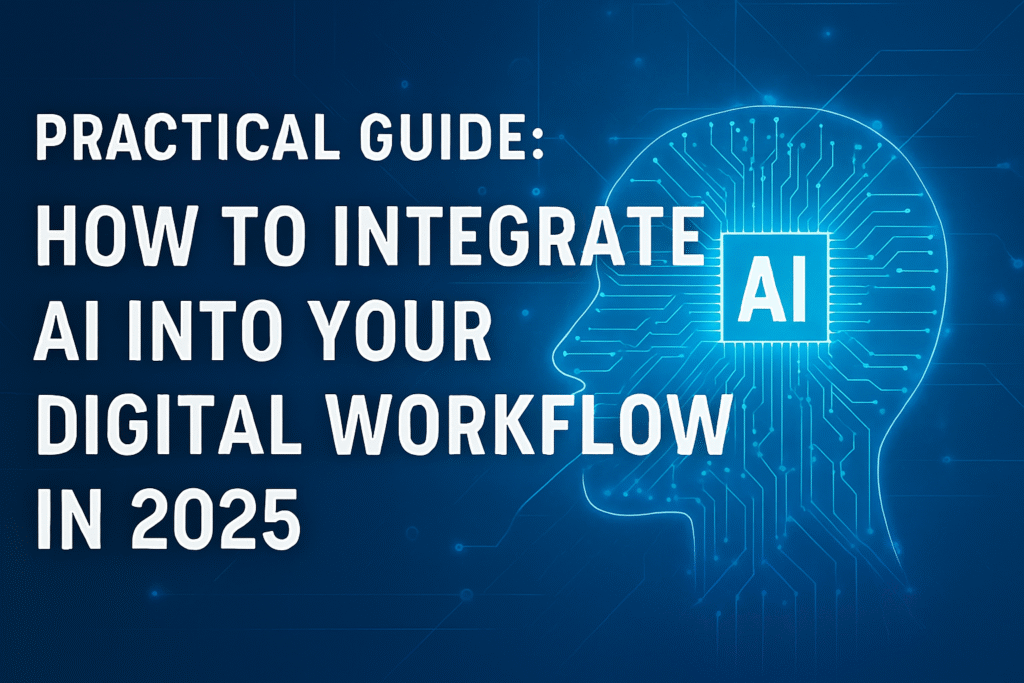
Artificial intelligence (AI) is no longer a futuristic concept—it’s now the backbone of modern digital workflows. In 2025, businesses and creators who effectively integrate AI into their operations gain a significant advantage in productivity, creativity, and decision-making.
Whether you’re a freelancer, a small business owner, or managing a full-scale digital enterprise, understanding how to practically embed AI into your daily workflow is essential. This guide will walk you through the most effective strategies, tools, and best practices to integrate AI seamlessly in 2025—without feeling overwhelmed by technology.
1. Understanding the Role of AI in Modern Workflows
AI has evolved from simple task automation to a deeply integrated digital co-pilot. In 2025, it’s reshaping everything—from how we plan projects to how we write emails, manage data, and design marketing campaigns.
AI integration is not about replacing human creativity; it’s about augmenting it. By delegating repetitive and data-heavy tasks to machines, you can focus on higher-value activities that require strategic thinking and emotional intelligence.
Key Areas Where AI Is Making an Impact:
- Project Management: Predictive analytics and task automation.
- Content Creation: AI writing assistants and visual generation tools.
- Marketing & SEO: Smart data-driven optimization.
- Customer Support: AI chatbots offering instant responses 24/7.
- Data Analysis: Turning massive datasets into actionable insights.
- Software Development: AI code completion and testing automation.
2. Assessing Your Workflow: Where Can AI Help the Most?
Before diving into tools, take a step back and analyze your existing workflow. This is crucial to determine where AI can bring the most value.
Step-by-Step Analysis:
- Identify Bottlenecks:
What tasks consume the most time or resources? These are your AI opportunities. - Categorize Tasks:
Break down tasks into repetitive (e.g., data entry), creative (e.g., design), and analytical (e.g., forecasting). AI can support each category differently. - Set Goals:
Do you want to save time, improve quality, or scale your output? Your goals will dictate which AI solutions to adopt. - Start Small:
Don’t attempt to overhaul everything at once. Begin with one department or task—like automating social media content scheduling or using AI for meeting summaries.
3. Core AI Tools to Integrate in 2025
The AI tool ecosystem in 2025 is vast and rapidly evolving. Below are the most practical categories and examples that can help integrate AI into your workflow effectively.
A. AI for Productivity & Organization
- Notion AI – Enhances project management with automated note summarization and content generation.
- ClickUp AI – Streamlines workflows by suggesting task dependencies and automating project updates.
- Microsoft 365 Copilot / Google Gemini Workspace – AI companions embedded in everyday productivity apps like Word, Excel, and Gmail.
B. AI for Communication & Collaboration
- Otter.ai / Fireflies.ai – Record, transcribe, and summarize meetings in real-time.
- Slack AI – Generates smart summaries of conversations and recommends action items.
- Zoom AI Companion – Automates meeting notes, follow-ups, and insights.
C. AI for Content Creation
- ChatGPT / Jasper / Copy.ai – Generate articles, scripts, or marketing copy.
- Canva Magic Studio / Adobe Firefly – Create professional-grade visuals with text prompts.
- Runway ML / Pika Labs – Edit videos, remove backgrounds, or generate visual effects using AI.
D. AI for Marketing & SEO
- Surfer SEO / Clearscope / NeuronWriter – Optimize content using AI-driven keyword insights.
- HubSpot AI / CopyMonkey – Automate email campaigns and ad copies.
- MarketMuse / SEMrush AI Assistant – Identify topic gaps and content opportunities.
E. AI for Analytics & Decision-Making
- Tableau AI / Power BI with Copilot – Turn raw data into interactive visual insights.
- ChatGPT Advanced Data Analysis (ADA) – Conduct predictive analysis and create custom charts.
- DataRobot / H2O.ai – Build machine learning models without deep coding knowledge.
4. How to Seamlessly Integrate AI Into Your Workflow
Integrating AI successfully requires a structured approach—not just installing new software. Here’s a practical roadmap to make the transition smooth and effective.
Step 1: Define the Workflow Vision
Start by mapping out how you want your ideal AI-enhanced workflow to look. Visualize where human input is essential and where automation can take over.
Step 2: Choose Tools That Fit Your Ecosystem
Compatibility is key. Select tools that integrate with your current software stack (like CRM, CMS, or analytics tools). For example, if you use Google Workspace, adopting Gemini Workspaces or third-party AI plugins ensures a smoother workflow.
Step 3: Train Your Team
AI is only as good as the people using it. Provide training sessions to ensure your team understands the tools, their capabilities, and their ethical boundaries.
Step 4: Start Automating Low-Risk Tasks
Begin with simple automations—like scheduling social posts or generating summaries. This builds confidence before moving on to core operations.
Step 5: Measure and Iterate
Use metrics to track efficiency, accuracy, and time saved. Refine the system as AI tools evolve or your business priorities shift.
5. Ethical and Practical Considerations
As AI becomes deeply integrated into workflows, ethical responsibility and transparency are more important than ever.
A. Data Privacy
Always ensure compliance with data protection regulations like GDPR or CCPA. Use AI tools that clearly disclose data handling policies and allow you to control what information is stored or shared.
B. Bias and Fairness
AI systems can unintentionally perpetuate bias. Choose platforms that prioritize responsible AI, and always review outputs—especially in hiring, marketing, or content creation.
C. Human Oversight
Automation doesn’t mean abdication. Keep a human-in-the-loop approach where AI suggestions are validated by real people before final decisions are made.
6. Future-Proofing Your AI Workflow
AI technology evolves rapidly. To ensure long-term success, your workflow must be adaptable.
Tips for Staying Ahead:
- Continuous Learning: Stay updated on new AI features or regulations.
- Scalable Infrastructure: Use cloud-based tools that can expand with your operations.
- Integration Flexibility: Prioritize APIs and tools that easily connect with other systems.
- Experimentation Mindset: Encourage innovation within your team—let them test and suggest AI-driven improvements.
In 2025, the most successful organizations aren’t necessarily the ones with the most AI tools, but those that know how to use them strategically.
7. Real-World Example: A Digital Agency’s AI Transformation
Let’s look at a realistic case study of how AI integration can transform a workflow.
Before AI:
A mid-sized marketing agency spent hours manually analyzing campaign data, writing blog drafts, and managing client communications. Creative burnout and inefficiency were frequent.
After AI Integration:
- Research: ChatGPT and SurferSEO analyzed keywords and trends.
- Content Creation: Jasper AI drafted content, which human editors refined.
- Visuals: Canva Magic Studio generated custom images for campaigns.
- Project Management: ClickUp AI automated status updates and reminders.
- Reporting: Power BI Copilot turned analytics into interactive dashboards.
Result:
The agency reduced project turnaround time by 40%, increased content output by 60%, and improved client satisfaction scores.
8. The Human-AI Collaboration Mindset
AI is not your competitor—it’s your collaborator. The most effective workflows in 2025 merge human creativity with machine precision.
Here’s the key mindset shift:
- AI handles the “how.”
- Humans focus on the “why.”
By treating AI as a partner rather than a tool, you’ll unlock exponential potential in productivity and innovation.
Conclusion
Integrating AI into your digital workflow in 2025 is no longer optional—it’s the new standard for efficiency, scalability, and innovation. The process doesn’t have to be overwhelming. Start with small, practical steps, choose tools that align with your goals, and continuously optimize as technology evolves.
Remember: AI isn’t here to take your job—it’s here to amplify your impact. Whether you’re managing a team, building content, or running a digital business, adopting AI strategically will give you a lasting competitive edge in the ever-accelerating digital landscape.