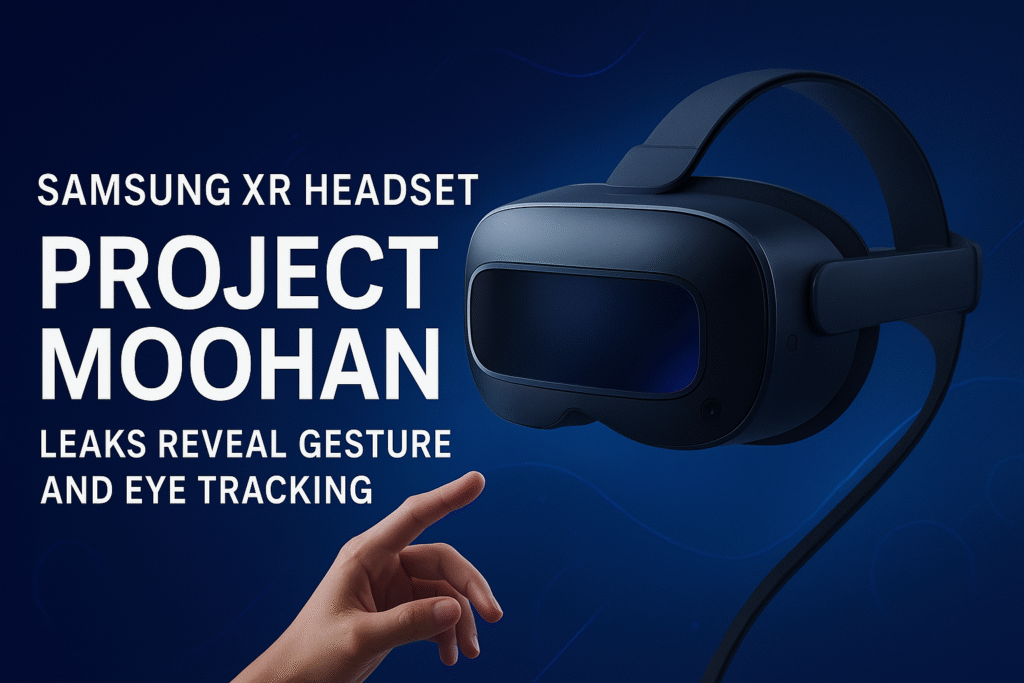
In the rapidly evolving world of immersive technology, Samsung appears ready to make its biggest leap yet into extended reality (XR). Fresh leaks surrounding Project Moohan — Samsung’s highly anticipated XR headset — have surfaced online, offering the clearest look so far at what could become the company’s flagship device in the mixed reality space.
According to multiple insider reports and patent filings, Project Moohan will feature advanced gesture recognition, eye-tracking capabilities, and deep integration with Samsung’s Galaxy ecosystem, aiming to compete directly with Apple’s Vision Pro and Meta’s Quest lineup.
Let’s take a deep dive into what these leaks reveal, how this device fits into Samsung’s broader strategy, and why Project Moohan could reshape the XR landscape in 2025.
What Is Project Moohan?
The codename Project Moohan first appeared in internal Samsung documents leaked earlier this year. The project, reportedly a collaboration between Samsung, Google, and Qualcomm, represents Samsung’s long-awaited return to the AR/VR market since the discontinuation of its Gear VR line.
A Three-Way Partnership
Samsung is handling the hardware design, Qualcomm is developing a custom Snapdragon XR chip, and Google is providing a specialized version of Android XR, optimized for spatial computing experiences.
This trio of tech giants seems intent on creating a platform that rivals Apple’s visionOS-powered Vision Pro — but potentially at a more consumer-friendly price point.
Design Leaks: Sleek, Lightweight, and Premium
Recent leaked renders and prototype images suggest that Project Moohan will feature a sleek and futuristic design combining lightweight aluminum with soft-touch materials for comfort during extended use.
Key Design Highlights:
- Weight: Expected to be under 400 grams, lighter than both the Vision Pro and Quest 3.
- Display: Dual Micro-OLED panels offering 4K resolution per eye.
- Lenses: Pancake optics to reduce glare and depth distortion.
- Headband: Adjustable and modular for different head sizes.
- Cameras: Multiple external RGB and depth cameras for mixed reality passthrough.
Samsung is reportedly emphasizing comfort and elegance, something early XR headsets have struggled to balance.
The Core Innovation: Gesture and Eye Tracking
Perhaps the most exciting part of the Project Moohan leaks is the introduction of gesture-based control and precise eye-tracking, two features expected to redefine user interaction in XR environments.
1. Gesture Recognition
Using an array of front-facing cameras and sensors, the headset will allow users to navigate, grab, rotate, and interact with virtual elements using natural hand movements — no physical controllers needed.
Samsung’s system seems inspired by Apple’s Vision Pro interface but may build on it by offering multi-hand tracking and custom gestures for app shortcuts, gaming, and productivity.
For example:
- Pinching fingers could open a menu.
- Rotating your hand could adjust volume or brightness.
- A “push” gesture could confirm a selection.
This could eliminate the need for handheld controllers entirely, offering a more intuitive, natural way to interact with digital content.
2. Eye Tracking
Eye-tracking is another cornerstone of the Moohan experience. Samsung is expected to use infrared sensors to monitor eye movement with high precision.
This enables:
- Foveated rendering (only rendering what you’re looking at in full detail, improving performance).
- Gaze-based selection, where users can simply look at an icon or window to interact.
- Dynamic depth focus, automatically adjusting visuals for comfort and realism.
This technology would not only enhance immersion but also optimize battery life and reduce motion sickness — key hurdles for current XR devices.
Hardware Specs: Powering Next-Gen XR
While Samsung has yet to confirm official specs, insider leaks from sources close to the supply chain have painted a compelling picture.
Expected Specifications
| Feature | Details |
| Chipset | Qualcomm Snapdragon XR2+ Gen 2 (custom Samsung variant) |
| Display | Dual 4K Micro-OLED panels |
| Refresh Rate | 120Hz adaptive |
| RAM | 12GB LPDDR5 |
| Storage | 256GB / 512GB variants |
| Battery Life | Approx. 3 hours of active use |
| Charging | 45W USB-C fast charging |
| Connectivity | Wi-Fi 7, Bluetooth 5.4, optional 5G tethering |
Samsung’s use of Qualcomm’s newest XR2+ Gen 2 processor — possibly customized for better thermal management — positions the headset as a top-tier performer capable of handling high-fidelity graphics, multitasking, and low-latency tracking.
Integration with Galaxy Ecosystem
One of Samsung’s major advantages lies in its interconnected device ecosystem. Leaks suggest that Project Moohan will seamlessly sync with Galaxy smartphones, tablets, and wearables, allowing users to transfer data, messages, or even control the headset using their phone.
Potential Integrations Include:
- Galaxy Buds for spatial audio support.
- Galaxy Watch as a biometric controller.
- Samsung Health for wellness and posture tracking.
- SmartThings integration for AR-based smart home control.
Imagine looking at your thermostat through the headset and adjusting the temperature with a hand gesture — that’s the level of integration Samsung seems to be aiming for.
Google’s Role: A New “Android XR” Operating System
Unlike previous Samsung headsets that relied on Oculus software or basic Android overlays, Project Moohan is expected to run a dedicated version of Android XR, being co-developed with Google.
This OS could bring:
- Native support for spatial apps.
- An XR Play Store with optimized 3D and AR apps.
- Integration with Google Workspace and YouTube XR.
- Multi-screen Android window support for productivity.
The partnership ensures that developers can use familiar Android tools (like Unity, Unreal, and ARCore) to build apps, drastically reducing the barrier to entry for XR development.
Price and Release Date Speculations
While there’s no official launch date, industry analysts speculate that Project Moohan could debut at Samsung’s Unpacked event in early 2025, possibly alongside the Galaxy S25 series.
Expected Price Range:
- Base model: Around $1,200 – $1,500
- Premium model: Up to $2,000
This pricing would place it below Apple’s Vision Pro ($3,499), making Samsung’s headset a more accessible option for mainstream consumers without compromising on premium features.
Samsung’s Vision for XR: Beyond Gaming
Unlike previous VR devices that focused heavily on gaming, Project Moohan aims to become a multi-purpose productivity and entertainment tool.
Key Use Cases:
- Work and Productivity: Virtual desktops, remote collaboration, and 3D visualization for designers or engineers.
- Entertainment: Immersive movies, concerts, and interactive experiences in mixed reality.
- Education and Training: Simulations and spatial learning experiences.
- Social XR: Virtual meetups and AR-enhanced communication.
Samsung envisions a future where XR devices are as essential as smartphones, blending physical and digital realities seamlessly.
How It Stacks Up Against Competitors
| Feature | Samsung Project Moohan | Apple Vision Pro | Meta Quest 3 |
| Display | 4K Micro-OLED (per eye) | 4K+ Micro-OLED | LCD (QHD+) |
| Control | Hand + Eye Tracking | Hand + Eye Tracking | Hand + Controller |
| OS | Android XR | visionOS | Meta OS |
| Price (est.) | $1,200 – $2,000 | $3,499 | $499 |
| Ecosystem | Galaxy + Google | Apple Ecosystem | Meta/PC |
Samsung seems to be strategically positioning Project Moohan between Apple’s luxury Vision Pro and Meta’s budget-friendly Quest 3 — a “sweet spot” for users seeking high-end XR performance without the premium Apple price tag.
The Future of Samsung in Spatial Computing
If these leaks hold true, Project Moohan could mark Samsung’s most ambitious hardware release since the Galaxy Fold. The company is betting on a future where spatial computing — a blend of AR, VR, and AI — becomes the next major tech frontier.
By combining Samsung’s hardware expertise, Google’s software infrastructure, and Qualcomm’s XR chip innovation, Project Moohan could redefine what consumers expect from a headset.
It’s not just about immersive experiences anymore — it’s about creating a new digital lifestyle that blurs the lines between the real and virtual worlds.
Final Thoughts
The leaked details of Samsung’s Project Moohan suggest a bold step into the next generation of computing. Gesture and eye tracking, an open Android XR platform, deep ecosystem integration, and sleek hardware all point toward a powerful contender in the XR race.
While the Vision Pro may have captured headlines, Samsung’s entry could democratize access to advanced mixed reality — bringing immersive, controller-free experiences to millions more users.
As we approach 2025, the XR battleground is shaping up to be one of the most exciting arenas in consumer tech. And with Project Moohan, Samsung looks ready to make history once again.