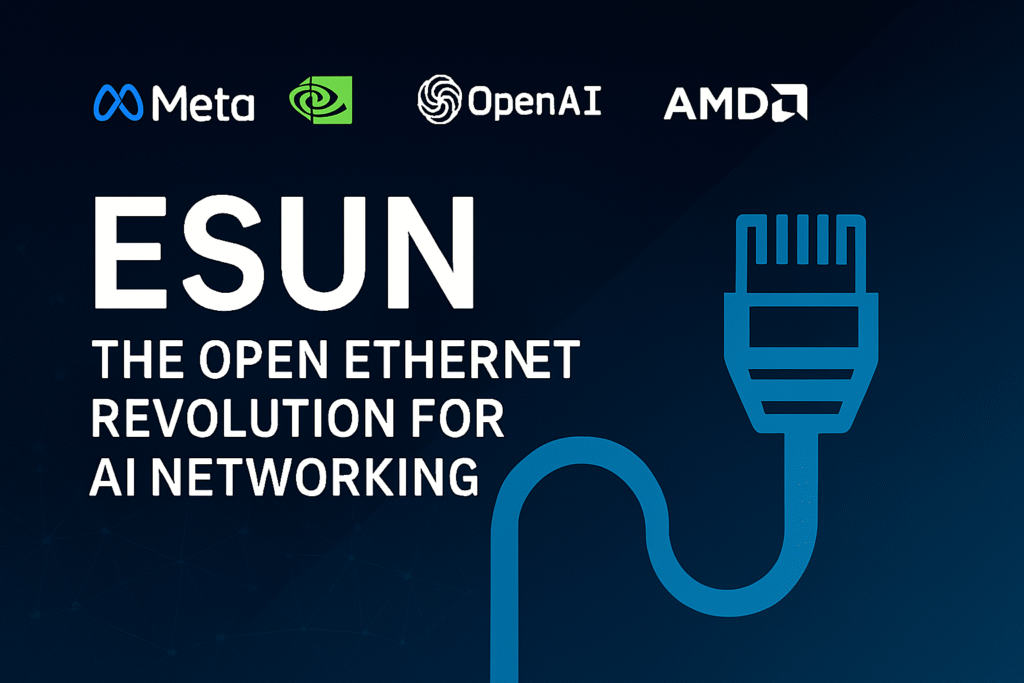
In October 2025, the artificial intelligence and data center infrastructure worlds stirred with news of a bold new collaboration: ESUN, or Ethernet for Scale-Up Networking. Spearheaded within the Open Compute Project (OCP), this initiative brings together leading players — including NVIDIA, OpenAI, AMD, and Meta — to define open standards for Ethernet-based interconnects in high-performance AI clusters.
What does this mean for the future of AI infrastructure? How does ESUN compare to existing interconnect technologies (like InfiniBand or NVLink)? And what role do giants like NVIDIA, AMD, and OpenAI play in pushing a new standard forward? In this article, we’ll unpack the technical motivations, challenges, and strategic implications behind ESUN — and why it may mark a turning point in how AI systems are interconnected.
Why ESUN — The Motivation Behind it
The Limits of Legacy Interconnects in AI Clusters
AI training clusters — especially for large models and deep learning — increasingly depend on scale-up communication: that is, ultra-high-bandwidth, low-latency links between many accelerators (GPUs, IPUs, XPUs) in a rack or across racks. Traditional interconnects include:
- InfiniBand / RDMA / RoCE: Widely used in HPC and AI clusters, prized for low latency and efficient collective operations.
- NVLink / NVLink Fusion: NVIDIA’s proprietary high-speed interconnect allowing tight coupling across GPUs and CPUs.
- Proprietary vendor interconnects: Many hardware vendors implement their own specialized fabrics (e.g. in some AI accelerators).
But each of these has drawbacks in terms of interoperability, cost, vendor lock-in, and complexity of integration.
ESUN emerges from the belief that Ethernet — as a mature, universally understood, and broadly supported standard — offers a path to unify, simplify, and scale AI interconnects. Rather than each vendor maintaining an isolated stack or fabric, ESUN aims for a common baseline that can evolve with the scale-up requirements of AI.
Advantages of an Ethernet-based Approach
Here are key strengths ESUN proponents highlight:
- Maturity & Ecosystem
Ethernet already has a vast existing hardware and software ecosystem (PHYs, switches, cables, NICs). Leveraging that helps reduce risk and deployment friction. - Interoperability & Openness
A vendor-neutral, open standard reduces vendor lock-in and gives customers flexibility to mix and match accelerators, vendors, and network fabrics. - Cost Efficiency & Scale
With economies of scale, Ethernet-based components can often be more cost-effective. If the performance targets can be met, it’s cheaper to adopt. - Unified Stack for Scale-Out & Scale-Up
Many data centers already use Ethernet for network and storage traffic. Having a consistent fabric for intra-cluster AI interconnects simplifies operations and integration. - Flexibility for Evolution
Because ESUN is designed in layers (headers, data link, PHY) and intends to build on existing standards (IEEE 802.3, Ultra Ethernet Consortium), it allows incremental evolution rather than radical reinvention.
What Is ESUN — Architecture and Scope
ESUN is not a product, but a workstream inside the OCP Networking project aiming to define how Ethernet can satisfy scale-up networking needs.
Key Focus Areas
The ESUN initiative explicitly focuses on the network side of scale-up domains (i.e. switch fabric, framing, etc.), leaving host-side stacks, application layers, and proprietary solutions outside its scope.
Some of the initial technical domains include:
- L2 / L3 Ethernet framing and switching
Defining how packets, headers, and switching behaviors should be adapted for lossless, deterministic AI traffic. - Error handling & reliability
Mechanisms to detect and correct bit errors or packet loss without disrupting tightly synchronized AI workloads. - Lossless transport & flow control
Using and perhaps extending mechanisms like Priority-based Flow Control (PFC), Link-Layer Retry (LLR), and credit-based flow control (CBFC) to prevent drops and manage congestion in deep AI communication graphs. - Interoperability with upper-layer protocols / transports
ESUN is built to support arbitrary upper-layer transport protocols, including SUE-T (Scale-Up Ethernet Transport) as a complementary workstream. - PHY compatibility & modular layering
Reuse existing Ethernet physical layers (optical, copper) when possible, to ease adoption across diverse deployments.
Relationship with Other Standards & Initiatives
ESUN is not working in isolation. It intends to align with and leverage complementary efforts:
- Ultra Ethernet Consortium (UEC): A group working on Ethernet-based communication stacks for AI / high-performance computing. ESUN will coordinate with UEC to ensure alignment and avoid fragmentation.
- IEEE 802.3 Ethernet standards: ESUN aims to stay compatible and build upon baseline Ethernet standards whenever possible.
- SUE-T (Scale-Up Ethernet Transport): A separate OCP workstream seeded by Broadcom’s SUE contribution; SUE-T addresses endpoint and transport-level enhancements (e.g. load balancing, reliability scheduling). ESUN works on the fabric side.
- UALink: AMD’s prior proposal (via its UALink consortium) for low-latency, high-efficiency interconnects. ESUN is designed to allow vendor-specific protocols like UALink to run over Ethernet, offering a bridge between specialized fabrics and standard infrastructure.
In short: ESUN is the Ethernet backbone for scale-up — the plumbing — while other schemes may handle the nuanced transport semantics above it.
Key Stakeholders & Their Roles
ESUN is backed by a sizable roster of influential companies. Notably:
- NVIDIA
As a dominant GPU and AI infrastructure player, NVIDIA will play a key role in specifying how Ethernet can integrate with or complement its existing fabrics (e.g. NVLink Fusion). - OpenAI
OpenAI’s participation underscores the demand side: for large AI model training workloads, efficient interconnects are critical. Their influence helps shape requirements around latency, collective operations, and scalability. - AMD
AMD, via its open-hardware and open-standards advocacy, is actively aligning its roadmap (e.g. Helios racks) to support UALink-over-Ethernet and open interconnects. - Meta
Meta is both a large-scale operator and a founding OCP contributor. It brings deep networking experience and real workloads to the table, helping ground ESUN’s specifications.
Other participating vendors include Arista, Broadcom, Cisco, HPE Networking, Marvell, ARM, Microsoft, and Oracle.
The diversity of participants helps ensure that ESUN is not viewed as a niche or vendor-favoring effort but as an industry-wide bridge between AI hardware and conventional networking.
How ESUN Compares to Existing Options
| Feature / Metric | InfiniBand / RoCE | NVLink / NVLink Fusion | UALink / Specialized Fabric | ESUN / Ethernet for Scale-Up |
| Latency & Overhead | Very low, optimized for collective operations | Extremely low (close coupling) | Ultra-low (vendor-specific) | Aim for low-latency with efficient headers and flow control |
| Vendor Lock-in | Depends on vendor (often HPC-focused) | Proprietary to NVIDIA | Vendor-specific | Open standard, vendor-neutral |
| Ecosystem & Interoperability | Limited to HPC & data center clusters | Tight NVIDIA integration | Custom deployment | Built on Ethernet — broad support |
| Cost / Deployability | Specialized hardware | Requires NVLink-capable devices | Custom switches / NICs | Leverage existing Ethernet silicon and infrastructure |
| Flexibility / Upgradability | Moderate | Tightly bound to NVIDIA architecture | Less flexible across vendors | Modular layering, extensible |
From this comparison, ESUN seeks to capture the sweet spot between performance and openness: delivering near state-of-the-art performance while retaining the flexibility of Ethernet’s broad ecosystem.
Challenges & Technical Hurdles
While ESUN is promising, it must overcome nontrivial challenges:
- Meeting Performance Parity
AI workloads are extremely sensitive to latency, jitter, packet loss, and congestion. The overhead of Ethernet framing and error recovery must be minimized to compete with custom fabrics. - Lossless Behavior at Scale
AI clusters often depend on deterministic delivery (e.g. synchronized all-reduce). Ensuring lossless behavior across many switches and hops without drops or backpressure is complex. - Congestion Management & Flow Control
Conventional Ethernet congestion control may not suffice for the high throughput and fine-grained communication patterns in AI. Extending flow control (PFC, CBFC, etc.) safely and effectively is critical. - Interoperability & Versioning
Ensuring that different vendor implementations interoperate seamlessly — while allowing vendor-specific optimizations — requires careful standards governance and testing. - Adoption & Ecosystem Momentum
To succeed, ESUN must gain support from hardware vendors, OEMs, software stack developers, and operators. If key players stay on proprietary paths, adoption will be limited. - Backward Compatibility & Incremental Deployment
Many data centers already use Ethernet for network, storage, or scale-out fabrics. ESUN must dovetail into existing infrastructures rather than demand wholesale replacement. - Security, Reliability, and Management
Robust mechanisms for link-security, diagnostics, resiliency (failover, redundancy) must be baked into ESUN’s design to meet enterprise and hyperscale needs.
Despite these challenges, the open, collaborative approach helps distribute the risk: cross-industry feedback and incremental evolution will guide refinement.
Strategic Implications & Use Cases
If ESUN succeeds, it would shift several dynamics in AI infrastructure:
- Lower Barriers for AI Cluster Deployment
Smaller AI developers or institutions may leverage off-the-shelf Ethernet components rather than expensive, proprietary fabrics. - Heterogeneous Accelerator Integration
Mixed deployments (GPUs, TPUs, IPUs, ASICs) could interoperate more easily under a unified fabric standard. - Greater Vendor Competition
By reducing lock-in, customers can mix and match, accelerating innovation and cost reduction across hardware vendors. - Efficiency Gains & Reduced Operational Complexity
A unified network fabric simplifies routing, debugging, and upgrades. - Parallel Evolution of Protocols
ESUN can coexist with other fabrics (e.g. UALink), allowing specialized protocols to ride on its backbone.
Notable Use Cases
- Large AI Training Clusters
For distributing massive models across hundreds or thousands of accelerators, ESUN would provide the high-throughput, low-latency fabric needed for synchronizing gradients, activations, and model shards. - Model Inference at Scale
Inference workloads requiring low-latency responses across many devices (e.g. serving large models) could benefit from a tight interconnect fabric to reduce overhead. - Composable / Disaggregation Architectures
Some forward-looking architectures propose disaggregating compute, memory, and accelerators. ESUN could help tie those nodes together. - Hybrid Cloud / On-Prem Integration
If Ethernet-based scale-up becomes common, integrating on-prem AI infrastructure with cloud or edge networks becomes more natural. - Research & Benchmarking Environments
Open labs, universities, and research institutions may adopt ESUN to prototype large-scale AI hardware setups without being locked into vendor-specific interconnects.
What to Watch Over the Coming Months
To see whether ESUN becomes a foundational standard (versus a niche experiment), keep an eye on:
- Specification Releases & Drafts
The early working drafts for headers, framing, and flow control will reveal the performance-ambition tradeoffs. - Interoperability Demonstrations
Labs or vendors showing multi-vendor components talking over ESUN will validate its credibility. - Adoption by Hardware OEMs
Inclusion of ESUN-compatible switches, NICs, and accelerators by major OEMs is a key milestone. - Performance Benchmarks
Public benchmarks comparing ESUN vs InfiniBand, NVLink, and UALink in large-scale workloads will influence adoption. - Software / Framework Support
AI frameworks (like PyTorch, TensorFlow) and distributed training libraries (e.g. NCCL, MPI) must support ESUN-aware transports. - Community & Standards Growth
As more ecosystem players join (e.g. other cloud providers, chip vendors), the momentum will either reinforce or dilute the initiative.
Conclusion
The launch of ESUN (Ethernet for Scale-Up Networking) by titans like NVIDIA, OpenAI, AMD, and Meta marks a bold bet: that Ethernet — long the backbone of networking — can evolve to meet the ultra-demanding demands of AI scale-up fabrics. Rather than each vendor building isolated, proprietary interconnects, ESUN offers a path toward convergence, interoperability, and openness.
That said, success is far from assured. ESUN must deliver near state-of-the-art performance while maintaining the flexibility and economy that makes Ethernet compelling. It must also cultivate a broad ecosystem of hardware, software, and operators willing to adopt and invest in the standard.
If ESUN succeeds, the AI infrastructure landscape would tilt: lower barriers to entry, more competitive vendor dynamics, and a more unified approach to scaling accelerators. For researchers, operators, and hardware vendors alike, ESUN deserves close attention — it may be the foundation upon which the next generation of AI clusters is built.