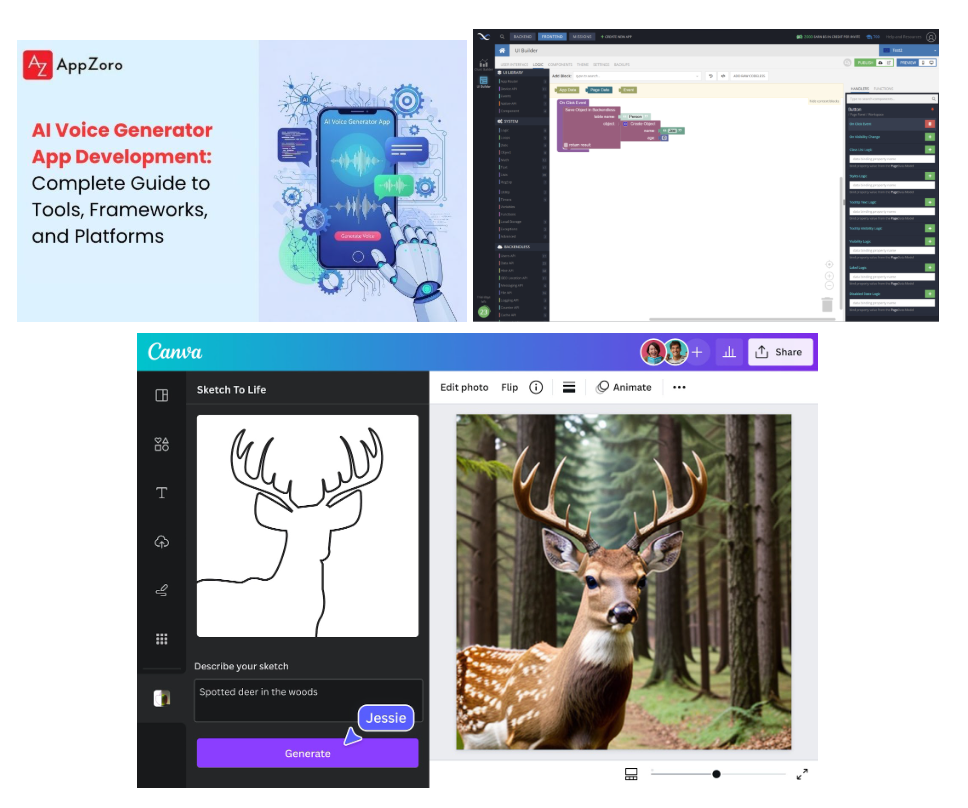
In recent years, the idea of programming software has been turned on its head. Rather than writing lines of code, we’re entering an era where the software writes the software — using human inputs such as voice commands, sketches, or simple natural-language prompts. These are the “no-code AI” platforms: tools that combine no-code / low-code visual environments with generative artificial intelligence (AI) and large-language-models (LLMs). The result? A non-developer can conceivably say “Here’s a rough sketch of my app” or “I want an app that does X” and see a working prototype in minutes.
This article explores how this works, why it’s emerging now, what platforms and examples are leading the way, what the benefits and risks are, and what this means for developers, designers, and the broader software industry.
Why Now? What’s Driving the Shift
Several trends converge to make no-code AI platforms viable today:
1. Generative AI & LLMs able to understand high-level prompts
LLMs (and multimodal models) have advanced to the point where they can interpret natural-language instructions and generate code, UI markup, or even full-stack app scaffolding. For example, research such as the paper “LLM4FaaS: No‑Code Application Development using LLMs and FaaS” shows how non-technical users can generate deployable code via natural language, with infrastructure abstracted away. arXiv
In other words: the “translation” barrier between idea → code is shrinking.
2. No-code / low-code tools matured
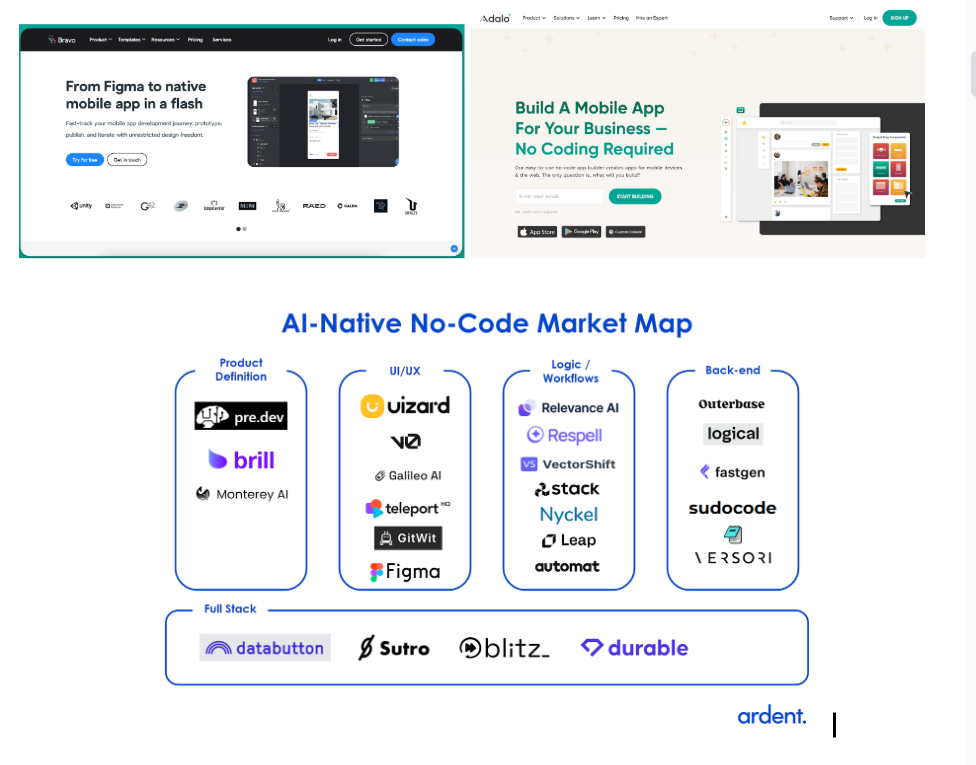
The no-code movement was already strong, enabling non-developers to build web and mobile apps using drag-and-drop, visual workflows, pre-built templates and connectors. Platforms like Adalo offer mobile-app builders without traditional coding. Wikipedia
Now, layering generative AI on top of this further raises the abstraction: not only is visual assembly possible, but the AI can generate structure and logic itself.
3. Demand for faster app delivery, lean teams
Businesses and creators increasingly need to launch apps, experiences or internal tools quickly, with fewer resources. If you’re a solo entrepreneur or small team, hiring full-stack dev talent may be less feasible. No-code AI platforms promise speed, lower cost, and democratization of app creation.
4. Integration of multiple modalities: voice, sketch, natural-language
The more input modes we allow — you sketch a screen, draw flow diagrams, say “Create login, dark mode, push notifications” — the broader the audience. Features such as voice-to-app or sketch-to-app are now becoming accessible. For example, platforms describe “Speak your app’s purpose – just like explaining to a friend” in their onboarding. codemojo.ai
Thus the barrier to entry becomes even lower.
How Do These Platforms Work? A Typical Flow
Let’s break down how many of these systems operate — the components, the inputs, the outputs.
- User input:
- Natural-language prompt or voice command: e.g. “Build a mobile app for booking yoga classes, with login, calendar and payment.”
- Sketch or wireframe: draw the main screens on paper or use a tool, maybe even upload a photo.
- Optionally select template, data source (spreadsheet, CSV), or connect existing backend.
- Natural-language prompt or voice command: e.g. “Build a mobile app for booking yoga classes, with login, calendar and payment.”
- AI interpretation & generation:
- The platform uses an LLM (or generative AI) to parse the intent, identify required user flows, UI screens, logic (CRUD operations, authentication, payment flows).
- It may generate UI markup (React/Flutter/HTML), database structure, API endpoints, and business logic.
- The platform uses an LLM (or generative AI) to parse the intent, identify required user flows, UI screens, logic (CRUD operations, authentication, payment flows).
- Visual builder and assembly:
- The generated components are placed into a visual no-code builder (drag-and-drop), where you can review, tweak UI elements, change styling, adjust workflows.
- The backend infrastructure is spun up: authentication, database, hosting, integrations.
- The generated components are placed into a visual no-code builder (drag-and-drop), where you can review, tweak UI elements, change styling, adjust workflows.
- Preview & refine:
- You preview the app on device (mobile/web) and can test flows. You may provide further voice/text instructions: e.g. “Change the colour scheme to dark mode, rename bookings to reservations”.
- The AI can iterate based on your feedback.
- You preview the app on device (mobile/web) and can test flows. You may provide further voice/text instructions: e.g. “Change the colour scheme to dark mode, rename bookings to reservations”.
- Deploy:
- One-click or guided deployment to web host, mobile stores (iOS/Android) or PWA.
- Post-deployment: you can update by describing changes (“Add chat support”, “Push notification when booking confirmed”) and the platform executes and redeploys.
- One-click or guided deployment to web host, mobile stores (iOS/Android) or PWA.
- Iterate & scale:
- Depending on the platform, you may export code, extend it manually, or continue using the platform as the codebase.
- Connect analytics, monetization, team collaboration workflows.
- Depending on the platform, you may export code, extend it manually, or continue using the platform as the codebase.
This flow isn’t hypothetical — reviews of platforms indicate these features. For example, in the list of “best no-code AI tools for building apps” from AppyPie: “Just describe your app — you can even use voice or text — and the AI App Generator instantly crafts a base version for you.” Appy Pie
Notable Platforms and Emerging Players
Here are some real-world platforms illustrating this trend:
- AppyPie: Their AI App Builder supports text-to-app, even voice input, and targets mobile/web/PWA deployment. Appy Pie+1
- Softr: A no-code platform which includes an “AI App Generator” capable of building apps from simple text prompts, including themes, logic, user roles. zeroqode.com
- Glide: Known initially for turning spreadsheets into mobile apps, Glide now offers generative AI features to build apps fast. Airtable+1
- Adalo: Visual mobile-app no-code builder; though not strictly voice/sketch-to-app yet, it’s indicative of the no-code movement. Wikipedia
- Research-level tools: e.g., LLM4FaaS shows how LLMs + FaaS (Function-as-a-Service) can enable natural-language → code → deployment. arXiv
While few platforms may yet deliver the full “sketch-on-paper to deployed mobile app” magic without any manual tweaking, the direction is clear: more abstraction, more natural input modes, more automation of full-stack logic.
The Promise: What’s possible
The advances bring several compelling benefits:
Faster time to market
What once took weeks or months of development (UI/UX design, front-end code, backend logic, authentication, deployment) can now be achieved in hours or days. For solo entrepreneurs or SMEs, this is transformative.
Broadening participation
With voice/sketch/natural-language input, people who are not professional developers — designers, entrepreneurs, domain experts — can build apps. The democratization of software creation is real.
Cost reduction
Less need for large dev teams or external agencies. A founder with a good idea can prototype and launch, iterate quickly, test product-market fit. Lower upfront cost means lower risk.
Rapid iteration
Because the platform handles deployment changes, you can pivot easily (“Change feature X”, “Add screen Y”), and the AI rebuilds parts. This improves agility.
Integration of AI features
These platforms often include AI-powered functionalities — chatbots, voice input, analytics, predictions — baked into the app without you needing to wire up separate machine-learning pipelines. The line between “app” and “AI-app” blurs.
Prototype to production
Some platforms allow you to export code or integrate with more traditional dev workflows, making the path from prototyping to production smoother than traditional no-code tools.
The Cautions & Limitations
Of course, with great promise come real caveats. Here are things to watch:
Quality and scalability
Just because you can build an app quickly doesn’t mean it’s built like production software. Performance, security, scalability, maintainability often lag in no-code AI-generated apps. As one user put it:
“I haven’t used any of the no-code ones that produce a full app from a prompt, but I wouldn’t expect much more than a decent starting point out of it.” Reddit
“Over the last few months I’ve tried a lot of AI app builder platforms … Honestly, most crap out the second you leave chatbot land.” Reddit
Lack of deep customization
When you rely on generated logic and templates, customizing deep or unusual behaviors may be harder. Visual/drag-and-drop tools may constrain you. If your app needs unique algorithms or heavy backend logic, you may still need professional developers.
Vendor lock-in and exportability
Some no-code platforms keep you within their ecosystem. If you want to migrate off or export full code, you may face limitations. It’s important to check whether code export or integrations are allowed.
Over-hyped expectations
Because the marketing often says “build an app with your voice in minutes”, users may expect “zero effort” — but real business apps still require thinking about data, UX, integrations, testing, deployment, and maintenance. One Redditor noted:
“The issue is: the AI agents often hallucinate and make up random sections or mess up the structure of the page completely over a simple prompt tweak.” Reddit
Governance, data, security
Apps with backend logic, database access, authentication, payments and user data must consider security, compliance, data privacy, and maintainability. Many no-code/AI platforms may not give you full visibility into infrastructure. Non-technical builders must still be aware of these concerns.
Skills shift (but not removal)
While these platforms lower the barrier, they don’t entirely eliminate the need for app design thinking, flow logic, data modeling, user experience, and deployment strategy. The role of developer may shift rather than disappear.
What This Means for Developers, Designers & Organisations
The emergence of no-code AI platforms is not purely disruptive—it’s additive and evolutionary. Here’s how different stakeholders might adapt:
Developers
- Roles may shift: from writing boilerplate code to supervising, extending, integrating, and optimizing AI-generated apps.
- Upskilling: Understanding how to integrate with these platforms, export code, extend logic, embed AI models, optimize performance.
- Focus on complex features: The mundane, repetitive parts of app creation may be handled by AI; developers can focus on deeper architecture, scalability, security, custom algorithms.
Designers & Domain Experts
- Empowerment: Designers or product managers with domain expertise can prototype apps directly rather than waiting on dev teams.
- Collaboration: Designers can work with AI-assisted tools to build, iterate, test with users rapidly.
Organisations & Startups
- Lean product launches: Startups can bring MVPs (minimum viable products) to market faster, test ideas, iterate based on real user feedback.
- Internal tools: Non-engineering teams may build custom internal tools (dashboards, workflows) without waiting for IT.
- New business models: Platforms and consultancies around “build with AI no-code” will emerge.
Education & Training
- More people can learn “software creation” without having to become full software engineers first. The entry point moves earlier in the funnel.
- But curriculum must shift: teaching users how to think about apps (flows, data, UX) rather than purely code syntax.
Looking Ahead: What’s Next?
What should we expect in the near-future?
Multimodal Input: Sketches, voice, video
We will see more platforms where you sketch a UI on paper (or take a photo of a whiteboard), upload it, and the AI interprets the sketch into screens and logic. Voice input (“I want a booking app”) will become more natural and accurate.
Full-stack generation including backend infrastructure
Rather than just UI + workflows, these platforms will increasingly spin up data stores, APIs, microservices, serverless functions, authentication, analytics—all in one click. Research like LLM4FaaS already points this way. arXiv
Deeper AI-powered behaviours
Incorporating not just basic workflows but AI-powered features: chatbots, predictive analytics, voice assistants, automated personalization — built into the app scaffold automatically.
Exportable and open code
To address vendor lock-in and scalability concerns, more platforms will allow you to generate full codebases you can hand off to dev teams, then continue to iterate.
Collaboration between human + AI in workflows
You’ll see more “co-pilot” style experiences where the human designer/developer works side-by-side with AI: human indicates flow, AI scaffolds, human tweaks, AI redeploys. This human-AI symbiosis will become more polished.
Ethical, governance, and security frameworks
As more businesses rely on these tools for production apps, issues of data privacy, vendor transparency, AI-generated code quality, and maintainability will drive stronger governance, standards, and best practices.
A Use Case: From Sketch to App in Minutes
Imagine you’re a fitness coach and you want an app to let clients book sessions, pay, track workouts, get reminders.
You open a no-code AI platform. You say: “Build me a mobile app for fitness coaching: user login, calendar view of sessions, payment integration, push notifications, dark mode theme, ability to upload workout videos.”
You optionally sketch a rough set of screens: Homepage → Sessions list → Booking UI → Payment screen → Profile.
The platform analyzes your prompt + sketch, generates the UI screens, backend logic (users table, sessions table, payments table), authentication flows, integration with Stripe or PayPal, push notification logic, dark mode theme. You preview it on mobile, you say: “Change colour palette to teal and charcoal, add button linking to community chat.” The system updates, redeploys instantly.
Within one afternoon you have a working prototype you can share with a few clients, collect feedback, iterate. If you like it, you deploy the app (Android/iOS) via the platform or export code to a dev team for further refinement.
All of this is possible today on many no-code AI platforms.
Final Thoughts
The notion of “software that programs software” is no longer science fiction. With no-code AI platforms, we’re seeing a fundamental shift: from code‐centric development to human‐idea-centred orchestration. Whether you’re an entrepreneur, a designer, a small business owner, or a developer, this shift matters.
It doesn’t mean traditional developers will become obsolete — far from it. It means the roles will evolve. Developers will focus on deeper architecture, scalability, and AI-systems. Designers and business people will take more direct control of app creation. Organisations will launch faster, iterate more, and experiment more.
For your tech-blog audience on ByteNest.tech, this is a rich topic: you could explore how these platforms fit into the broader software-industry ecosystem, how they challenge traditional dev agencies, how they change developer skill sets, and how SEO can target keywords like “voice to app builder”, “sketch to app AI”, “no-code AI platform comparison”.