A New Era for Space Access
When people think of launching satellites, they often imagine large government agencies or deep-pocketed aerospace firms dealing with multimillion-dollar budgets. Yet today, a new wave of “citizen space tech” is emerging—companies, kits, and initiatives that let individuals, schools, and small start-ups assemble, test, and even launch nanosatellites.
This article explores how that’s becoming possible, examines key players and kits, addresses the technical and regulatory hurdles, and outlines what aspiring space makers need to know to get started.
What is a Nanosatellite (and Why It Matters)
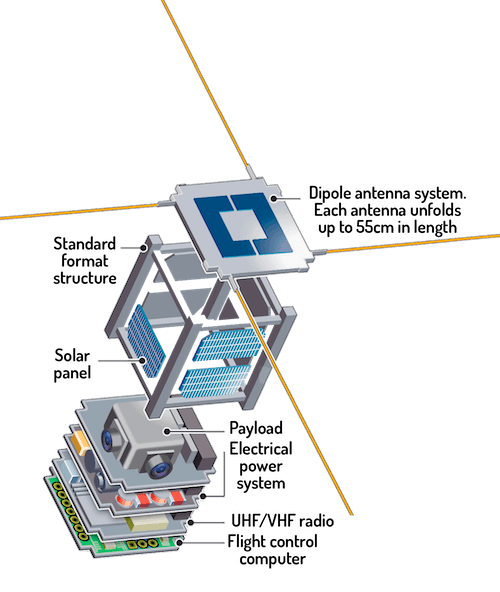
The term nanosatellite generally refers to small satellites weighing from roughly 1 kg up to 10 kg (sometimes more), often built using standardised form-factors like the CubeSat (10×10×10 cm units). sflmissions.com+2Agencia Espacial Europea+2 These smaller platforms matter because they drastically reduce cost, development time and size of the launch vehicle share needed.
The European Space Agency (ESA) has noted that a modular kit-based architecture for nanosatellites allows reuse of components, large-scale manufacturing, and thus lower costs compared to traditional custom satellites. Agencia Espacial Europea A dataset tracking nanosat launches shows thousands of such satellites have been built, many from universities, start-ups and even hobbyist teams. Nanosats Database+1
Key takeaway: the “mini-sat” revolution is real. It opens the door for far more actors to get into space, not just national agencies.
The Citizen-Space Tech Phenomenon
“Citizen space tech” refers to the combination of three trends:
- Miniaturisation and standardisation of satellite hardware (smaller size, standard bus, modular parts)
- Lowered launch access via rideshare missions and small-launcher companies
- DIY and education-oriented kits and programmes that make satellite building accessible outside elite labs
Below are some representative examples of each.
Example: Start-up Platforms
- Kepler Communications (Canada) – A small-sat start-up focused on IoT connectivity via nanosatellites. They opened registration for developer kits to allow prospective users to build payloads and test connectivity. TechCrunch+1
- Kineïs (France) – An independent private company developing IoT-nanosatellite constellations (satellites under ~30 kg) to provide global connectivity. They raised ~€100 million in 2020. EU-Startups+1
- EnduroSat AD (Bulgaria) – Designs and builds CubeSats and nanosatellites for commercial and scientific missions; one of the emerging small-sat start-ups. Wikipedia
While these companies are not literally selling a “launch from your backyard” kit, they show how the ecosystem of small satellites is broadening — which in turn makes DIY or citizen involvement more feasible.
Example: Kits and Educational Platforms
- AmbaSat – A kit provider that enables individuals, schools and small teams to build a modular CubeSat platform. The company enables selection of sensors, supports assembly and coding, and promotes hands-on satellite involvement. ambasat.com
- MySat Kit – A personal satellite kit (10×10×10 cm) marketed to space enthusiasts, with sensors, flight-computer board, and design to “watch launches and build your own spacecraft”. mysatkit.com+1
- CubeSatSim – A lower-cost educational kit to build a CubeSat simulator with solar panels, sensors and frame; designed for learning and test flights rather than immediate launch. amsat.org
These kits highlight two things: one, that the entry cost and skill-barrier are reducing; and two, that even if full orbit launches aren’t always included, the satellite-building mindset is now open to “citizens”.
Example: Citizen Science Missions
- ArduSat – A CubeSat built on Arduino-based boards and sensors, with the goal of enabling the general public to run experiments in space. It was launched in 2013. Wikipedia+1
- KickSat – A very small femtosatellite project (mini satellites) aimed at allowing many tiny spacecraft to be launched and used by individuals; included DIY development kits. Wikipedia
These demonstrate early “citizen scientist” attempts at space access.
How It Works: From Kit to Orbit
Here’s a rough breakdown of how a citizen/DIY nanosatellite journey might go:
- Kit-Selection and Build
- Choose a CubeSat kit (1U, 2U, etc) or assemble hardware from modular components (as ESA’s NanoSat project suggests) Agencia Espacial Europea+1
- Integrate sensors/payload (camera, magnetometer, temperature sensor, etc)
- Build frame, power system, communications, attitude control (if needed)
- Program software, set telemetry, test ground communications
- Choose a CubeSat kit (1U, 2U, etc) or assemble hardware from modular components (as ESA’s NanoSat project suggests) Agencia Espacial Europea+1
- Testing & Qualification
- Even small satellites must meet some quality, vibration, thermal and communications testing
- Ensure communications with ground station, ensure de-orbit/disposal plan if required
- Even small satellites must meet some quality, vibration, thermal and communications testing
- Launch Arrangement
- Find a launch provider or rideshare (many small-sat/ CubeSat launch slots exist)
- Pay for launch slot (can still be tens to hundreds of thousands of dollars depending on size & orbit)
- Integrate the satellite into the deployer or launcher dispenser
- Find a launch provider or rideshare (many small-sat/ CubeSat launch slots exist)
- Ground Station & Operation
- Once in orbit, obtain telemetry, sensors data, perform mission operations
- Many kits or citizen projects link to online dashboards (e.g., AmbaSat mentions a web dashboard) ambasat.com
- Once in orbit, obtain telemetry, sensors data, perform mission operations
- End-of-Life / Debris Mitigation
- Regulatory and safety concerns: small satellites generally must deorbit within a certain timeframe to reduce space debris
- Designs increasingly include de-orbiting mechanisms or natural decay
- Regulatory and safety concerns: small satellites generally must deorbit within a certain timeframe to reduce space debris
Important Note: While kits exist, the full path to orbit involves regulatory, communications licensing, launch provider contracts, and budgeting for testing & integration—which still means non-trivial cost and effort.
Opportunities for Individuals, Schools & Makers
- Education & STEM Outreach: Using kits like MySat or AmbaSat, schools can let students build a real satellite bus, learn sensor programming, aerodynamics (if balloon tests), communications.
- Innovation & Experimentation: Makers/hobbyists can test novel sensors or payloads on CubeSats, explore remote sensing, IoT, environmental monitoring from space.
- Entrepreneurial Ventures: Spin-out small teams might design payloads for niche markets (agriculture, IoT, Earth observation) leveraging the small-sat platform.
- Citizen Science & Crowdsourced Data: Groups of amateurs can collaborate to create satellite constellations, share data openly, promote open-access space missions.
Key Challenges & Considerations
While the barrier is lowering, there are still real hurdles:
- Launch cost & timing: A CubeSat bus may cost modestly, but launch and integration remain expensive and time-consuming.
- Regulatory/licensing: Frequency usage, orbital slot allocation, debris mitigation policies must be followed.
- Technical complexity: Even small satellites need power management, thermal control, communications, and often attitude/pointing control.
- Operations and maintenance: Once in orbit, remote operations, ground station access, data downlink, failure handling are all factors.
- Launch risk: Missions can fail due to launch failure, deployment issues, or on-orbit malfunctions (e.g., KickSat’s sprites were not deployed in time). Wikipedia
Why This Matters for the Next Decade
- Democratisation of access: Just as personal computing empowered individuals, “personal satellites” empower new actors in space.
- Innovation acceleration: More frequent launches, smaller form-factors, and modular hardware (ESA’s kit-based NanoSat project) means faster iteration. Agencia Espacial Europea
- New markets: IoT from space (e.g., Kineïs, Kepler) shows how nanosats can serve new business models beyond government/defence.
- Educational impact: Inspiring young engineers, citizens, makers to work on space missions fosters broader scientific literacy.
- Global inclusion: With lower cost, universities or groups outside major space nations can participate meaningfully in space tech.
What to Do if You Want to Get Started
Here’s a practical starter guide:
- Choose your objective: Is it educational, hobbyist, or commercial? Will you build a full CubeSat or a high-altitude balloon test?
- Pick a kit or platform: Consider AmbaSat, MySat Kit or educational CubeSat kits for learning; for serious orbital missions look into CubeSat bus suppliers.
- Learn the subsystems: Focus on power, communications, sensors, structure, ground station. DIY guides such as “DIY CubeSat: 7 Steps” can help. Instructables
- Budget & schedule: Factor in hardware cost, testing, ground station setup, launch slot cost, satellite integration lead time.
- Regulations & licensing: Understand radio frequency licensing in your country, orbital regulations, and debris mitigation requirements.
- Join a community: Forums, maker spaces, student satellite teams, online networks of CubeSat builders. Learning from others reduces risk.
- Prototype & test: Using balloon flights or sub-orbital flights can help validate hardware before committing to full orbit.
- Plan for data & operations: What kind of data will you receive? How will you process and downlink it? How will you operate your satellite?
- Launch integration: Find a rideshare or small-sat launch provider; prepare your spacecraft for integration and acceptance tests.
- Celebrate & share: Even small missions can generate big impact—telemetry dashboards, community contributions, education materials.
Conclusion
The idea of launching a satellite “from home” might sound far-fetched, but thanks to miniaturised hardware, modular kits, start-ups focused on nanosatellites and educational platforms, the pathway is increasingly real. While the full path to orbit remains non-trivial, the barrier to entry has dropped dramatically. For makers, students, citizens and entrepreneurs, this means space is no longer a distant frontier—it’s a platform they can build, code, launch, and contribute to.
If you are building a blog post (especially for your tech-blog bytenest.tech) about this topic, you could highlight key kits (AmbaSat, MySat), show a step-by-step build flow, feature one or two start-ups like Kepler or Kineïs, and explore how individuals or schools in Colombia or Latin America might engage.