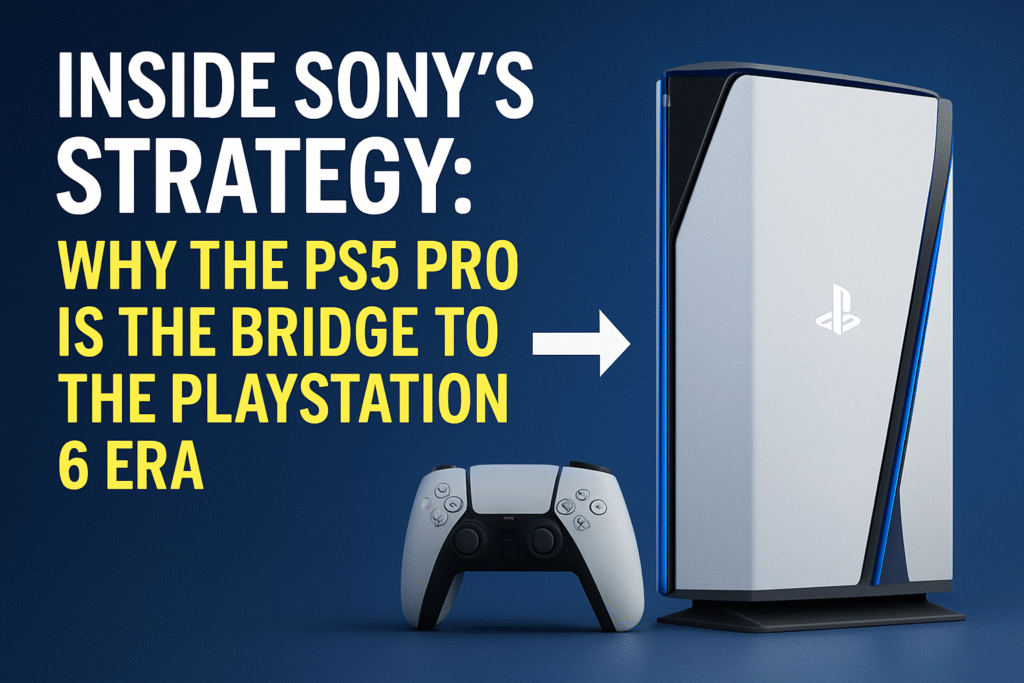
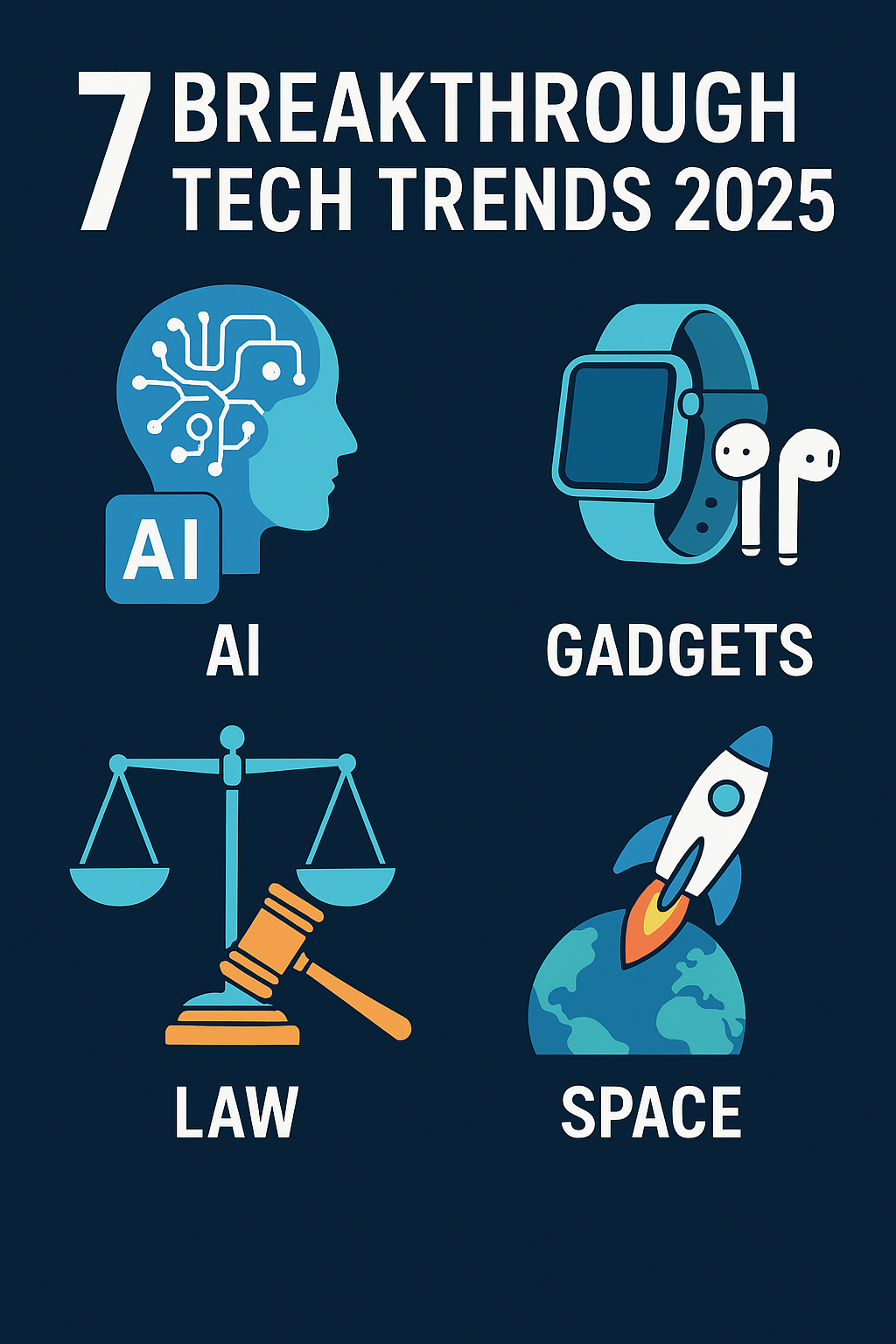
In this week’s rapid-fire tech roundup, we spotlight six game-changing developments across artificial intelligence, consumer gadgets, regulatory law, and space technology. These aren’t incremental tweaks — they signal meaningful shifts in how industries operate, how regulation is catching up, and how hardware and software are evolving together.
We’ll break them into six categories: (1) Agentic AI, (2) Consumer gadget leap, (3) AI regulation & competition law, (4) Space & satellite AI, (5) On-device/fog computing hardware, (6) Sensor & novel modality advances. For each, we’ll explore what’s new, why it matters, and what to watch.
1. Agentic AI: From Suggesting to Acting
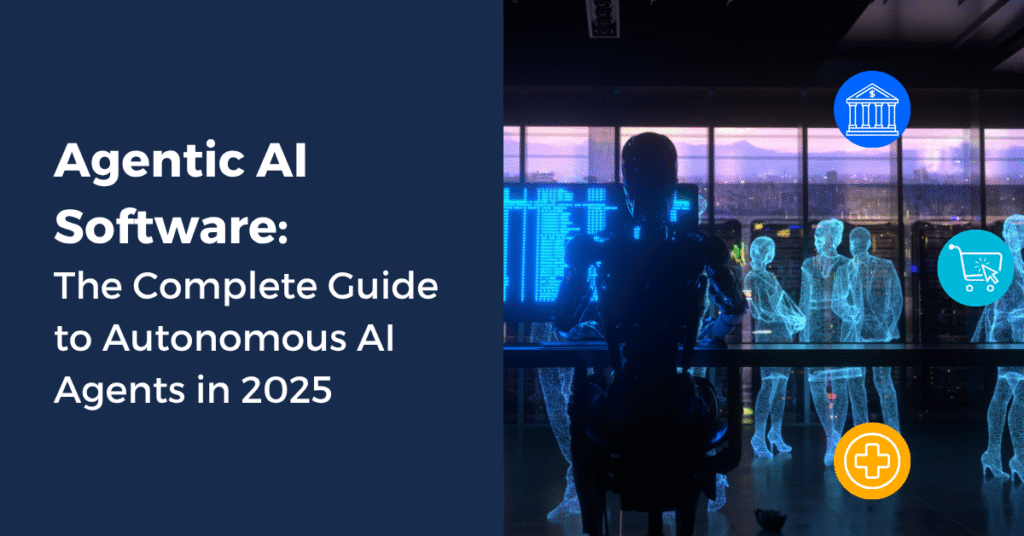
One of the most disruptive waves right now is what is being called agentic AI — AI systems that don’t just assist, they act autonomously or semi-autonomously toward goals. According to a recent overview of technology trends for 2025, our earlier categories of applied AI, generative AI and industrial ML are now subsumed under AI, with “agentic AI” newly added. mckinsey.com+1
What’s happening
- AI systems are increasingly being designed to take actions (not just make suggestions). These can plan, monitor, sense, use tools, and follow safety guidelines. Plain Concepts
- Enterprises are moving beyond experiments into “piloting” and “scaling in progress.” mckinsey.com
- The implication: the line between “human decision” and “machine decision” is blurring — which raises major questions about control, responsibility and trust.
Why it matters
- Productivity jumps: Businesses that equip workflows with agentic AI could radically reduce human workload in domains like customer service, logistics, and monitoring.
- Strategic shifts: Companies that build these systems first may gain outsized advantage as the “core” of operations becomes intelligence + autonomy.
- Risk vector: With systems that act comes the question of errors, liability, transparency. If an agentic AI makes a bad decision, how do we trace it?
What to watch
- Which sectors adopt agentic systems fastest (e.g., manufacturing, finance, logistics).
- Governance frameworks emerging to regulate agentic AI (see Section 3).
- The first major “failure event” of an agentic system and how the industry responds.
2. Gadgets Leap Forward: Smart + AI + Hardware
At the gadget/hardware layer, advances this week show how smart devices are shifting from “connected” to “intelligent & anticipatory.”
Highlights
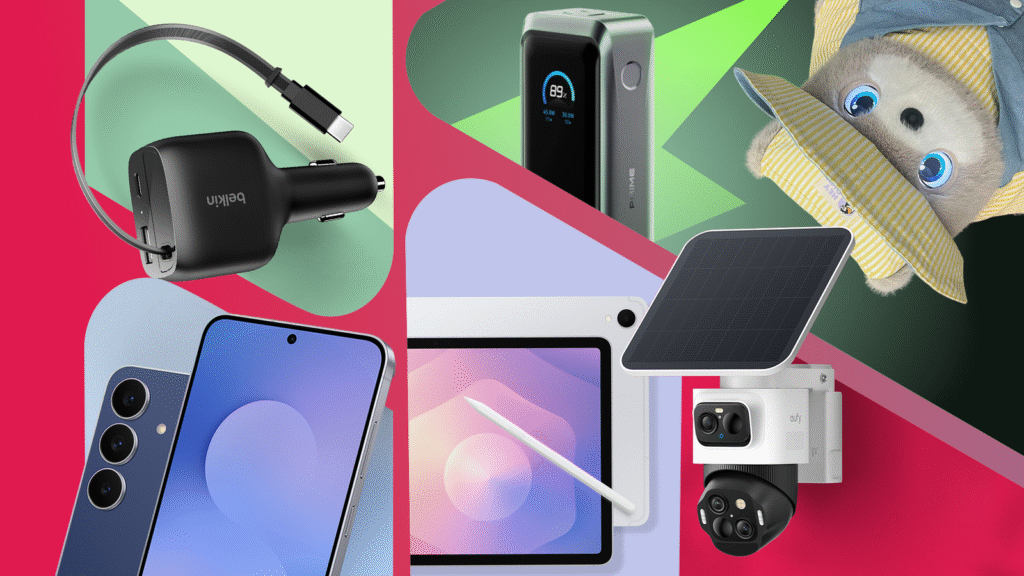
- At the recent IFA 2025 show, standout new devices included ultra-slim smartphones, AI glasses, mini-PCs with huge RAM, robot vacuums with advanced AI obstacle avoidance, and modular wireless chargers. Tom’s Guide
- At the CES 2025 (Consumer Electronics Show), the overarching theme was “Home AI” – devices that don’t just respond but anticipate human needs (e.g., a TV that understands when you’ve fallen asleep and turns off the lights). New York Post+1
Why it matters
- Consumer expectations are rapidly evolving: Smart devices will increasingly feel less like “appliances with connectivity” and more like proactive assistants.
- Hardware-software convergence: The divide between gadget and AI platform is collapsing; companies previously known for hardware are now AI incubators.
- Ecosystem fights: As devices get smarter, platform and data advantages will matter more (which ties into the regulatory pressures we’ll discuss next).
What to watch
- Which device categories (smart home, wearables, AR/VR) see the fastest AI integration.
- How privacy, data and on-device vs cloud trade-offs evolve: Will more intelligence be pushed to the edge?
- Whether consumer trust keeps pace with functionality (e.g., will people accept AI-infused home devices that monitor behaviour?).
3. Law & Regulation: Tech Power Checked
Innovation doesn’t happen in a vacuum, and this week we saw fresh moves in regulation and competition law that could shift incentives for large and small tech companies alike.
Key developments
- The Artificial Intelligence Act of the European Union (entered into force 1 Aug 2024) is now being seen as a global reference point for how to regulate AI by risk-tier. Wikipedia+1
- The EU published a draft revision (Sept 11 2025) of the Technology Transfer Block Exemption Regulation (TTBER) and associated guidelines, aimed at adapting rules around tech transfers/licensing in light of new market realities. gtlaw.com+1
- A major antitrust move: The EU handed out its first fines under the Digital Markets Act (DMA) – for example, the bloc fined major firms for anti-competitive behaviour. The Guardian+1
Why it matters
- Regulation = structural shift: These laws mean that large tech firms must internalise new compliance burdens, rethink business models (especially around data, platforms, transfers).
- Innovation trade-offs: Some experts warn heavy regulation could hamper innovation, particularly for smaller firms or those lacking compliance budgets. Broadband Breakfast
- Competitive dynamics: Regulation may open up opportunity for challenger firms if gatekeepers are constrained; or conversely, smaller companies may struggle against compliance overhead.
What to watch
- How enforcement plays out: Are fines symbolic or meaningful? Do they lead to corrective behaviour?
- International spill-over: Will other jurisdictions adopt EU-style frameworks, or will divergences arise (e.g., US vs EU vs China)?
- Business model adaptations: How will companies restructure to comply (data localisation, architecture changes, licensing reforms).
4. Space & Satellite AI: Intelligence Beyond Earth
Not only is AI growing on Earth — it’s now going into orbit. The combination of space tech, AI/ML, and hardware accelerators is beginning to reshape what satellites can do.
Breakthroughs
- A recent article described the first documented case of a satellite autonomously making decisions about where and when to image the Earth — the so-called “dynamic targeting” capability. TNW | The heart of tech+1
- Edge computing for space: Research shows that satellites are increasingly leveraging FPGAs and dedicated AI accelerators (VPU/TPU) to do ML onboard (not just sending raw data to Earth). arXiv+1
- The trend is moving from “space instrument + ground control” to “space intelligence + autonomy.” spacedaily.com+1
Why it matters
- Reduction of latency & bandwidth: On-orbit processing means satellites don’t have to downlink everything; they can filter, prioritise, act in near real-time.
- New business models: Satellite operators can lease compute or intelligence capacity (rather than just imaging) and offer more sophisticated services.
- Strategic implications: Autonomous satellites could play roles in defence, climate monitoring, disaster response — making space tech more central.
What to watch
- How widespread onboard AI becomes in real missions, not just demonstrations.
- What regulatory, security, and strategic controls emerge (autonomous satellites raise new governance questions).
- The interplay between space capabilities and terrestrial infrastructure (e.g., how 5G, edge, cloud tie into orbital systems).
5. On-Device & Edge Hardware: Smarter At the Edge
The hardware fundamentals enabling AI shifts are just as important as the software. This week, multiple reports emphasise the maturation of edge computing, hardware accelerators, and hybrid architectures.
Highlights
- According to tech-trend analyses, “hardware is eating the world” — as AI infrastructure (semiconductors, edge accelerators) becomes a strategic differentiator. Deloitte Brazil+1
- Edge devices and hybrid computing architectures (cloud + on-device + on-site) are moving from novelty toward mainstream. Plain Concepts
Why it matters
- Cost & power constraints: Edge deployments reduce need for large-scale cloud resources, reduce latency and increase privacy (data stays near device).
- Democratization: Smarter hardware enables smaller firms and innovators to build novel applications (not just big cloud players).
- Ecosystem shift: The advantage may shift toward firms that own both hardware + software + platform rather than software alone.
What to watch
- Adoption rates of edge accelerators in consumer and industrial devices (e.g., IoT, smart home, robotics).
- Energy/thermal efficiency breakthroughs (key for mobile & embedded devices).
- Supply-chain implications: Who controls the hardware stack, what geopolitics influences chip manufacturing and distribution.
6. Novel Sensing Modalities & Emerging Tech: Beyond the Obvious
Lastly, disruptive tech isn’t just about smarter software or faster hardware — it’s also about entirely new sensing modalities and novel application spaces.
Recent development
- A cutting-edge reviewed paper describes machine olfaction (AI + biophotonic/ bioelectronic sensors) that enable detection at near single-molecule resolution — effectively giving “electronic noses” new capability. arXiv
- This underlines a broader trend: as sensing becomes richer (visual, auditory, chemical, spatial), the volume and kinds of data available for AI change dramatically.
Why it matters
- New frontiers: Imagine devices that can “smell” gases for diagnostics, detect environmental hazards, or monitor industrial processes at molecular scales.
- Data richness: The more varied the sensor input, the more AI can extract novel insights — enabling entirely new applications, business models, and risks.
- Ethical & regulatory layers: New sensing means new privacy and safety questions (e.g., chemical sensing in public spaces).
What to watch
- Commercialisation timeline of these novel sensors (what moves from lab to market).
- Regulation around unconventional sensing (what legal frameworks evolve to govern what’s “seen” or “smelled” by machines).
- Cross-domain convergence (sensors + AI + hardware platforms combining into new products).
Conclusion & Looking Ahead
Taken together, these six advances form part of a broader wave of disruption. We’re moving from an era of connected devices toward intelligent, autonomous systems; from hardware platforms toward smart hardware + AI platforms; from isolated regulation toward platform-wide legal frameworks; and from Earth-bound tech toward space-enabled intelligence.
For your tech blog (by the way, I know you’re building a strong SEO-driven site at ByteNest.tech), here are a few suggestions:
- Deep-dive posts: Each of the six items above could be a full blog article (~1 200-1 500 words) with keywords like “agentic AI”, “edge hardware 2025”, “space satellite AI”, “EU tech regulation DMA”, “machine olfaction sensors”.
- Timeliness: Reference these breakthroughs with date anchors (e.g., Sept 2025 revision of TTBER, IFA 2025 gadget announcements) to emphasise freshness.
- Images & diagrams: Use visuals for each category (hardware photos, regulatory charts, satellite diagrams) to boost engagement.
- SEO angle: Use headings, bullet lists, internal linking (to your own past posts on AI/regulation), and external credible references (like the ones we cited).
Call-to-action: Since you’re seeking monetisation via AdSense, include a “What to watch next” section and perhaps a “Subscribe for more weekly tech roundups” to increase repeat visits.