In 2025 the major technology companies — notably Meta Platforms, Inc. (Meta), Microsoft Corporation and Amazon.com, Inc. (Amazon) — are engaged in a sweeping and aggressive build-out of artificial intelligence (AI) infrastructure and capability. This article examines why they’re investing at such scale, how much they’re committing, and the implications and risks of this capital surge.
1. Why the surge in AI & infrastructure investment?
A. AI as the next growth frontier
All three firms recognise that AI — especially generative AI, large language models (LLMs), and edge/cloud compute services — represents a foundational layer for future innovation, monetisation and competitive advantage.
Meta, for instance, has described “the opportunities for the company in AI as ‘staggering’”. Investopedia+2Reuters+2
Microsoft CFO noted that AI infrastructure demand “still outpaces our spending”. Reuters+1
B. Infrastructure is the enabler
It’s one thing to build AI models — but another to power them at scale. Datacentres, custom chips (GPUs, accelerators), high-performance networking, power and cooling solutions all feed into AI capability. Firms are shifting from “software only” to “software + specialized hardware + global infrastructure”.
According to Reuters, the global “AI build-out” by these tech giants shows no sign of slowing. Reuters+1
For example, Meta said it plans to raise its capital expenditures to the range of US$64 billion-72 billion in 2025 to increase its AI capacity. Investopedia+2AInvest+2
C. Platform & ecosystem scale
These companies already have massive ecosystem footprints — social networks, cloud platforms, marketplaces. Investing in infrastructure helps them lock-in these platforms, optimise their existing assets and create new business models (e.g., enterprise AI offerings, developer platforms, etc.).
Meta, for instance, is looking beyond its social-advertising roots to become a “frontier AI lab” and infrastructure operator. AInvest
Amazon’s AWS division is likewise extending into AI infrastructure to drive not just its retail cloud but large-scale AI customers and services. wheresyoured.at+1
D. Competitive positioning and fear of missing out
These are Investments with strategic urgency. With so many players vying for AI leadership, the risk of being left behind compels high spending.
As one analysis puts it: “We are in the early innings … the pace of AI innovation is the fastest we have seen in decades.” Reuters+1
2. How much are they spending? The scale is unprecedented
Meta Platforms – the bold pivot
- Meta has announced plans to spend US$60-65 billion in capital expenditures in 2025 to expand its AI infrastructure. Reuters+2Investopedia+2
- Later, guidance pointed to US$64-72 billion for 2025. Investopedia+1
- Meta also invested approximately US$14.3 billion into Scale AI (49% stake) to bolster its model-training data and super-intelligence ambitions. fool.com+1
- It is raising “private credit” of US$29 billion from firms like PIMCO to fund AI data-centre building. Reuters
- Meta’s CEO said the company will spend “hundreds of billions” on AI data-centers in the coming years. Reuters+1
Microsoft – cloud + compute heavyweights
- Microsoft reported capital expenditures of nearly US$35 billion in just one quarter (Q1 2025). Investopedia+1
- Some reports state a plan to invest US$80 billion in its AI data-centre infrastructure for the fiscal year. barrons.com
- Microsoft is doubling its data-centre footprint over the next two years, aligning with the surge in AI demand. Investopedia
Amazon – hyperscale cloud + AI
- Amazon expects capital expenditure of US$125 billion in 2025, mostly going toward AI/data-centre build-out. Reuters+2Business Insider+2
- The company announced a US$10 billion investment in North Carolina for AI and cloud infrastructure. Reuters
Combined & macro scale
- The four major tech firms (Meta, Microsoft, Amazon, Alphabet Inc./Google) are projected to spend US$300–350+ billion in 2025 alone on AI infrastructure and related capex. Reuters+2wheresyoured.at+2
- Some estimates even project global AI-related infrastructure capex of US$3 trillion to US$4 trillion by 2030. Reuters
3. What are they building? Key areas of investment
Data-centres and hyperscale compute
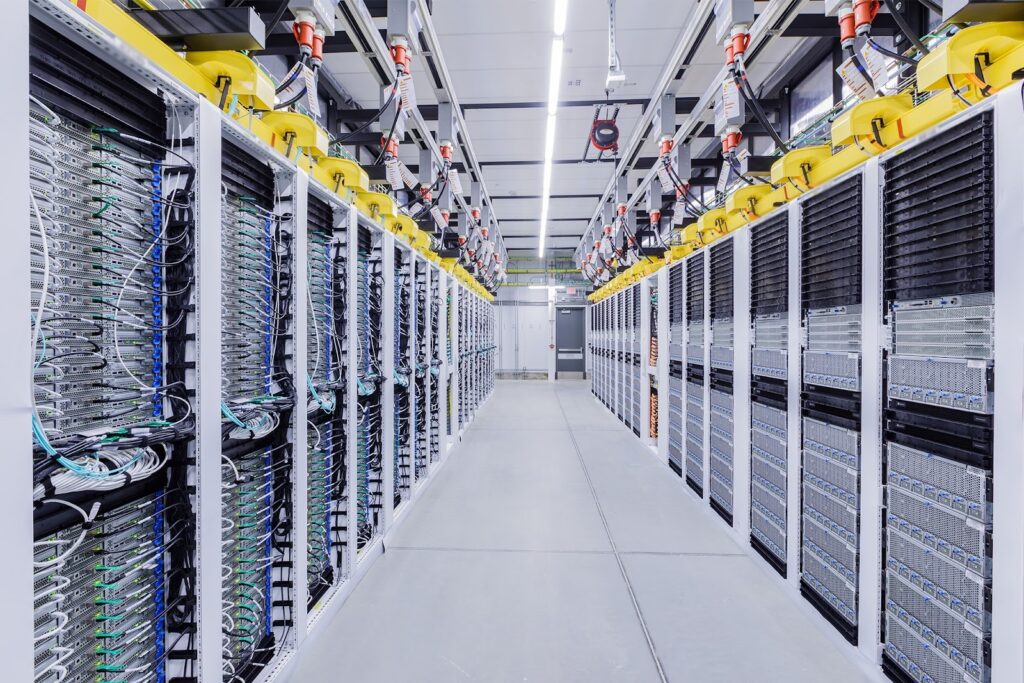
Massive facilities housing GPU/TPU clusters dedicated to model training, inference, storage and networking. Meta is building new sites; Microsoft and Amazon are expanding aggressively.
For example, Meta’s planned new data centre is described as “so large it would cover a significant part of Manhattan.” technologymagazine.com+1
Custom silicon & accelerators
Chips, GPUs, high-bandwidth memory, networking gear: The infrastructure race is hardware-intensive. Amazon’s in-house Trainium chips and Microsoft’s deals for large GPU clusters are examples. soic.in+1
Networking, power & cooling systems
AI compute demands massive power and cooling. Data-centres are being built with huge utilities, liquid cooling, energy-efficiency designs. Some centres are powered by entire utility-scale amounts of electricity. technologymagazine.com+1
Data & model building
Beyond hardware, companies are investing in datasets, model frameworks, AI labs and talent. Meta’s investment in Scale AI shows the importance of high-quality training data. fool.com+1
Global footprint & edge infrastructure
These are not just US-based builds — international data-centres and intercontinental cables, global infrastructure to support AI consumption around the world. socialmediatoday.com
4. Implications for the tech industry, economy & society
A. Platform dominance and lock-in
As these firms build more specialized infrastructure, their capacity to control large portions of the AI stack (from hardware to software to deployment) strengthens. This increases their strategic moat.
B. Acceleration of innovation
With more capacity and lower latency compute, new applications of AI (generative content, real-time inference, complex simulation) become feasible. The effect ripples into sectors: finance, healthcare, automotive, entertainment.
C. Macro-economic stimulus
The investment cycle in AI infrastructure is contributing significantly to global trade, manufacturing (especially semiconductors and cooling systems) and power consumption. For instance, Reuters noted AI infrastructure spending is propping up global trade flows. Reuters+1
D. Local economic impact
New data-centres mean jobs (construction, operations, engineering), local tax revenue and economic development (e.g., Amazon’s North Carolina investment). However, they also raise issues around land use, power demand, water usage, and environmental impact.
E. The monetisation challenge
While the build-out is enormous, the business models for monetising it — especially in AI services and enterprise use-cases — are still evolving. Some analysts caution that spending is far ahead of revenue realisation. soic.in+1
5. Risks and challenges ahead
1. Return on Investment (ROI) uncertainty
Spending hundreds of billions doesn’t guarantee returns. If AI model usage or monetisation lags, these infrastructure investments may struggle to pay off. Analysts warn of “bubble” risks. The Guardian+1
2. Rapid obsolescence
Hardware, chips and data-centres have limited useful life in the AI context. As newer GPU generations or architectures arrive, older infrastructure may become inefficient or stranded. The research on datacentre lifecycle emphasises this challenge. arXiv
3. Power, cooling & sustainability constraints
Massive compute = massive electricity and cooling. Environmental, regulatory and cost pressures may influence future build-out feasibility.
4. Competition & regulatory scrutiny
As infrastructure gives these firms power, regulators may pay more attention to antitrust, data-privacy, AI ethics and platform dominance. Also, new entrants or international players could disrupt the landscape.
5. Asset-bubble risk
If demand for model training or inference doesn’t scale as expected, some data-centres may become under-utilised. The Guardian warns of a “bubble” in the data-centre business. The Guardian
6. What to watch next
- Capex guidance changes: Future quarters will show how spending forecasts evolve. An increase suggests momentum; a cut may signal caution.
- Revenue derived from AI infrastructure: When firms start attributing meaningful revenue to their AI infrastructure investment, that signals monetisation.
- Geographic expansion & data-centre siting: Where new centres are built reveals strategy: proximity to power, favourable regulation, global reach.
- Hardware refresh cycles: New generations of GPUs/chips will drive refresh costs and impact existing infrastructure ROI.
- Regulatory signals: Government policy on data-centres, power usage, AI safety and competition may shape the investment environment.
7. Company-by-company snapshot
Meta Platforms
Meta has emphatically shifted from its “metaverse” narrative to an “AI first” strategy — pivoting its investment and messaging accordingly. It is building out data centres, investing in Scale AI, raising debt to fund new infrastructure and guiding massive capex for the year (US$64-72 billion). Meta is aiming to become not just a social-platform company but an AI infrastructure and services company. Investopedia+1
Microsoft
Microsoft is leveraging its Azure cloud and enterprise software base. It is seeing strong cloud growth (e.g., Intelligent Cloud revenue up 28 % in Q1) and associating AI infrastructure spend with meeting that demand. Its capex in a single quarter (US$34.9 billion) underlines the scale. Microsoft is building global data-centre footprints, deals for GPUs, and deepening its AI infrastructure stack. Investopedia+1
Amazon
Amazon’s investment centres around AWS, its cloud business, and building infrastructure to support AI workloads at hyperscale. Its capex for 2025 (US$100-125 billion) puts it among the biggest investors globally. Its site investments (e.g., US$10 billion in North Carolina) show the regional footprint strategy. Reuters+1
8. Conclusion
The scale, speed and ambition of AI-infrastructure investment by Meta, Microsoft and Amazon represent one of the major structural shifts in the tech industry. It is not merely incremental growth but a foundational commitment — to compute, data centres, platforms and ecosystems — that may reshape competitive dynamics and the broader economy.
Yet, this race is not without risk. The magnitude of capital being deployed raises questions about whether monetisation will keep pace, whether infrastructure will remain useful as hardware evolves, and whether regulatory/social concerns will catch up.
For readers, observers and participants in the tech sector (including your blog, ByteNest.tech), this moment represents a fertile source of stories: from the engineering and architecture of AI data-centres, to the business models built atop them, to the policy/regulation fallout of infrastructure dominance.