
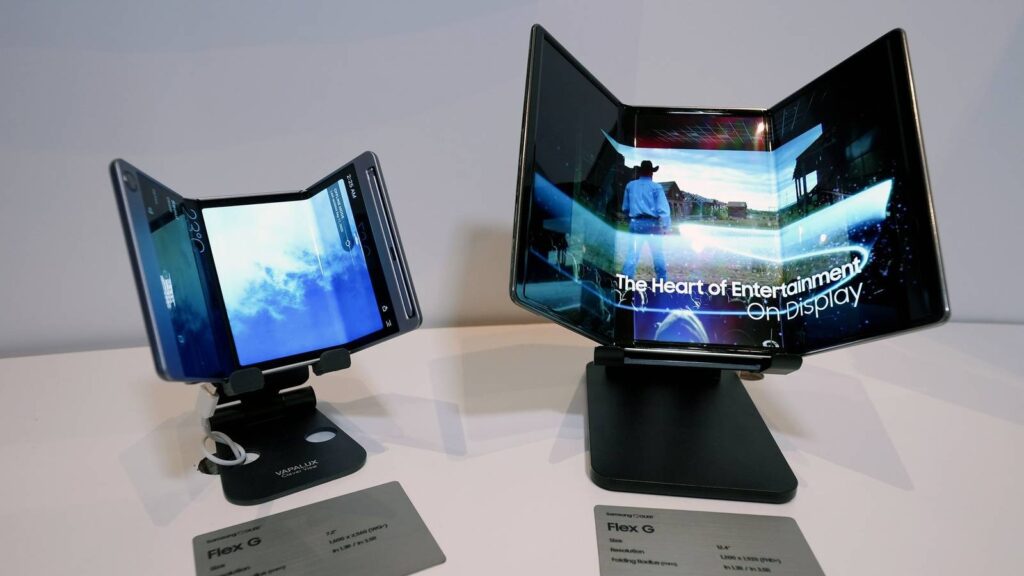
The foldable-smartphone era is evolving fast, and Samsung is preparing to push the envelope further with what appears to be its first tri-fold device. Recent leaks and patent filings point to a design featuring three display segments, two in-folding hinges, and a brand-new form factor that may redefine how we think of “phone” vs. “tablet”.
In this article I’ll walk you through the key leaked design cues, hinge mechanics, display layout, expected specs, launch timeline, and what this could mean for the broader foldable market. I’ll also include insights from reliable sources so you can assess how credible these claims are.
What’s leaked so far
The design gist
- According to an animation discovered in the One UI 8 firmware, Samsung’s upcoming tri-fold device (codenamed “Multifold 7” in the files) shows three rear-panels and dual hinges. Android Authority+1
- The design appears to have the two outer panels fold inward toward the central panel, creating a “G-shaped” or tightly folded stack. The Verge+1
- A later leak suggests three distinct display segments (not just two), and three internal battery modules – one under each segment. TechRadar
- Another report indicates the device uses a dual-hinge in-folding mechanism and transitions from a cover-display size when closed to a full ~10-inch size when fully opened. Android Central
Display and hinge details
- The animation shows the central panel housing what appears to be the cover display when the device is closed; the two side panels fold inwards. Android Authority+1
- One hinge appears slightly larger than the other, presumably to accommodate the extra folding action and to ensure the panels sit flush when folded. Android Authority+1
- Importantly, the device appears to only fully operate when completely unfolded — partial usage of one outer panel might be restricted by the hinge architecture. Tom’s Guide+1
Cameras and other features
- The leaked animations show a triple-camera island on the right-most panel (when fully open) and an NFC module placed there. The Verge+1
- The phone will presumably retain flagship-class features: large internal screens, high-end cameras, and Samsung’s foldable software refinements (via One UI). One leak suggests it may even support wireless charging and reversed wireless charging via the camera panel when closed. Android Central+1
Why this matters: what the tri-fold brings
Bigger screen real estate in a portable form
With the tri-fold design, Samsung seems to be aiming to blur the line between smartphone and tablet. For instance, the rumor that the fully unfolded device could reach about a 10-inch display makes it far more versatile for multitasking, media consumption, or productivity. Android Central+1
Improved hinge mechanics and durability
Foldable phones have often faced scrutiny over hinge durability, creases, and overall robustness. By using two in-fold hinges (versus outward folds) and a more complex hinge geometry, Samsung may be seeking to deliver better durability and a flatter fold. The asymmetry in hinge sizes (one larger) could reduce stress on the folding screen and hinge mechanism. Android Authority+1
New multitasking paradigms
With three screen segments, the potential for enhanced multitasking is significant: you could run three apps side-by-side, or have a larger workspace for creative or productivity tasks. One source suggests that the UI (One UI 8) is being optimized for “triple-screen” workflows. Cinco Días+1
A new flagship showcase
For Samsung, this device likely serves as a “halo” product — less about mass market adoption right immediately, and more about demonstrating technological leadership. The tri-fold form factor, at least initially, may carry a premium price and limited availability. One leak notes Samsung may restrict the first batch to ~50,000 units. Android Central
What we don’t yet know (and what to watch)
- Name and global availability: While some leaks call it “Galaxy Z TriFold,” others reference “Galaxy G Fold” or “Multifold 7”. Android Authority+1
- Exact specifications: The chipset, camera sensors, display refresh rates, battery capacities are still speculative. For example, one leak suggests three battery modules, but we don’t know total capacity. TechRadar
- Durability and reliability: The mechanistic complexity (two hinges, three panels) raises questions about long-term durability, crease behavior, hinge wear, and how thick/heavy it will be.
- Price and market segments: Judging from previous foldables, this device could cost significantly more than existing ones. For mainstream adoption, cost and availability will be critical.
- Software optimization: Three-panel devices require sophisticated UI handling. One UI will need to adapt seamlessly across folded, semi-folded, and fully unfolded states. How smooth that will be is unknown.
- Release timeline: Rumours suggest late 2025. For example, one source expects a launch before year-end. TechRadar
Timeline & launch expectations
- July 3, 2025: Leaked One UI 8 build reveals animations of tri-fold design. The Verge+1
- October 10, 2025: TechRadar reports patent showing final design and potential three-battery arrangement. TechRadar
- Late October 2025: Reports from AndroidCentral suggest Samsung may unveil the tri-fold at the APEC CEO Summit in South Korea. Android Central
- End of 2025: Samsung confirms a tri-fold device will launch in the second half of the year. LOS40+1
In short: expect an official reveal sometime near the end of 2025, with limited availability and very high tier specs.
How does it compare with competitors?
The tri-fold space is still nascent. One notable competitor is Huawei with its Huawei Mate XT (Ultimate Design) which was one of the first commercially available triple-fold phones. Wikipedia
That device uses an S-shaped fold, where one hinge folds outward. By contrast, Samsung’s design appears to be fully in-folding. This could provide better screen protection when closed, less exposure, and potentially better durability. The Verge+1
However, Huawei’s solution already allowed versatile “one-two-three panel” usage. Samsung’s might lock you into either closed or fully opened states (less flexibility for partial use) according to some leaks. Tom’s Guide
So the trade-off: Samsung aims for refined folding mechanics and durability; Huawei aimed for greater use-mode flexibility. Which approach wins consumer hearts is still to be seen.
What this means for you (the consumer)
If you are someone who:
- uses a phone and tablet interchangeably, and want one device to do both
- handles multitasking with many windows/apps open
- travels or works on-the-go and would appreciate a big screen in a smartphone form factor
then this Samsung tri-fold could be very compelling.
On the flip side, you should consider:
- The likely very high price, making it a luxury device at first.
- The potential weight and thickness (three panels + two hinges + large battery setup) means it may be bulkier than standard phones.
- The software maturity — first-generation foldables often have quirks and caveats; in this case three-panel folding adds complexity.
- The availability — initial units might be limited to certain regions (e.g., Korea, China, Taiwan) before global rollout. One leak specifically notes US availability might be delayed. Android Central
- The risk of new form factor: hinge durability, repair cost, and longevity all become higher stakes when more moving parts are involved.
If you don’t need three panels today, you might want to wait for the 2nd-gen version where costs come down and reliability improves.
Key take-aways
- Samsung’s leaked tri-fold smartphone features three display segments and two in-folding hinges (inwards fold), likely to be a flagship showpiece.
- The design reveals a central cover display + two side panels, a triple-camera island, and a refined hinge system.
- Launch expected in late 2025, with limited units and high cost.
- Samsung’s approach differs from competitors by emphasizing inward folding, hinge durability and a more “sealed” design rather than outward-fold panel exposure.
- For consumers: compelling for productivity and big-screen use, but comes with cost, bulk, and first-gen risks.
Final thoughts
The rumoured tri-fold device from Samsung represents an important milestone in the evolution of foldable smartphones. From the leaks, it’s clear that Samsung is not just scaling up the foldable size, but rethinking the folding architecture and screen usage model. If the hinge and display durability are truly refined, this could usher in a new class of devices that merge phone, tablet and even lightweight laptop functionalities.
However, as with any bleeding-edge hardware, there are caveats. The price, availability, and software polish will all determine how well it is received. For many users, the current dual-fold devices (like the Galaxy Z Fold line) may remain more practical in the near term.