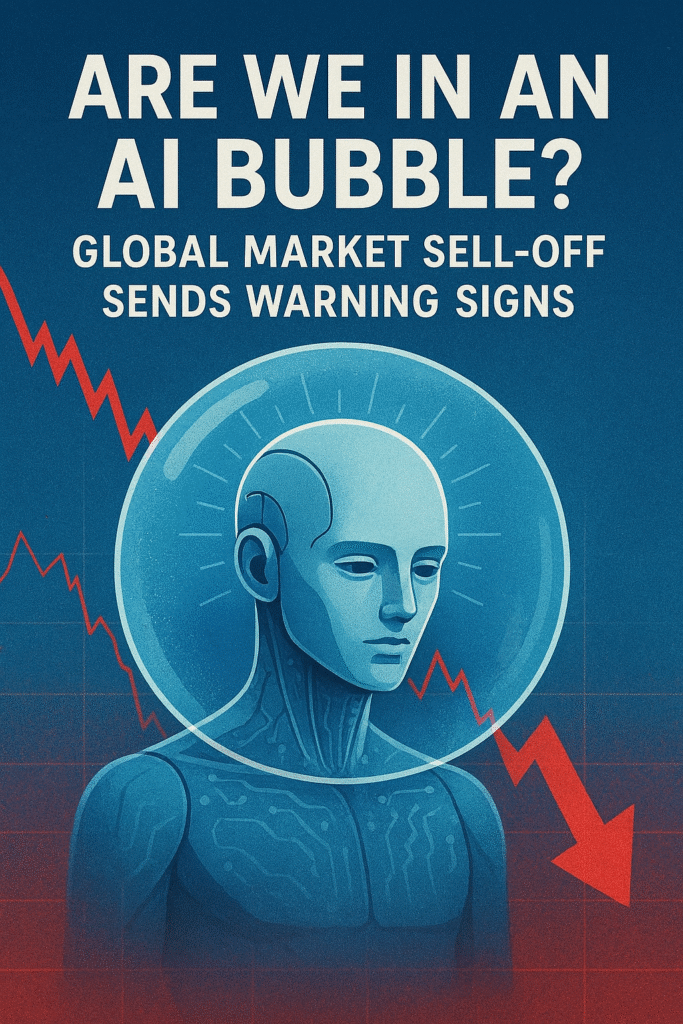
In early November 2025, global equity markets experienced a sharp sell-off, led by technology stocks and semiconductor makers, driven by rising investor concerns that the artificial intelligence (AI) boom may have overshot reality. Indices in Europe and Asia fell as much as ~2.85%, with chip-related firms among the hardest hit. Analysts are cautioning that the current pull-back may mark the beginning of a broader correction, as many of the companies most exposed to the AI narrative face elevated valuations and heightened risk.
1. What Happened?
On November 4-5, 2025, global equity markets saw a coordinated downturn:
- In Asia, the Nikkei 225 in Japan fell about 2.5% and the KOSPI in South Korea dropped up to 2.85%. The Guardian+2Reuters+2
- In Europe, technology shares led the losses and broader European indices also dipped. The Guardian+1
- In the United States, the tech‐heavy Nasdaq Composite fell about 2% and the S&P 500 dropped ~1.2%. Financial Times+1
- The semiconductor sector in particular took a hit: one estimate put roughly US$500 billion of value erased from global chip stocks. Bloomberg+1
While the numbers varied by region and index, the common denominator was clear: stocks closely tied to the AI narrative, particularly chipmakers and their supply chains, were disproportionately impacted.
2. Why the Drop? AI Bubble Fears and Elevated Valuations
Several factors converged to create this sell-off:
2.1 Elevated valuations & mounting skepticism
Investors are increasingly questioning whether the recent rally in AI-driven technology stocks is justified. According to one Reuters piece:
“Sharp falls in technology stock prices are cause for caution but not panic yet … How much further can they go? How much more can they buy?” Reuters
Bloomberg similarly pointed out that this year’s rally in global semiconductor stocks “hit a setback on concerns that valuations for some of the biggest winners have soared too quickly.” Bloomberg
2.2 Industry leaders turning cautious
Executives at major banks expressed concern that the broad tech market might be due for a correction. For example, the CEOs of Goldman Sachs and Morgan Stanley flagged the possibility of a 10–20% drawdown. New York Post+1
2.3 Supply-chain and macro risks
Chipmakers in Asia were especially vulnerable because their valuations had surged dramatically on the expectation of AI infrastructure build-outs. But rising concerns about demand, competition, and export restrictions (especially in China) weighed heavily. For instance, South Korea’s Kospi dropped ~6.2% at one point in the day, with major chip companies such as SK Hynix and Samsung Electronics down ~8-9%. Business Insider+1
2.4 Profit-taking after a strong run
Some analysts attributed the move to positional trades being unwound:
“The sell-off appears to be largely positioning-driven, with recent outperforming names taking the worst of the move.” — Jon Withaar, Pictet Asset Management Reuters
In short: the combination of lofty valuations, cautious commentary from market leaders, and concentrated gains in tech made the recent drop a kind of “breather” in a market that had been highly enthusiastic about AI.
3. The Hardest Hit: Chipmakers & Tech Giants
3.1 Semiconductor stocks
As noted, chipmakers have been the epicentre of the sell-off. The Bloomberg piece cited the semiconductor stock rally stumbling due to valuation concerns. Bloomberg
In Asia, shares of chip-testing equipment maker Advantest Corporation fell ~6% while Taiwan Semiconductor Manufacturing Co. (TSMC) dropped ~3%. The Guardian+1
3.2 AI-linked technology firms
While many AI‐related firms reported solid earnings, the market’s reaction has been muted because of the high expectations embedded in their valuations. For example:
- Palantir Technologies’ shares plunged nearly 8% even after raising guidance. The Guardian+1
- Nvidia Corporation saw a ~4% drop, contributing to broader market losses. The Washington Post+1
The message: strong earnings are no longer enough when valuations are predicated on near‐perfect execution—any hint of risk or slowdown is magnified.
4. Regional Breakdown: Asia, Europe & U.S.
4.1 Asia
Asia bore the brunt of the drop. Japan’s Nikkei and South Korea’s Kospi both experienced their sharpest declines in months. The sell-off was particularly acute in companies heavily exposed to AI chip demand. mint+1
4.2 Europe
European markets fell more modestly, but technology sectors dragged overall performance. While some investors saw the drops as selective, the mood shifted toward caution. The Guardian
4.3 United States
In the U.S., the tech-led sell-off pulled the major indices lower. The Nasdaq and S&P saw their largest one-day percentage drops in weeks. However, some of the decline was later cushioned when U.S. labour data showed some improvement, helping markets stabilize a bit. Financial Times+1
5. What It Means for Investors & Markets
5.1 Is this a correction or panic?
While some headlines refer to this as the beginning of a crash, many analysts caution that what we’re seeing is more likely a healthy correction rather than a full‐blown meltdown. For example, Reuters reported that the sharp drop in tech stocks was “cause for caution but not panic yet.” Reuters
5.2 Potential rotation in themes
Investors may start rotating away from high‐flying AI/tech stocks toward more defensive or value-oriented names. The risk is that the “magnificent seven” (large tech firms dominating the narrative) may lose some of their magnetism if growth expectations become too lofty.
5.3 The importance of valuations and earnings
The event underlines the idea that valuations matter. Firms are now being asked not only for strong earnings but for credibility in their growth narratives. If AI demand or infrastructure build-outs slow, expectations may adjust downward—creating pressure on multiple fronts.
5.4 Macro linkages
The sell-off also highlights how themes like interest-rates, inflation, global trade, and geopolitical risk can interact with growth stocks. For instance, if rate cuts are delayed or economic growth disappoints, highly valued growth stocks tend to suffer more.
6. What to Watch Going Forward
Here are some key indicators and developments investors should monitor:
- Earnings and guidance from major AI/tech firms – whether they meet elevated expectations or not.
- Chip-demand signals: Orders, inventory levels, and demand from data centres and AI infrastructure build-outs.
- Macro data: Employment figures, inflation, central-bank commentary on interest rates and growth. For example, a stronger than expected U.S. jobs report may support the view of delaying rate cuts, which can impact high-growth stocks. Financial Times
- Regulatory / geopolitics: Export controls, trade tensions (especially U.S.–China), and government policy on AI chips. These were cited as concerns in the current sell-off. The Guardian+1
- Market sentiment / flows: Where are investors putting or pulling money? Are hedge funds initiating short positions (as noted in some AI stocks) or rotating into other sectors? The Washington Post
7. Implications for Tech & Chip Sector Specifically
7.1 The promise vs. the reality of AI
The narrative around AI has powered tremendous investor enthusiasm, but the current correction signals that markets are beginning to ask tougher questions: Can growth be sustained? Are margins realistic? Are valuations supported by actual earnings trajectories?
7.2 Supply-chain stress and execution risk
Chip companies are capital-intensive and highly exposed to demand cycles. If enterprise AI spending slows or infrastructure build-outs are delayed, the downside risk is meaningful. Oversupply or weaker forward outlooks will hurt.
7.3 Valuation reset possible
Given how far some companies have run based on future expectations, a pull-back in investor optimism may trigger a valuation reset. Some firms may still deliver strong growth, but markets may demand higher proof of sustainability.
7.4 Long-term still intact for AI — but riskier
Most analysts continue to believe that AI as a trend is structurally significant. What’s shifting is timing, pace, and risk premium. A “breather” or correction may actually strengthen the sector by resetting expectations—though the path forward may be more volatile.
8. Key Takeaways for Your Blog Audience
- Global markets are affected simultaneously by tech risk: Asia, Europe and the U.S. have all seen tech‐driven declines.
- The AI-driven rally in technology and chip stocks is facing its first meaningful test of confidence; elevated valuations are being scrutinised.
- Chipmakers and highly rated AI/tech companies are the most vulnerable segments; strength in earnings may no longer be enough without strong forward guidance.
- While this may be a correction rather than a crash, the risk profile of growth/tech stocks has increased.
- For investors and tech-blog readers: understanding thematic risk (AI hype), macro interdependence (rates, trade), and valuation discipline is key going forward.
- Tech blogs and analysis sites should emphasise that while the AI revolution is ongoing, investing through it is not “set-and-forget” — execution, timing, and risk matter.
9. Conclusion
The recent global sell-off in technology and chip stocks marks a noteworthy turning point in the market’s attitude toward the AI boom. What had been an almost unquestioned growth narrative is now facing a reality check: elevated valuations, execution risks, macro vulnerabilities, and concentrated investor positioning. For the readers of a tech-oriented blog like yours, this moment offers rich material: it’s not just about “AI = future”, but about how that future is priced today.
As markets reassess, opportunities will emerge — but so will risks. Tech companies that can deliver robust earnings, show sustainable growth, and manage execution will stand out. Others may endure sharper corrections if supply-chain issues, demand slowdowns, or regulatory headwinds bite.
In short: the AI story remains important, but the tide of smooth sailing is over. For bloggers, investors, and tech watchers alike, it’s a reminder that narratives must be backed by numbers, and that growth without guardrails is a higher-risk proposition than many believed just a few weeks ago.