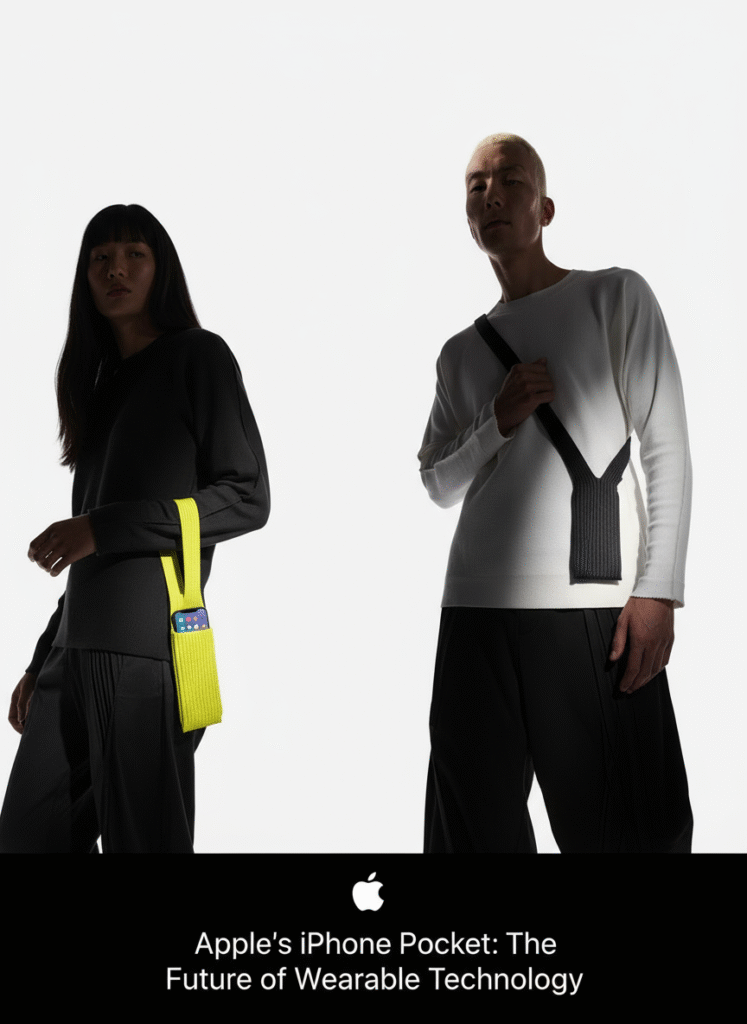
In November 2025, Apple unveiled a surprising new accessory: the iPhone Pocket, developed in collaboration with Japanese designer ISSEY MIYAKE. Designboom+3Apple+3Newsweek+3
At first glance, it appears to be more fashion accessory than heavy-tech gadget—a 3D-knitted textile case that allows a user to carry their iPhone in a wearable form. But beneath the surface, it signals a broader shift: the merging of smartphone hardware, personal fashion and wearable carrying solutions. In this article, we’ll dive into the iPhone Pocket’s design, its position in the wearable-technology landscape, why Apple is doing this, what it means for the future of wearables, and the implications for smartphone design and user behavior.
What is the iPhone Pocket?
Design & Features
The iPhone Pocket is described by Apple as “a beautiful way to wear and carry iPhone” and was developed in partnership with ISSEY MIYAKE. Apple+1
Key attributes:
- A singular 3D-knitted construction, inspired by the “piece of cloth” concept of ISSEY MIYAKE, designed in Japan. Apple+1
- It’s essentially a textile sleeve/pouch that accommodates any iPhone model (and other “pocketable items”) and can be worn on the body, tied to a bag, etc. Apple+1
- Two sizes/versions:
- Price: U.S. retail starts at $149.95 for the short strap version, and $229.95 for the long strap version. Apple+1
- Availability: Launching November 14, 2025 in select countries (U.S., U.K., Japan, France, etc). Apple+1
Context & Positioning
Why is Apple, primarily a hardware and software company, launching what is essentially a textile accessory? It’s a strategic move:
- It underscores Apple’s interest in the wearing of the iPhone rather than simply carrying it in a pocket or bag. The term “Pocket” here is literal—and symbolic: a wearable pouch. Spyglass
- It signals an evolving user behaviour: smartphones are large, omnipresent, and our ways of carrying them are changing (cross-body straps, small bags, wearable holsters).
- It ties into the broader luxury/fashion accessory market: by collaborating with ISSEY MIYAKE, Apple taps into fashion credibility and a premium accessory mindset. Business Insider
Why This Matters: Wearable Technology Meets Smartphone
Redefining what “wearing a phone” can mean
Typically, wearables are devices you wear on your body (e.g., smartwatches, AR headsets). The iPhone Pocket changes the equation: the smartphone becomes something you wear, not just carry.
In the commentary, one industry voice noted:
“the iPhone Pocket is actually a very Apple-like collaboration… the most important/interesting aspect is actually the continuing trend of turning the iPhone into a wearable.” Spyglass
This realization has several ramifications:
- User interaction: If your phone is hanging cross-body or at your wrist, how do you access it? Does the usage paradigm shift?
- Design implications: How bulky phones can get (or remain slim) if we assume they’ll be worn rather than pocketed.
- Accessory ecosystem: A surge in carry-solutions becomes as important as protective cases or chargers.
Fashion and tech convergence
The interview with Apple’s design director emphasised the shared philosophy with ISSEY MIYAKE: simplicity, craftsmanship, and delight. Apple
By positioning an iPhone accessory as fashionforward and premium, Apple is elevating an accessory category into luxury territory. It isn’t just “a phone sleeve” but a “wearable statement.” As one article put it:
“This is hardly a stocking stuffer … it’s more like the stocking you would use if your stuffers were diamonds.” Spyglass
This blurs the line between gadget and fashion, inviting questions about what the next frontier for smartphone accessories might be.
Strategic signals from Apple
- Diversifying accessory revenue streams: As the core iPhone business matures, accessories with high margins (and aesthetic appeal) become attractive.
- Reinforcing ecosystem lock-in: A stylish accessory designed for iPhone may increase switching costs for consumers.
- Testing new form-factors: By promoting “wearing” the iPhone, Apple may be exploring how hardware, accessories and user behaviour can co-evolve (especially as phones get larger).
Potential Benefits & Challenges
Benefits
- Hands-free convenience: Wearing your phone can free up your hands, avoid misplacing it in a bag, and enable quick access.
- Style and personalization: With multiple colours and strap lengths, users can match their phone wear to their fashion aesthetic.
- Accessory premium branding: For Apple and luxury fashion brands, such accessories strengthen brand identity and differentiation.
Challenges & Limitations
- Price point & mass appeal: At ~$150–230, the iPhone Pocket is expensive for a “carrier pouch.” Some users may question the value. (Newsweek called it “jaw-dropping” in price. Newsweek )
- Practicality: How practical is it in everyday usage? Would users prefer a lightweight phone in the pocket rather than a strap across the body? One commentator noted awkwardness when clutching a strap while trying to use the phone. Spyglass
- Protected vs exposed: The textile sleeve offers a carry option, but does it provide protection from shocks, drops, water? That remains a question.
- Cultural / gender dynamics: Some usage patterns (cross-body, wrist strap) may align more with existing “bag” or accessory norms than with typical male phone-carry habits (pockets, belt holsters). This may affect adoption.
What It Signals for the Future of Wearables
Toward hybrid gadget-fashion items
The iPhone Pocket suggests a future where gadgets are not purely tech but also fashion statements. We may see:
- More wearable phone accessories: straps, harnesses, textile-based sleeves.
- Smart-textiles merging with phone-carrying: imagine integrated textile phone pouches with sensors.
- Accessory ecosystems becoming more modular: phone + wearable carrier + bespoke fashion element.
Rethinking phone form-factor & carry behaviour
As phones become larger (bigger screens, more battery, more cameras), carrying them becomes a challenge. The iPhone Pocket acknowledges that pocketing may no longer be ideal for every user.
This could lead to:
- Phones designed with strap-loop or wearable carry in mind.
- More lightweight accessory-friendly builds: since the carry method changes, weight and size constraints evolve.
- A shift in UI/UX: if the device is worn in front of the body (e.g., cross-body bag style), how does reachability, one-handed use, notifications change?
Fashion-tech collaborations will expand
Given the success of Apple’s earlier luxury collaborations (e.g., Apple Watch + Hermès), this latest move reinforces that trend.
Expect:
- More high-end fashion brands partnering with consumer-tech companies.
- Limited-edition wearable accessories as status symbols (not just functional).
- Tech companies exploring textile/garment integration (smartwear) rather than just hardware.
Deep Dive: The Collaboration With ISSEY MIYAKE
The partnership between Apple and ISSEY MIYAKE carries deep roots:
- Steve Jobs famously wore ISSEY MIYAKE’s black turtlenecks, tying the brand to Apple’s design legacy. Business Insider+1
- The textile concept—“a piece of cloth”—reflects ISSEY MIYAKE’s signature pleating and innovative fabric techniques. Apple+1
- Apple’s design team collaborated closely with Miyake’s studio to produce the 3D-knitted construction. Apple
From a strategic standpoint:
- It elevates what could have been a generic phone sleeve into a design object.
- It leverages fashion-brand cachet to create a premium accessory launch just ahead of the holiday season.
- It reinforces Apple’s image of design leadership—not just in devices, but in how devices are carried and integrated into life.
Use Cases & Scenarios
Here are several user-scenarios where the iPhone Pocket makes sense:
- Urban commuter: Someone walking through a city without pockets (or in clothing without roomy pockets) can carry their phone across body securely.
- Festival/conference attendee: When bags are inconvenient or not allowed, a wearable phone pouch ensures quick access and reduces risk of theft.
- Fashion-conscious smartphone user: Someone who views the phone as an accessory and wants colour-coordinated carry.
- Multi-device carry: The sleeve fits not just the iPhone but other small “pocketables” (AirPods, wallet card) so it becomes a small carry pouch. Apple
At the same time, potential non-ideal scenarios:
- Someone who already uses a belt pocket and doesn’t want a strap across the body.
- Users who prioritise phone protection over styling: since the product emphasises textile and style, not heavy-duty protection.
- Minimalists who dislike extra accessories; might see this as adding rather than reducing bulk.
Broader Impacts on the Tech & Accessory Market
Rising accessory sophistication
Accessories are no longer just add-ons; they are experience differentiators. With the iPhone Pocket, Apple is treating an accessory as a first-class product. This could stimulate:
- Other manufacturers to launch their own wearable-phone accessories (not just cases).
- Textile and fashion companies to partner more aggressively with tech brands.
- A new niche: phone wearables (phone straps, pouches, cross-body carriers, wearable holsters).
Smartphone design ripple effects
If carrying changes, design may follow:
- Attachment points or built-in loops may become standard on future phones.
- Phones may be designed to hang off the body rather than always sit in pockets—impacting shape, weight, materials.
- Foldables or ultra-slim phones may gain more value when worn as accessories.
Sustainability and lifespan considerations
When you think of wearables and accessories, questions of lifecycle/replaceability matter:
- Will the textile accessory age (fabric wear, stretching)?
- Does the modularity of accessories (e.g., detachable strap) future-proof the phone’s carry method?
- How will Apple handle repair/replace aspects for non-electronic accessories (vs. their typical device warranty)?
Potential Criticisms and What to Watch
- Is it “just a bag” for a phone? Some online commentary suggests it might be seen as a novelty or fashion gimmick rather than a must-have tech innovation. Spyglass+1
- Function vs form trade-off: If the accessory is expensive but doesn’t improve phone usability or protection significantly, will users adopt it?
- Market segmentation: This product likely appeals to premium users; mainstream users might ignore it. That raises questions about scale.
- Environmental footprint: Textile production, fashion accessory models have environmental implications; will Apple address that?
- Compatibility & future-proofing: Although it fits “any iPhone,” how wearable will it be as phones evolve (size, form-factor)?
Looking Ahead: What the iPhone Pocket Foreshadows
1. Smartphone + Wearable ecosystem expansion
We might see future “wearables” that integrate smartphone functions:
- Wearable pouches with built-in power / MagSafe charging for the phone.
- Smart wearable straps that include sensors (fitness, location) tied to the phone.
- Textile integrated phone carriers with AR-capabilities.
2. Modular accessories as competitive edge
Accessories become differentiators among premium brands, not just devices. Apple’s move may force competitors to “own” the wearable carry space.
3. New interaction patterns
If your phone is on a strap across the chest rather than in a pocket, you might:
- Receive notifications differently (raised position vs pocket).
- Use voice/gesture controls more.
- Design UI for “worn phone” scenarios (standing, walking, reaching).
4. Fashion + Tech brand collaborations accelerate
Expect more collaborations like Apple × ISSEY MIYAKE: other smartphone brands might partner with fashion houses to launch wearables, accessories, limited editions—with higher margins.
Conclusion
The iPhone Pocket may seem—on the surface—a high-end textile phone pouch. But in the broader context of wearable technology, smartphone evolution and fashion-tech convergence, it’s a meaningful signal.
For bytenest.tech, this accessory offers rich terrain: you can frame it as part of a wearable-tech trend, critique the practicality vs style trade-off, and explore future implications for how we carry and interact with our devices.
In short: Apple isn’t just selling a phone accessory—they’re hinting at a world where the smartphone becomes something we wear, not just something we carry.