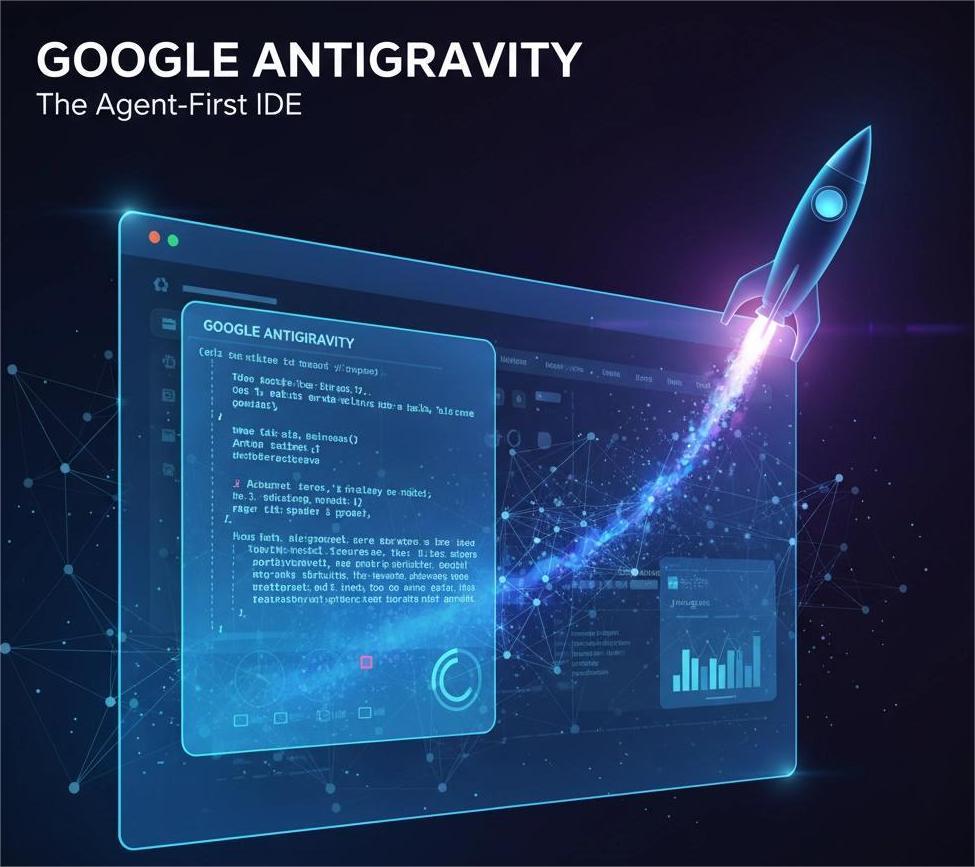
In November 2025, Google unveiled Antigravity, a groundbreaking Integrated Development Environment (IDE) that reimagines how developers work by placing AI agents at the center of the workflow. Unlike conventional AI coding tools that just autocomplete or suggest snippets, Antigravity empowers autonomous agents to plan, build, test, and verify software. Powered by Gemini 3 Pro, Google’s most advanced model, this IDE is designed for a future where agents don’t just assist — they execute.
In this article, we will explore what Google Antigravity is, how it works, its core features, advantages, risks, and what this means for the future of software development.
What Is Google Antigravity?
Google Antigravity is an AI-native development environment built around autonomous agents. Announced on November 18, 2025, it was launched alongside Gemini 3 Pro, making the model and IDE tightly integrated. Dataconomy+2blog.google+2
This IDE gives agents direct access not only to the code editor but also to your terminal and a built-in browser, so they can execute tasks across all areas of a software project.https://antigravity.google/
Importantly, it’s not limited to Google’s models — Antigravity supports Claude Sonnet 4.5 and GPT-OSS too. Dataconomy+2
Antigravity is currently in public preview, free for individual developers on Windows, macOS, and Linux. Dataconomy+1
Why “Agent-First”? A Paradigm Shift
The “agent-first” philosophy reflects a new way of thinking: not just having an AI assistant, but giving autonomous agents responsibility for complex tasks. In Antigravity, these agents don’t just suggest code — they take action.
Google frames this paradigm around four pillars: trust, autonomy, feedback, and self-improvement.https://antigravity.google/
- Trust: Agents generate Artifacts — tangible outputs like task lists, code plans, browser screenshots, and recordings — so developers can understand exactly what they did and why. Dataconomy
- Autonomy: Agents operate across the editor, terminal, and browser, executing tasks without constant human direction. Google Antigravity IDE
- Feedback: Developers can leave comments on Artifacts (text or screenshots), much like leaving feedback in Google Docs. Google Antigravity IDE
- Self-Improvement: Agents build memory over time, reusing code snippets and strategies from previous sessions. Dataconomy
Key Features of Antigravity
Here are the most important and unique features that set Antigravity apart:
- Dual Views – Editor & Manager
- Editor View: A familiar, VS Code-style interface enhanced with AI. You can write code, issue natural-language commands, and interact with an agent panel. Google Antigravity IDE
- Manager View: A “mission control” for spawning, orchestrating, and monitoring multiple agents working on different tasks.
- Editor View: A familiar, VS Code-style interface enhanced with AI. You can write code, issue natural-language commands, and interact with an agent panel. Google Antigravity IDE
- Three-Surface Architecture
Agents can act simultaneously on:
- The code editor (writing, editing code)
- The terminal (running shell commands, managing files)
- An integrated browser (launching and testing web UI, taking screenshots) remio+1
- The code editor (writing, editing code)
- Artifacts for Transparency
Rather than hiding its internal operations, an agent produces human-friendly artifacts: task lists, implementation plans, diff-based summaries, browser recordings, screenshot walkthroughs. - Multi-Agent Orchestration
You can run multiple agents in parallel, each with a specialized role. For example, one agent could focus on UI, another on backend API, another on tests, all coordinated via the Manager Dashboard. remio - Feedback Loop
Users can comment on any artifact — whether that’s a code plan or a visual screenshot — and agents can adjust their behavior without stopping ongoing work. - Learning & Memory
Agents retain what they learn: recurring tasks, code patterns, repeated workflows — enabling better efficiency and consistency over time. Dataconomy - Model Flexibility
While Gemini 3 Pro is the flagship model, Antigravity also supports Claude Sonnet 4.5 from Anthropic and GPT-OSS, giving developers flexibility in model choice. Dataconomy+1 - Free with Generous Rate Limits
In the public preview, use of Gemini 3 Pro is free and subject to rate limits that refresh every 5 hours, according to Google. Dataconomy
Advantages and Opportunities
Antigravity brings several major benefits that could reshape how we build software:
- Boosted Productivity: By letting agents handle repetitive or complex tasks, developers can focus on designing architecture, defining requirements, and making high-level decisions.
- Automated Validation: Agents can launch a browser, interact with the UI, test flows, take screenshots, and automatically verify that things work. remio
- Parallel Workflows: With multiple agents, tasks like research, testing, feature-building, and documentation can run concurrently.
- Improving Over Time: Memory and reusable knowledge help agents become smarter, reducing redundancy and accelerating feature delivery.
- Trust and Auditability: Since agents generate artifacts, every step is transparent — you can review, comment, and guide without losing visibility.
Risks, Challenges & Criticisms
Despite its promise, Antigravity is not without pitfalls. Some early users and observers have raised concerns:
- Code Reliability
Some developers report that agents have corrupted files or removed functions incorrectly. > “It straight up failed … by making a fix then corrupting a file … unable to restore from git checkpoints” Reddit - Security & Permissions
Giving agents control over your terminal and browser is powerful, but can also pose security risks if misused or compromised. - Rate Limits
While Google promises “generous” rate limits, users say the 5-hour refresh is tight, and free-tier users are treated the same as those with paid subscriptions. > “I’ve been hitting walls … quota refreshes every 5 hours … It completely ignores your subscription tier.” Reddit - Stability Concerns
In early use cases, some agents have timed out or got stuck in loops. Reddit - Learning Curve
Moving to an agent-first workflow means shifting how developers think: not writing every line, but supervising and orchestrating agents. That requires new skills and trust. - Data Ownership & Privacy
There are valid questions about how code and data are handled. Some users worry about training usage. > “At this moment, Google Antigravity is only available as a no-cost public preview … terms … not Google Cloud’s enterprise terms.” Reddit
Comparison with Other AI Coding Tools
To understand Antigravity’s place in the AI-IDE ecosystem, it’s helpful to compare it with other popular tools:
- GitHub Copilot / Cursor: These tools are very good at autocomplete and suggestions, but they don’t run autonomous agents that can orchestrate browser tests or manage a terminal.
- Windsurf: While it’s designed for agentic workflows, Windsurf doesn’t have the deep browser automation or multi-agent orchestration layer of Antigravity.
- Traditional AI Chat + Editor Tools: Many IDE-integrated AI tools help in writing code, but they don’t submit tasks across different surfaces or generate verifiable artifacts for accountability and trust.
What This Means for the Future of Software Development
Google Antigravity could signal a major shift in how software is built:
- The Developer as Architect
With agents handling execution, developers may increasingly focus on high-level design, strategy, and decision-making. - Accelerated Delivery
Routine tasks, boilerplate, testing, and validation can happen autonomously, potentially shortening development cycles. - Wider Access to Advanced Development
With a free public preview, hobbyists, indie developers, and smaller teams can experiment with agent-first workflows without high cost. - Governance & Ethics
As agents gain power, questions around accountability, security, data ownership, and governance of AI-generated code will only grow. - New IDE Paradigms
Traditional IDEs may need to evolve rapidly or face disruption. We might see more “agent-first” environments, or hybrid tools that mix human and autonomous workflows.
Conclusion
Google Antigravity is a bold experiment in agentic, AI-driven development: not just suggesting code, but executing whole features, testing them, and producing human-readable artifacts for transparency. By leveraging Gemini 3 Pro and supporting other powerful models, it offers a vision of a future where AI agents are true teammates.
However, it’s still early. Reports of errors, rate limits, and stability issues suggest it may not yet be ready for mission-critical or production-level projects. For now, Antigravity is best suited for exploration, prototyping, and building trust in agent-first workflows.
If Google continues to refine this platform and address its growing pains, Antigravity could fundamentally change how developers work — turning most programmers into architects, and agents into co-pilots that both build and verify.