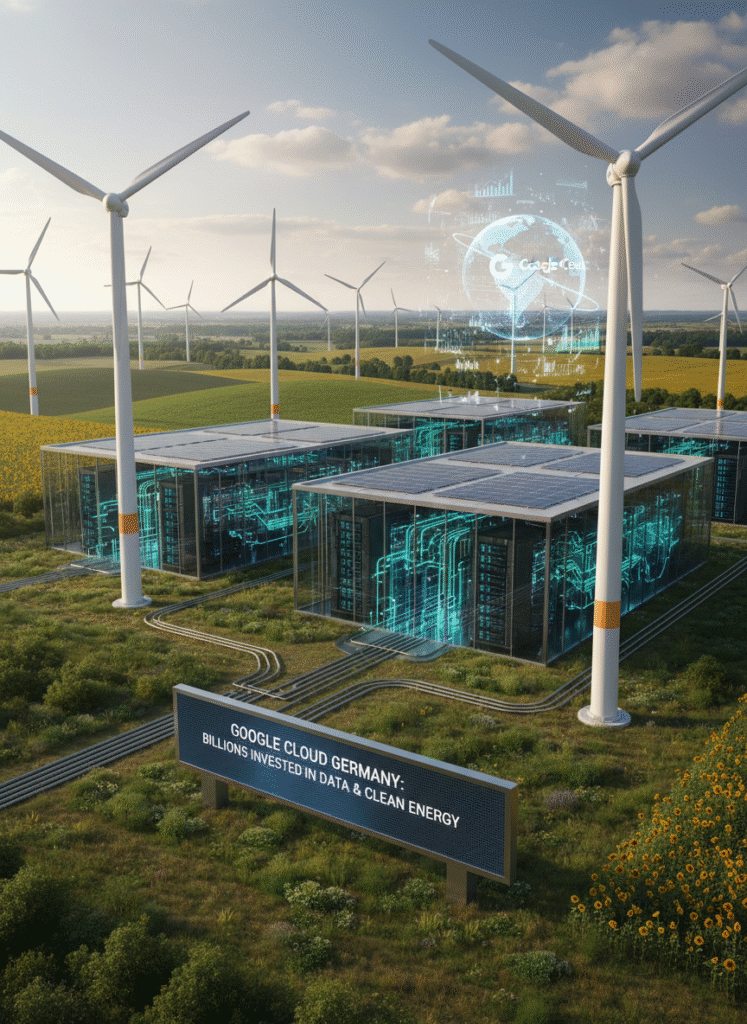
Global tech giant Google LLC is set to deepen its presence in Germany in a move that combines digital infrastructure expansion, cloud services, renewable-energy procurement, and sustainability innovation. Reports indicate that Google is preparing its “largest-ever investment plan” in Germany, centred on building and upgrading data centres, strengthening its cloud regions, and tying those to clean energy and waste-heat reuse. Reuters+2Data Center Dynamics+2
This article explores:
- What the investment entails and why Germany is the focus.
- The strategic context: cloud growth, data sovereignty, Industry 4.0.
- How renewable energy, waste-heat reuse and sustainability tie into the plan.
- Implications for Germany’s economy, the European cloud market, and global tech sustainability trends.
- Potential challenges and what to watch.
What’s on the Table: Google’s Germany Plans
Expanding Data & Cloud Infrastructure
In Germany, Google has already invested meaningfully in cloud infrastructure: for example, back in 2021 it pledged about €1 billion from 2021 to 2030 to expand its German cloud regions and build out renewable energy supply. Google Cloud+2Nasdaq+2
More recently, reports say Google is preparing to announce a larger than ever investment plan (date reported as Nov 11 2025) covering new infrastructure and data centres in Germany-notably in Munich, Frankfurt and Berlin, plus projects linking renewable energy and waste-heat reuse. Data Center Dynamics+1
Key Components
- Building or upgrading data-centre capacity in Germany (cloud regions in Frankfurt/Hanau, Berlin-Brandenburg region). Dgtl Infra+1
- Partnering for renewable energy supply: e.g., a 140 MW contract with ENGIE Deutschland to supply wind- and solar-derived power in Germany. Data Center Dynamics+1
- Waste-heat reuse and circular economy practices for data-centre infrastructure: part of the sustainable push referenced in recent reports. Data Center Dynamics
Why Now?
Several factors converge:
- Germany is Europe’s largest economy and a vital market for cloud services, enterprise infrastructure, Industry 4.0.
- Local regulation and digital sovereignty concerns (European customers increasingly want regional infrastructure) make Germany attractive for cloud providers.
- Sustainability is no longer optional: data centres consume large amounts of energy, so aligning with renewables and decarbonisation is both a regulatory and reputational imperative.
- Competitive pressure: Other cloud providers (e.g., Amazon Web Services, Microsoft Corporation) are also expanding heavily in Germany, so Google is matching/raising the bar.
Germany’s Strategic Role in Europe’s Cloud & Green Infrastructure
Germany offers a unique blend of advantages for large-scale cloud and data-centre operations, while also presenting specific challenges—understanding both helps clarify why Google is doubling down.
Advantages
- Market size: With ~83 million people and deep enterprise markets in manufacturing, automotive, finance, Germany is a major cloud market in Europe.
- Connectivity: Regions such as Frankfurt host major internet exchange points (e.g., DE‑CIX) and robust fibre infrastructure—important for latency-sensitive cloud services. Dgtl Infra+1
- Regulatory environment favourable for cloud regions: German/European businesses increasingly prefer local data residency, compliance with GDPR, and European-based infrastructure.
- Renewable energy ecosystem and sustainability push: Germany has been advancing in wind, solar, battery storage and grid decarbonisation—creating a favourable backdrop for green-powered data-centres.
Challenges & Considerations
- Land, energy and cost pressures: Germany is not the lowest-cost location in Europe for hyperscale data centres—land can be pricey, grid capacity and permits may be more complex than in some Nordic countries.
- Energy grid/availability constraints: While Germany pushes renewables, balancing high-capacity data-centre loads with grid stability and energy sourcing remains a challenge.
- Regulatory and planning hurdles: Building large-scale infrastructure (data centres, energy systems, waste-heat capture) often involves multi-year permitting, local stakeholder engagement and sustainability reviews.
Overall, the strategic combination of Germany’s market, infrastructure, sustainability agenda, and location gives Google a strong rationale—even if cost pressures are not minimal.
Sustainability Dimension: Renewables, Waste Heat, Carbon-Free Operations
Sustainability is core to Google’s German investment, not just as a “nice to have” but as integral to the infrastructure plan. Some of the noteworthy components:
Renewable-Energy Agreements
- Google signed a 140 MW renewable-energy supply contract with ENGIE Deutschland in Germany: 39 MW solar PV and 22 wind parks across five states. The aim: deliver nearly 80 % carbon-free supply by 2022 (hourly matching). Data Center Dynamics+2gems.engie.com+2
- In Germany, Google’s digital-infrastructure and clean-energy investment (approx. €1 billion since 2017) is said to accelerate progress toward a net-zero digital economy. cms.implementconsultinggroup.com+1
- Globally, Google has committed to 24/7 carbon-free energy usage by 2030—matching every hour of operation with clean energy in every grid region. Rivista AI+1
Waste-Heat Reuse and Circular Economy Practices
Modern data-centres produce significant waste heat; re-using that heat (for district heating, industrial processes) is becoming a differentiator. In Germany, Google’s upcoming plan reportedly includes waste-heat reuse as a component. Data Center Dynamics
Efficiency and Design
- A report on Germany (“A greener and more digital Germany”) notes that Google’s computing facilities are approximately 1.5 × more energy-efficient than traditional data-centres. cms.implementconsultinggroup.com+1
- In the Hanau facility near Frankfurt (under the German investment plan), the 10,000 m² data-centre was built with energy-efficient infrastructure and a circular-economy model for waste. Google Cloud+1
Implications for German & European Tech Landscape
Economic and Workforce Impacts
- Infrastructure investments of this scale create construction jobs, operations roles, supply-chain opportunities, and indirect benefits for local economies. Google’s earlier German-investment data: approx. €1 billion in digital infrastructure since 2017 has driven benefits in employment and GDP contribution. cms.implementconsultinggroup.com+1
- For Germany, it reinforces its position in the European cloud/AI ecosystem, helping domestic and industrial customers access advanced cloud, AI and data-services locally rather than relying solely on non-European data-centres.
Competitive Dynamics in Europe
- Google’s investment appears to match moves by rivals (AWS, Microsoft) expanding European data centre footprints. Data Center Dynamics
- For Europe broadly, this strengthens the trend of hyper-scalers localising infrastructure, supporting latency-sensitive workloads, on-premises-adjacent cloud, and regional compliance.
- From a sustainability angle, Google’s push underscores that hyperscale cloud is increasingly about “green infrastructure” not just servers and storage.
Strategic Themes: Digital Sovereignty & Sustainability
- Germany emphasises digital sovereignty—having data-centres inside the country, under EU jurisdiction, with local controls and trust. Google’s localised investment aligns with that.
- Sustainability is no longer a secondary goal; data-centre operators are being judged on energy sourcing, carbon-free matching, heat-reuse, water usage and circular-economy practices. Google’s Germany plan reflects this.
What to Watch / Potential Risks
Regulatory / Planning Delays
Large-scale infrastructure projects in Germany can face lengthy permitting, community objections, environmental-impact assessments, grid-connection issues, etc. Execution risk must be considered.
Energy and Grid Dynamics
Even if Google secures renewable contracts, scale-up and integration remain complex. Grid stability, balancing, local generation and demand-matching (especially for AI-heavy loads) are non-trivial.
Land and Cost Efficiency
Germany’s land and energy costs may be higher than some alternative European locations (Nordics, central Eastern Europe). The business case must justify the premium.
Geopolitical / Supply-Chain Factors
The broader environment (geopolitics, supply-chain shocks for servers, chips, renewables) could affect rollout timelines or cost.
Local Community / Sustainability Expectations
Expectations are rising for data-centres to demonstrate real green credentials (e.g., genuine 24/7 carbon-free energy, waste-heat reuse, low water usage). Any shortfall may lead to reputational cost or local resistance.
Why This Move Matters—And Why It’s Bigger Than Just One Country
While the Google-Germany story is highly relevant for Germany, its significance is broader:
- It signals an era where cloud-infrastructure expansion is tightly coupled with sustainability commitments. Tech giants are no longer just expanding; they’re doing so in ways aligned with 2030 decarbonisation goals.
- It shows how major digital infrastructure investments are shifting toward continental hubs with strong policy/regulatory backing, not just low-cost sites.
- It reinforces how digitalisation (data centres, cloud, AI) and the energy transition (renewables, efficiency, waste-heat reuse) are becoming intertwined. Google’s Germany programme is a “digital + green” package, not just more servers.
- For blog readers and tech-industry watchers this trend matters: enterprises choosing cloud providers will increasingly consider not just features and pricing but location, sustainability credentials, carbon footprint, local compliance—and infrastructure like this shapes that choice.
Deep Dive: The Hanau Facility & German Cloud Regions
A concrete example within Google’s German strategy is the facility in Hanau (near Frankfurt). Techerati+2Google Cloud+2
- The Hanau data centre covers 10,000 m² (approx. 108 k ft²). Dgtl Infra
- It is part of Google Cloud’s Frankfurt-region expansion to meet growing German demand for cloud services. Google Cloud+1
- The building was constructed to high sustainability and circular-economy standards (material reuse, efficient cooling, etc). Techerati
- The location is ~20 km from the DE-CIX hub in Frankfurt, giving high connectivity and latency advantages. Dgtl Infra
From this we see Google is not just leasing space; it is constructing owned facilities, integrating sustainability design, and positioning the cloud stack for Germany and Europe.
The Bigger Number: Is It Really “Billions”?
Although many headlines say “billions,” it’s worth unpacking the figures:
- In 2021, Google announced approximately €1 billion investment in Germany (2021–2030) for digital infrastructure & clean energy. Nasdaq+1
- More recently, reports (Nov 2025) say Google is preparing a “largest-ever investment plan” in Germany, possibly exceeding prior commitments—though exact figure hasn’t been publicly confirmed. Reuters+1
- Given the size of prior investments (eg. €1 billion) and the scale of data-centre + cloud + renewables infrastructure, “billions” (plural) are plausible though exact numbers are still under disclosure.
Thus for article purposes, we can say “billions” as a valid description pending full detail, while noting exact totals may be disclosed at the official announcement.
Takeaways for Tech Industry / Cloud Buyers / Sustainability Advocates
- For enterprise cloud buyers in Germany and Europe: Google’s investment reinforces that you can get local cloud infrastructure with sustainability credentials—latency, locality, compliance matter increasingly.
- For data-centre and renewable-energy ecosystem participants: This is a signal that hyperscalers will continue to push large-scale renewables, circular-economy designs, waste-heat capture—so opportunities exist for energy firms, district-heating operators, materials/reuse firms.
- For sustainability advocates and regulators: It shows how digital-infrastructure and decarbonisation agendas can converge—data-centres are not just energy consumers, they can contribute to district-heating, grid flexibility, and zero-carbon energy models.
Conclusion
Google’s forthcoming major investment in Germany marks a nexus of cloud expansion, data-centre infrastructure, and renewable-energy ambition. By anchoring in Germany—expanding data centres, strengthening its cloud regions, securing renewable supply agreements, and embedding sustainability features like waste-heat reuse—Google is signalling that the next wave of cloud infrastructure in Europe is not just about scale, but about sustainable scale.
For Germany, this could accelerate its digital-transformation and green-economy agenda. For the broader tech ecosystem, this investment underscores that the future of cloud is multi-dimensional: capacity and climate.