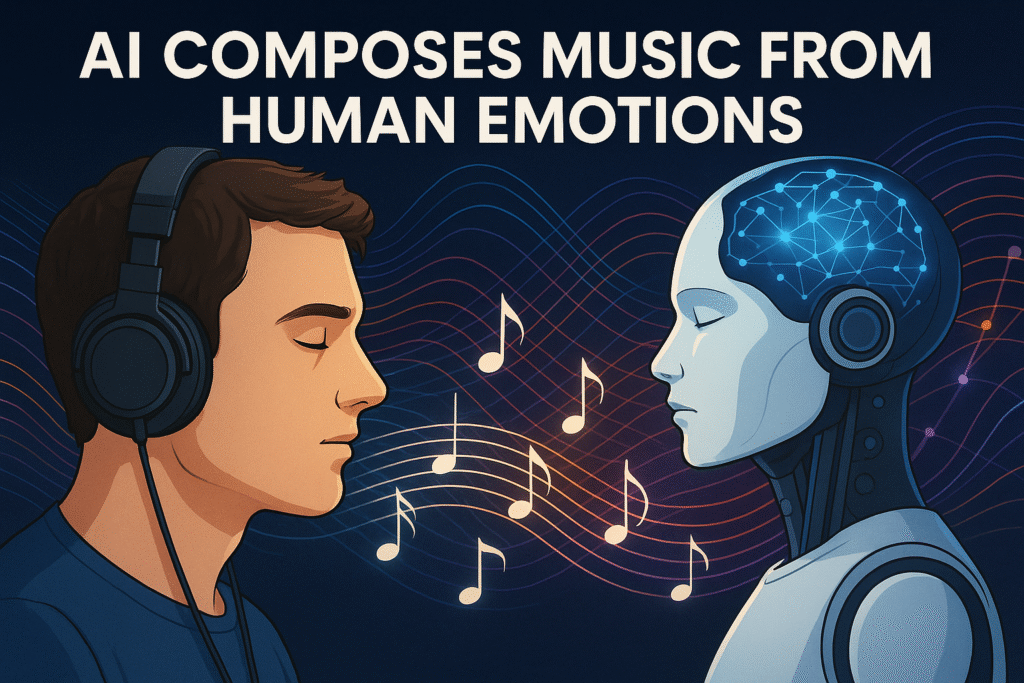
In a world where artificial intelligence (AI) continues to blur the lines between machine and human creativity, a fascinating new frontier is emerging—AI-generated music composed based on human emotions. This technology leverages advanced deep learning models, biofeedback data, and real-time emotion recognition to generate original music that reflects a listener’s current mental or emotional state.
Whether it’s a calm piano melody when you’re anxious or an upbeat rhythm when you’re feeling joyful, AI’s ability to interpret and transform emotions into music is changing how we experience sound—and how we connect with ourselves.
1. How Does AI Read Human Emotions?
AI doesn’t have feelings, but it can detect and interpret human emotions using various technologies, including:
- Facial Recognition: AI models analyze facial microexpressions using cameras to detect emotional cues like happiness, sadness, or anger.
- Voice Analysis: Tone, pitch, speed, and inflection in speech help AI gauge emotional states.
- Brain-Computer Interfaces (BCIs): Devices like EEG headsets capture brainwave activity, which AI can process to understand cognitive and emotional patterns.
- Physiological Signals: Heart rate, skin conductance, and breathing patterns provide additional biometric data.
These inputs are processed using machine learning algorithms trained on large datasets to recognize emotional states with increasing accuracy.
2. Turning Emotions Into Music: The Tech Behind It
Once emotions are detected, the next step is translating them into musical parameters. Here’s how AI accomplishes that:
- Emotion-to-Music Mapping: Emotions are mapped to musical elements such as tempo, key, chord progression, and instrumentation. For example, sadness might translate to a slow tempo in a minor key, while excitement could lead to fast-paced beats in a major scale.
- Generative AI Models: Tools like OpenAI’s MuseNet or Google’s Magenta use transformer-based neural networks trained on thousands of music tracks to generate new compositions.
- Real-Time Adaptation: Some systems can adjust the music dynamically as a person’s emotions shift, creating a continuously evolving soundscape.
The result? A unique piece of music tailored to your emotional state in real time.
3. Notable Projects and Companies Leading the Way
Several pioneering companies and research labs are pushing the boundaries of this emotional-music synthesis:
A. AIVA (Artificial Intelligence Virtual Artist)
AIVA is known for composing classical-style music using deep learning. While originally focused on general composition, recent developments are aiming toward emotion-driven soundscapes for films and games.
B. Brain.fm
This company uses EEG and neurofeedback to create music designed to improve focus, relaxation, or sleep. While not fully emotion-based yet, their work is laying the groundwork for emotion-reactive sound environments.
C. AI Music (acquired by Apple)
Their technology adapts music in real time based on user activity and mood, suggesting that Apple could integrate emotion-responsive soundtracks into future apps or devices.
D. MIT Media Lab’s “Affective Computing”
MIT is exploring how to combine emotional AI and generative music to assist in therapy, mental health, and personalized entertainment.
4. Applications: Where Emotional AI Music is Making Waves
Mental Health Therapy
Music therapy is a well-established psychological tool. Now, with AI-driven emotional soundtracks, patients can experience personalized therapeutic sessions that resonate with their current feelings, offering support in managing anxiety, depression, or PTSD.
Gaming and Virtual Reality (VR)
Imagine a horror game that changes its soundtrack based on your fear levels, or a VR meditation experience that generates calming music in real time as your stress decreases. Emotion-driven AI music enhances immersion in gaming and virtual environments.
Wearable Tech Integration
Future smartwatches and AR glasses may detect your stress levels and generate personalized music to boost your mood, enhance focus, or help you unwind.
Creative Tools for Musicians
Artists can collaborate with AI to explore new emotional landscapes in music composition, creating tracks that dynamically evolve based on listener input or crowd-sourced emotions during live performances.
5. Ethical Considerations and Limitations
While this innovation is groundbreaking, it also raises ethical and technical challenges:
- Privacy Concerns: Collecting emotional data—especially from biometric sources—requires strict data privacy and consent protocols.
- Emotional Manipulation: There’s potential for misuse in marketing or entertainment, where users’ emotions could be manipulated through AI-curated soundtracks.
- Loss of Human Creativity?: Some critics argue that emotional AI in music may undermine the authenticity of human expression. However, many see it as a complement rather than a replacement.
6. The Future: Hyper-Personalized Soundscapes
The next decade could see a rise in “emotional sound companions”—apps or devices that accompany you throughout the day, adapting their output to how you feel.
Music streaming platforms like Spotify and Apple Music may integrate emotion-aware algorithms to recommend not just what you like, but what your mood needs.
As AI continues to evolve, music could become more than entertainment—it could become a mirror to our inner selves, enhancing well-being, creativity, and emotional intelligence.
Conclusion
The fusion of AI and human emotion is crafting a new musical language—one that listens as much as it speaks. From therapeutic tools and immersive gaming to personalized soundtracks that echo your mood, emotion-based AI music is redefining our relationship with sound.
While there are hurdles to overcome, the promise is clear: a world where every beat, chord, and melody is a reflection of how you feel in the moment.