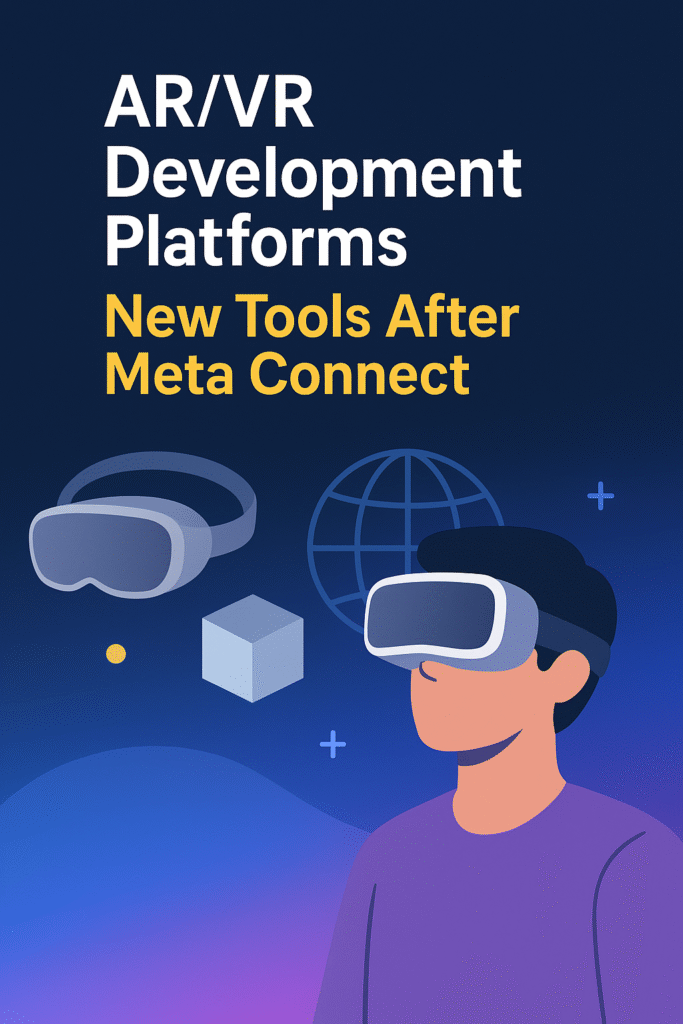
The AR/VR ecosystem has accelerated rapidly in recent years, with hardware becoming lighter, software becoming more powerful, and immersive experiences increasingly mainstream. After Meta Connect, one of the industry’s most influential events, developers and creators now have access to a new wave of tools, platforms, and frameworks designed to make building in extended reality (XR) more accessible than ever.
This article explores the most important AR/VR development platforms introduced or updated after Meta Connect, how they compare with existing solutions, and what they mean for the future of immersive development.
The State of AR/VR Development Before Meta Connect
Before the most recent Meta Connect, the AR/VR development landscape was dominated by a handful of platforms and engines:
- Unity: Widely used for VR gaming and AR experiences, offering robust integrations with ARKit, ARCore, and Meta’s own SDKs.
- Unreal Engine: Preferred for high-fidelity VR projects thanks to its photorealistic rendering capabilities.
- ARKit (Apple): The go-to platform for iOS AR experiences.
- ARCore (Google): The Android counterpart, focused on mobile AR applications.
- WebXR: An open standard enabling AR and VR experiences directly within web browsers.
While these platforms set the foundation, many developers complained about fragmentation, steep learning curves, and the lack of cross-platform consistency. Meta Connect 2025 aimed to address some of these pain points with new tools and integrations.
Key Announcements at Meta Connect
Meta’s announcements placed a strong emphasis on developer empowerment. The company highlighted new frameworks, SDKs, and cross-platform compatibility layers designed to simplify XR creation.
Here are the standout tools and updates:
1. Meta Horizon SDK 2.0
The updated Horizon SDK focuses on social and collaborative VR experiences. With this release:
- Developers can integrate persistent avatars across apps.
- A shared spatial anchors system allows objects to remain in the same place in AR and VR.
- Expanded APIs for multiplayer interactions in mixed reality.
This marks a shift from gaming-only experiences to persistent, connected XR ecosystems.
2. Meta XR Unity and Unreal Extensions
Meta unveiled official extensions for Unity and Unreal, offering plug-and-play modules that:
- Reduce boilerplate code.
- Offer drag-and-drop components for spatial mapping and hand-tracking.
- Provide cross-device compatibility, particularly with Quest and AR glasses.
This makes XR development far more accessible for indie developers.
3. AR Glasses Toolkit
With Meta’s push into lightweight AR glasses, the new toolkit provides:
- Eye-tracking and gesture input APIs.
- Optimized rendering pipelines for low-power devices.
- Seamless integration with existing ARCore and ARKit projects.
The toolkit shows Meta’s determination to compete directly with Apple’s Vision Pro ecosystem.
4. Mixed Reality Interaction Framework (MRIF)
Perhaps one of the most exciting announcements, MRIF offers:
- Pre-built libraries for object occlusion, spatial physics, and passthrough blending.
- Templates for mixed reality apps, where digital and physical worlds interact seamlessly.
- A low-code editor for rapid prototyping.
This framework lowers the barrier to entry for non-technical creators.
How These Tools Compare With Existing Platforms
Let’s see how Meta’s new offerings stack up against established players:
| Platform/Tool | Strengths | Limitations | Best Use Case |
| Meta Horizon SDK 2.0 | Social VR, shared anchors, multiplayer APIs | Meta device ecosystem focus | Social VR worlds, collaboration |
| Unity (with XR Extensions) | Large dev community, cross-platform support | Performance issues in high-fidelity VR | AR/VR gaming, indie projects |
| Unreal Engine | Photorealistic visuals, powerful rendering | Steeper learning curve | AAA VR games, cinematic XR |
| ARKit (Apple) | Precision AR for iOS | iOS-only | iPhone/iPad AR apps |
| ARCore (Google) | Android AR, scalable | Android-only | Mobile AR |
| Meta AR Glasses Toolkit | Lightweight hardware optimization | Still early-stage | Smart glasses apps |
| WebXR | Browser-based, accessible | Limited performance | Cross-device demos, web AR/VR |
Meta’s new tools don’t replace Unity or Unreal but complement them with XR-specific modules. The AR Glasses Toolkit is also a signal that competition with Apple’s ecosystem is heating up.
The Shift Toward Mixed Reality
A recurring theme from Meta Connect is the convergence of AR and VR into Mixed Reality (MR). The new frameworks focus on blending the digital and physical seamlessly rather than treating AR and VR as separate worlds.
For example:
- Developers can now anchor digital objects to real-world environments with persistent accuracy.
- Passthrough technology enables users to interact with both their living room and virtual overlays at the same time.
- Shared anchors allow multiple users to see the same object in the same place across devices, a huge step for collaboration and multiplayer experiences.
This shift is critical because it aligns with broader industry trends: productivity in MR, AR-assisted healthcare, industrial training, and even MR in retail.
What Developers Need to Know
If you’re a developer entering AR/VR today, here are the key takeaways after Meta Connect:
- Focus on cross-platform flexibility. Building exclusively for one ecosystem is risky—consider Unity or WebXR with Meta’s SDKs.
- Prioritize performance optimization. AR glasses and standalone VR headsets are power-constrained; efficient rendering is essential.
- Leverage low-code tools. Frameworks like MRIF allow rapid prototyping, letting you test ideas quickly before scaling.
- Explore social and collaborative features. Persistent avatars, shared anchors, and multiplayer APIs hint at XR becoming increasingly social-first.
- Keep an eye on standards. OpenXR and WebXR are gaining traction, meaning future compatibility will be easier.
Opportunities Beyond Entertainment
While gaming and entertainment dominate conversations around AR/VR, the tools presented at Meta Connect expand use cases in multiple sectors:
- Healthcare: Mixed reality surgery simulations and patient treatment apps.
- Education: Virtual classrooms with persistent learning spaces.
- Retail: AR glasses-powered shopping experiences.
- Enterprise Training: Collaborative VR training modules with realistic interactions.
- Architecture & Design: Real-time mixed reality visualization of buildings.
The new toolkits make it easier to build scalable, cross-industry solutions.
Challenges Ahead
Despite the progress, challenges remain for AR/VR developers:
- Hardware adoption: AR glasses remain niche.
- Battery life and performance: Lightweight devices still struggle with intensive XR workloads.
- Platform wars: Apple, Google, and Meta each want dominance, making interoperability a long-term question.
- Monetization: The XR app economy is still maturing, with few developers achieving sustainable revenue.
Meta’s announcements are promising, but they don’t fully solve these systemic issues yet.
The Future of AR/VR Development
After Meta Connect, it’s clear that AR/VR development is entering a new phase of accessibility and social integration. With improved SDKs, cross-platform frameworks, and AR glasses toolkits, developers now have more freedom to innovate than ever before.
The winners in this space will be those who:
- Embrace mixed reality as the default rather than choosing between AR and VR.
- Build cross-platform applications that don’t lock users into one device.
- Leverage social features to make XR experiences collaborative and persistent.
As the tools mature, AR/VR will expand well beyond gaming into healthcare, education, enterprise, and everyday consumer experiences.
Conclusion
The tools unveiled after Meta Connect represent a major step toward making immersive technology mainstream. From the Horizon SDK 2.0 to the Mixed Reality Interaction Framework, developers now have a richer toolbox than ever. While challenges remain, the momentum is undeniable: the future of AR/VR development is social, cross-platform, and deeply integrated into daily life.
For developers, this is the moment to start experimenting, building, and positioning themselves at the forefront of an industry poised to reshape how we interact with technology.