In the constantly evolving world of gaming hardware, Asus has taken another bold step toward redefining how players experience sound. The company has officially unveiled a new line of gaming headsets equipped with active noise cancellation (ANC) and haptic feedback technology, delivering an audio experience that’s not only heard — but also felt.
With immersive audio becoming a cornerstone of competitive and casual gaming, Asus is positioning itself at the forefront of innovation, combining its engineering excellence with sensory technologies designed to amplify realism, precision, and comfort.
A Leap Forward in Gaming Audio
For years, gaming headset innovation has revolved around surround sound enhancements, microphone quality, and wireless connectivity. But Asus’s latest announcement signals the dawn of a new sensory dimension — where players can physically feel the action through haptic vibrations synchronized with in-game sounds.
The headsets, expected to be part of the ROG (Republic of Gamers) lineup, aim to blur the boundary between player and game world. According to Asus, the integration of advanced ANC ensures uninterrupted focus, while the haptic drivers deliver real-time feedback corresponding to explosions, footsteps, and weapon recoil.
Imagine feeling the thump of a grenade detonating near you or the subtle vibration from a distant engine roar — without sacrificing audio clarity. That’s the kind of immersion Asus is promising.
The Power of Active Noise Cancellation (ANC)
Active Noise Cancellation isn’t new to premium headphones, but its implementation in gaming headsets remains relatively rare and technically challenging.
Asus’s new headsets use multi-microphone ANC arrays to detect and neutralize external noise in real time. Unlike passive isolation (which relies on physical ear-cup sealing), ANC actively inverts external sound waves to cancel them out — resulting in a pure, distraction-free soundstage.
This means:
- Competitive gamers can maintain focus in noisy environments like LAN tournaments or shared gaming spaces.
- Streamers and content creators benefit from cleaner in-game sound and reduced background interference.
- Casual players can simply enjoy an undisturbed escape into their virtual worlds.
Asus claims that the ANC system dynamically adjusts based on environmental changes — a technology inspired by the adaptive noise-canceling algorithms used in its ROG Cetra True Wireless earbuds. It’s a move that demonstrates how cross-pollination between Asus’s mobile audio and gaming divisions is shaping a unified sound ecosystem.
Haptic Feedback: Sound You Can Feel
While ANC enhances what you don’t hear, haptic feedback enhances what you do — transforming soundwaves into physical sensations.
This feature is powered by precision haptic actuators integrated into each earcup. The system converts low-frequency audio signals into vibration patterns, adding a tactile layer to the auditory experience. For instance:
- Explosions deliver a deep, resonant rumble.
- Engine vibrations in racing games mimic real-life feedback.
- Weapon recoil and melee hits provide subtle tactile confirmation.
Unlike generic “bass vibration” gimmicks of older gaming headsets, Asus’s system reportedly uses intelligent vibration mapping. That means haptic strength and duration are contextually linked to the in-game audio signal rather than being a constant buzz.
The result? A more natural and immersive feel that complements rather than overpowers the soundstage.
Design and Comfort: Built for Long Gaming Sessions
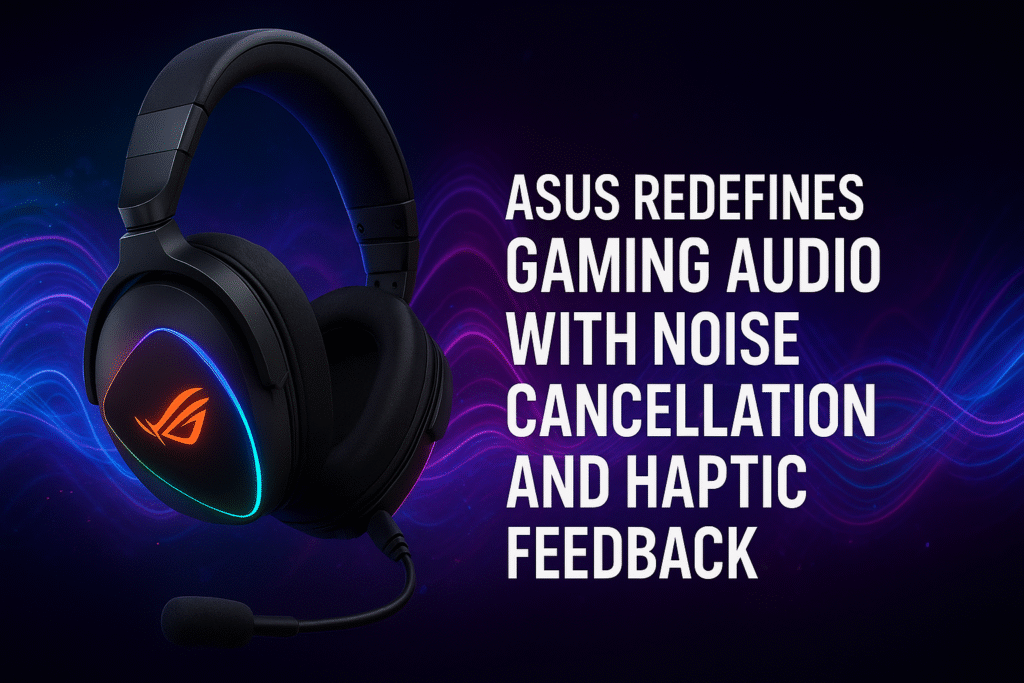
Asus’s design philosophy has always balanced aesthetics with function. Early images and leaks show a sleek, futuristic headset that mirrors the design language of the ROG Delta S — with angular earcups, customizable RGB lighting, and lightweight aluminum framing.
Comfort remains a major focus. The headsets are rumored to feature:
- Protein leather ear cushions for improved heat dissipation.
- Adjustable headbands reinforced with memory foam.
- Rotating earcups for easier portability and ergonomic fitting.
Weight reduction is also a highlight. By using composite polymer materials, Asus ensures that even with the inclusion of ANC chips, batteries, and haptic modules, the headset remains light enough for marathon sessions without neck strain.
Audio Performance and Customization
Under the hood, Asus integrates high-resolution 50mm neodymium drivers, tuned for wide dynamic range and crisp detail. The frequency response is optimized for both cinematic and competitive gaming, ensuring accurate positional sound.
But what truly makes these headsets stand out is the customization software. Through the Armoury Crate app, users can:
- Toggle ANC and haptic levels.
- Adjust EQ profiles for specific genres (FPS, MOBA, racing, RPG).
- Enable virtual 7.1 surround sound.
- Sync lighting and effects with other ROG devices.
Additionally, Asus’s AI Noise-Cancelling Microphone returns — using deep-learning algorithms to filter out keyboard clatter and background chatter while preserving natural voice tones. This makes the headset a dual powerhouse for both gaming and streaming.
Wireless Connectivity and Battery Life
Connectivity options have been expanded to match modern gaming needs. The new headsets support:
- 2.4GHz low-latency wireless mode via USB-C dongle.
- Bluetooth 5.3 for cross-platform compatibility (PC, console, mobile).
- 3.5mm analog mode for legacy systems.
Asus boasts an impressive up to 60 hours of battery life with ANC and haptics turned off, and around 40 hours with all features active. Fast-charging support provides up to 6 hours of use from a 15-minute charge — a significant advantage for mobile and tournament gamers.
Competing in a Crowded Market
The gaming audio market has seen rapid innovation from brands like SteelSeries, Corsair, Razer, and HyperX, but few have tackled the integration of both ANC and haptics in one device. Asus’s new entry puts it in direct competition with Razer Kraken V3 HyperSense and Sony’s INZONE series, but with the potential for higher precision and smarter feedback tuning.
If Asus can deliver on its promise of balanced sound fidelity and responsive haptics, it could set a new benchmark for the category. Early reviews from tech insiders suggest that the headset’s ANC performance rivals high-end lifestyle headphones, while maintaining the positional accuracy essential for eSports.
Integration with Asus’s Gaming Ecosystem
The new headsets are not isolated products — they’re part of a broader ROG ecosystem strategy. When paired with other Asus gear, such as ROG laptops, monitors, or the ROG Ally handheld, users can unlock synchronized RGB effects and profile switching.
For instance:
- Switching from desktop to handheld mode automatically toggles EQ and latency profiles.
- Using ROG Aura Sync enables unified lighting patterns across your setup.
- Integration with ROG Command Center allows quick on-the-fly adjustments without leaving your game.
This ecosystem synergy underscores Asus’s long-term vision: a seamless audio-visual environment where every device communicates intelligently with the other.
Release Date and Pricing
While Asus has not yet revealed a firm release date, industry sources hint at a Q4 2025 launch, aligning with the holiday season and upcoming gaming hardware releases.
Pricing is expected to fall between $249 and $299 USD, placing it in the premium mid-range segment, directly competing with Razer’s and SteelSeries’ flagship headsets.
Given Asus’s history of delivering top-tier build quality and software integration, this price range could represent a strong value proposition for serious gamers seeking next-generation immersion.
The Bigger Picture: The Evolution of Gaming Sound
Gaming audio is no longer just about hearing where your opponent is — it’s about feeling the world around you. Technologies like haptic feedback, 3D spatial audio, and adaptive noise control are rapidly changing how players engage with their favorite titles.
Asus’s move signals a larger industry trend: the merging of sensory and emotional realism. Just as visual fidelity has evolved from pixels to ray tracing, audio is now evolving from simple stereo cues to multi-sensory immersion.
With these headsets, Asus is not just selling hardware — it’s selling presence. The kind of presence that makes you forget you’re wearing a device at all.
Conclusion: Redefining the Future of Gaming Audio
The announcement of Asus’s new gaming headsets marks a pivotal moment for immersive gaming technology. By combining Active Noise Cancellation, Haptic Feedback, and AI-powered sound processing, Asus is redefining what it means to experience sound.
Whether you’re a professional gamer seeking a competitive edge or a casual player chasing cinematic realism, these headsets promise a transformative leap forward. If early impressions hold true, Asus may have just built the blueprint for the next decade of gaming audio innovation.
Key Takeaways
- ANC + Haptics = Total Immersion: Noise cancellation removes distractions while haptics bring physical realism.
- Cross-Platform Versatility: Works across PC, console, and mobile setups.
- AI Microphone + Custom Sound Profiles: Ideal for both competitive gaming and streaming.
- ROG Ecosystem Integration: Enhances performance and aesthetics across devices.
Asus continues to show that innovation isn’t just about more pixels or frames per second — it’s about crafting experiences that engage all the senses.