Artificial Intelligence (AI) has gone beyond being just a buzzword—it has become a core driver of how we live, work, and connect with technology. Among its many branches, contextual AI is emerging as one of the most impactful, especially when applied to wearable devices.
From smartwatches that monitor our health in real time to AR glasses capable of recognizing objects and guiding users, contextual AI is redefining what wearables can achieve. Unlike traditional AI, which relies on static inputs, contextual AI interprets data within its environment, allowing devices to adapt intelligently to changing conditions and user needs.
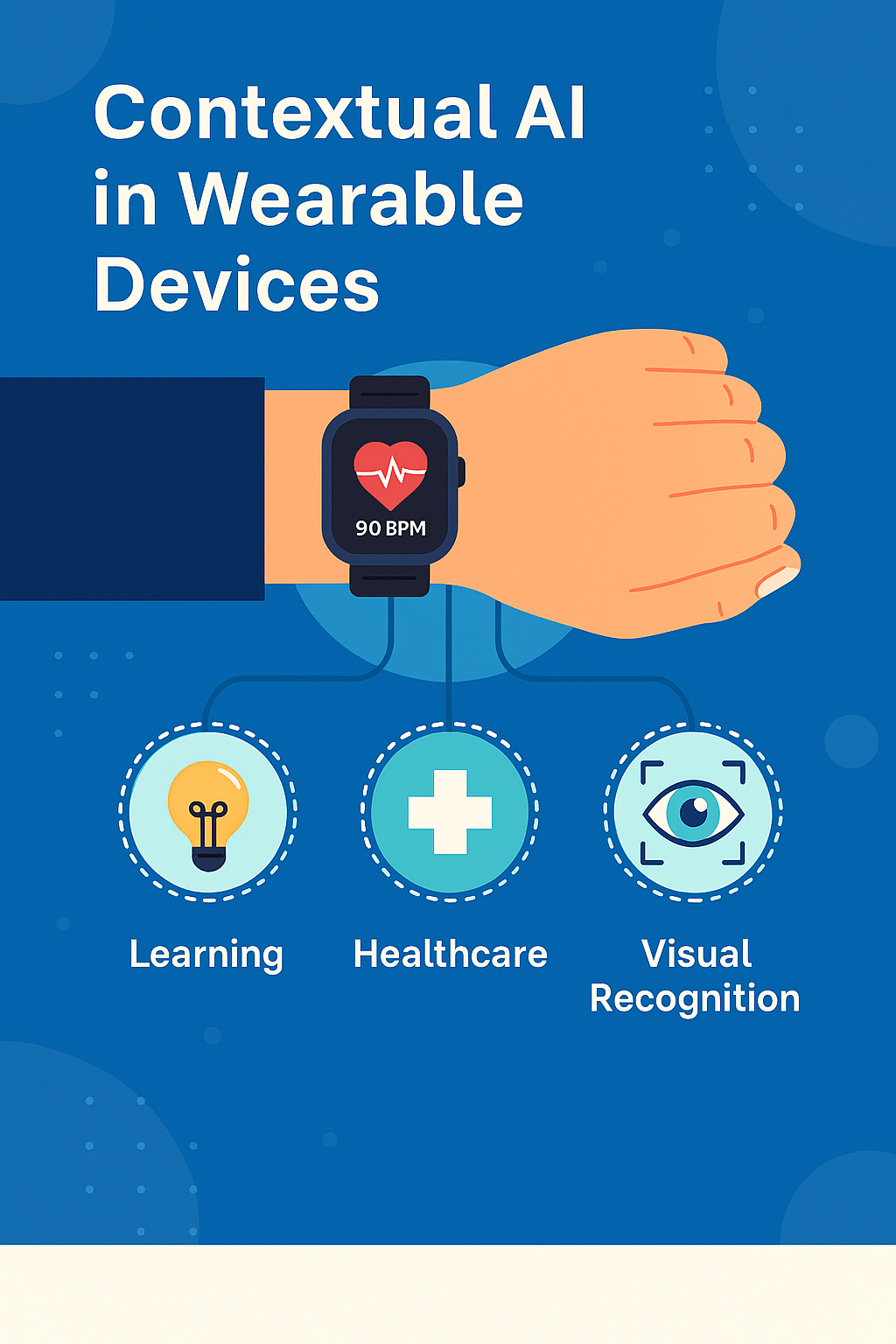
In this article, we’ll dive deep into how contextual AI is shaping wearables, with a particular focus on learning, healthcare, and visual recognition—three areas where its transformative potential is already being felt.
What is Contextual AI?
Before exploring its applications in wearables, it’s important to understand what contextual AI really means.
At its core, contextual AI processes data not in isolation but in relation to the context in which it occurs. This includes:
- Environment: The surroundings of the user (location, lighting, weather, noise).
- Behavior: The actions, habits, or routines of the user.
- Intent: What the user is likely trying to accomplish.
- History: Past interactions and preferences.
By combining these factors, contextual AI enables wearables to anticipate needs, provide proactive suggestions, and adapt dynamically. This goes far beyond basic tracking—it’s about making technology feel intuitive, personalized, and human-like.
Why Wearables are the Perfect Match for Contextual AI
Wearables are uniquely positioned to leverage contextual AI because they are always in close contact with the user. Unlike smartphones or laptops, wearables are designed to be carried on the body, making them ideal for continuous data collection.
For example:
- A smartwatch can detect heart rate, skin temperature, and movement.
- Smart glasses can process real-world visuals in real time.
- Fitness bands can recognize sleep patterns and stress levels.
- Earbuds can monitor vocal patterns, tone, and even breathing.
When combined with contextual AI, this data becomes far more actionable. Instead of simply recording stats, wearables can interpret, learn, and act, providing personalized insights and assistance.
1. Contextual AI in Learning
Education is no longer confined to classrooms. With the rise of e-learning and digital tutoring platforms, wearables are becoming important tools for personalized learning experiences. Contextual AI enhances this by adapting learning content in real time based on the user’s environment, pace, and engagement.
Adaptive Learning with Wearables
- Smart Glasses in Education: Imagine a pair of AR glasses helping a student in a biology lab. As the student looks at a specimen, the glasses identify it, display interactive diagrams, and even quiz them instantly.
- Focus Detection: Wearables can detect whether the learner is distracted or fatigued. If attention wanes, the AI can adjust by shortening content, adding visuals, or suggesting a break.
Benefits in Learning
- Personalized Tutoring: Lessons adapt to the student’s pace and comprehension.
- Hands-Free Learning: Perfect for technical skills, such as engineering or medical training.
- Gamified Learning Experiences: AI-driven AR can make complex subjects more engaging.
In short, contextual AI makes learning not only interactive but also empathetic—responding to the learner’s state rather than delivering rigid, one-size-fits-all content.
2. Contextual AI in Healthcare
Perhaps the most exciting and impactful application of contextual AI in wearables is in the healthcare sector.
Real-Time Health Monitoring
Wearables already track basic health metrics, but contextual AI pushes this further by interpreting the meaning behind the data. For instance:
- A spike in heart rate may not always indicate danger. Contextual AI can recognize if it’s due to exercise, stress, or an underlying medical issue.
- Instead of flooding users with raw numbers, AI provides actionable insights—such as suggesting hydration, calming exercises, or scheduling a doctor’s visit.
Predictive Healthcare
Contextual AI can detect early warning signs of chronic conditions by analyzing patterns over time. For example:
- Detecting irregular heart rhythms linked to atrial fibrillation.
- Identifying sleep apnea symptoms through combined breathing and movement data.
- Predicting diabetic episodes by merging glucose readings with lifestyle patterns.
Benefits in Healthcare
- Early Intervention: AI alerts doctors and patients before conditions become critical.
- Personalized Care: Recommendations based on individual context rather than generic thresholds.
- Remote Monitoring: Particularly valuable in telemedicine and eldercare.
The long-term vision? A world where wearables act as always-on health companions, reducing hospital visits, preventing emergencies, and empowering individuals to manage their well-being proactively.
3. Contextual AI in Visual Recognition
Visual recognition powered by contextual AI is revolutionizing smart glasses, AR headsets, and camera-equipped wearables.
Object & Scene Recognition
Contextual AI enables wearables to recognize objects in real time and provide relevant information. For example:
- A tourist wearing AR glasses in Paris could look at the Eiffel Tower and instantly receive historical facts, nearby restaurants, or ticket booking options.
- For industrial workers, smart glasses could identify machinery components and display step-by-step repair instructions.
Accessibility for the Visually Impaired
One of the most heartwarming applications is in assistive technology. Wearables with contextual AI can:
- Read text aloud from signs, menus, or books.
- Identify faces, emotions, and even gestures.
- Guide users safely through crowded or unfamiliar spaces.
Benefits in Visual Recognition
- Enhanced Productivity: Workers and students access information instantly.
- Improved Safety: Real-time hazard detection in industries.
- Empowerment: Helping individuals with visual impairments live more independently.
Challenges and Considerations
While contextual AI in wearables offers immense benefits, several challenges must be addressed:
- Privacy Concerns: Constant monitoring raises questions about who owns and controls the data.
- Battery Limitations: Context-aware processing demands high energy consumption.
- Accuracy & Bias: AI models must be trained inclusively to avoid biased interpretations.
- User Trust: For widespread adoption, people need confidence that AI enhances their lives without intruding on them.
Companies working in this space must prioritize data security, ethical AI, and transparent user consent.
The Future of Contextual AI in Wearables
Looking ahead, the integration of contextual AI into wearables is set to become even more seamless. Advancements in edge computing will allow faster processing directly on devices, reducing dependence on cloud servers and improving privacy.
We can also expect:
- Smarter Healthcare Ecosystems: Wearables integrated with hospitals and pharmacies for real-time treatment adjustments.
- Hyper-Personalized Learning: Devices that adapt not only to performance but also emotional states.
- Everyday AR Assistance: Glasses that overlay contextual tips in daily life, from cooking instructions to navigation.
Ultimately, contextual AI will move wearables from being passive trackers to active companions—technology that truly understands the user’s world.
Final Thoughts
Contextual AI in wearable devices represents a paradigm shift in how we interact with technology. No longer are wearables just about numbers, steps, or calories—they’re about understanding context to provide meaningful, proactive support.
Whether it’s helping students learn smarter, empowering doctors to save lives, or giving visually impaired individuals more independence, the possibilities are both practical and life-changing.As technology continues to evolve, one thing is clear: the future of wearables lies not in tracking us, but in understanding us. And that future is already unfolding through contextual AI.