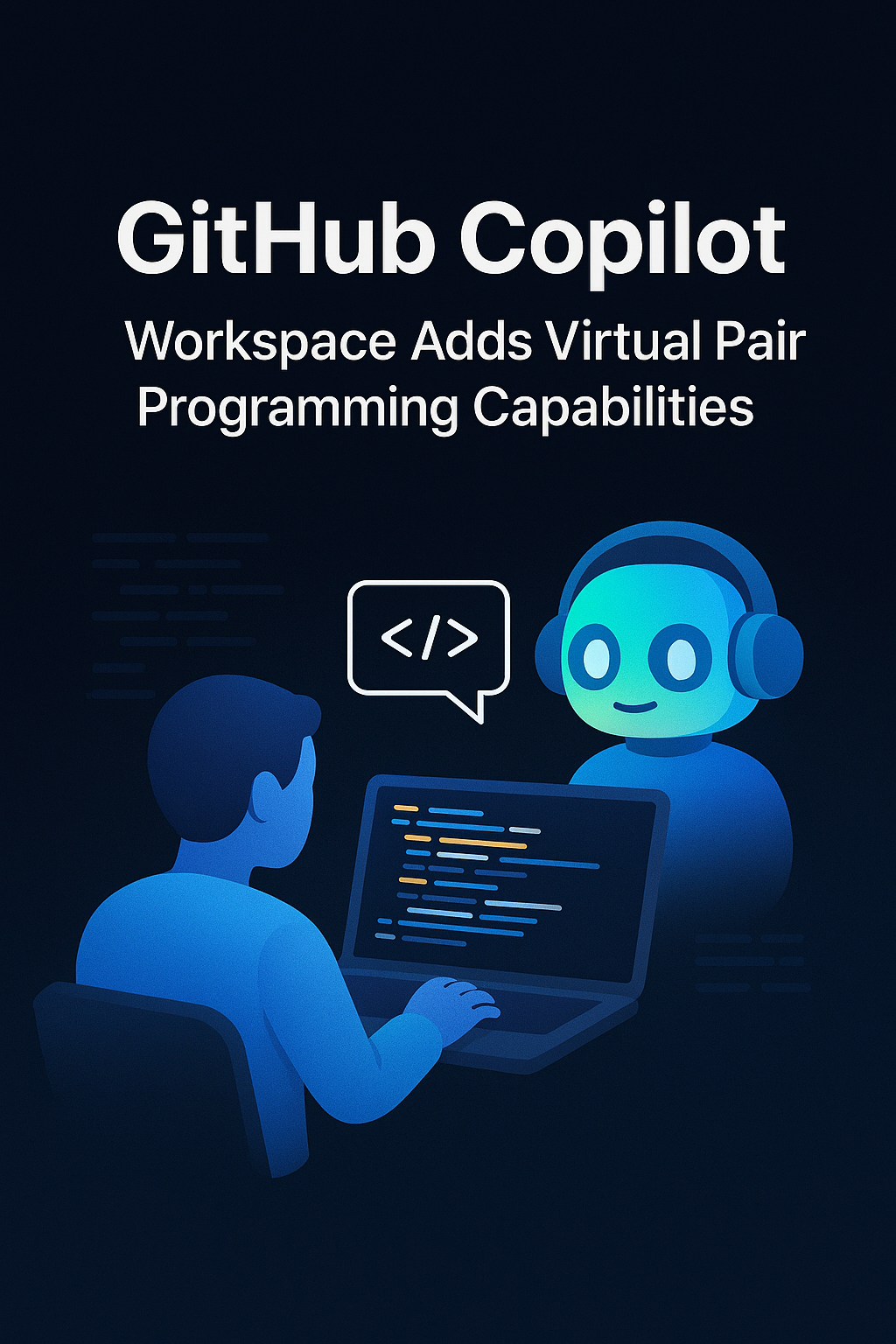
Artificial intelligence continues to reshape the software development landscape. One of the latest innovations comes from GitHub Copilot Workspace, which has introduced virtual pair programming capabilities. This update redefines how developers collaborate with AI, turning the coding assistant into a true partner rather than just a tool for autocompletion.
With this feature, GitHub Copilot Workspace extends beyond suggesting lines of code or boilerplate—it becomes an interactive collaborator that can reason about context, explain decisions, and help developers navigate the full lifecycle of programming tasks. Let’s dive into what this means for the future of coding, productivity, and team collaboration.
What Is GitHub Copilot Workspace?
GitHub Copilot Workspace is an AI-powered integrated development environment (IDE) companion designed to boost developer efficiency. While the original GitHub Copilot started as an intelligent autocomplete tool, Workspace takes things a step further. It allows developers to:
- Plan tasks by transforming plain English prompts into step-by-step coding workflows.
- Write and edit code using context-aware AI suggestions.
- Review and refactor projects with intelligent insights.
- Collaborate by explaining complex functions and suggesting improvements.
The addition of virtual pair programming is the natural next evolution, aiming to replicate the dynamic exchange between two developers working side by side.
What Is Virtual Pair Programming?
Traditionally, pair programming is a practice where two developers work together on the same code. One writes (the “driver”), while the other reviews and guides (the “observer”). This method improves code quality, fosters learning, and reduces errors.
GitHub Copilot Workspace’s virtual pair programming adapts this concept by placing AI in the observer role. Instead of passively generating snippets, the AI can now:
- Discuss coding decisions in natural language.
- Proactively point out issues like security risks, inefficient patterns, or missing documentation.
- Explain code behavior in human-like dialogue.
- Offer alternative approaches and compare trade-offs.
This makes the AI less of a tool and more of a collaborative teammate, enhancing human creativity rather than replacing it.
Key Features of GitHub Copilot’s Virtual Pair Programming
1. Conversational Collaboration
Developers can now engage in back-and-forth discussions with Copilot Workspace. Instead of only asking for code completions, they can ask:
- “Why did you suggest this method?”
- “Is there a more efficient way to implement this loop?”
- “Can you explain how this function impacts memory usage?”
The AI responds with explanations that feel more like a mentor than a machine.
2. Task-Oriented Planning
Copilot Workspace can break down a task into smaller steps. For example, if you ask:
“Build an API endpoint to fetch user profiles with authentication,”
the AI will outline:
- Set up authentication middleware.
- Create a database query function.
- Implement error handling.
- Write test cases.
This structured approach helps developers focus while ensuring no step is overlooked.
3. Error Detection and Debugging
Beyond syntax errors, Copilot’s virtual partner can:
- Detect logic flaws in the code.
- Suggest secure coding practices.
- Provide debugging strategies instead of just fixes.
For instance, if your API endpoint risks exposing user data, Copilot will raise concerns about privacy compliance.
4. Code Review Simulation
The AI can simulate a peer review, highlighting:
- Inefficient queries.
- Unclear function names.
- Missing documentation.
- Opportunities for modularization.
This aligns with industry practices where every line of code should undergo review before merging.
5. Learning-Oriented Explanations
Developers at all levels can benefit from explanations that read like tutorials. For juniors, it’s an excellent way to learn best practices. For seniors, it’s a productivity boost, as they can offload repetitive teaching tasks to AI.
How Virtual Pair Programming Impacts Developer Productivity
The shift from “code completion” to “AI collaboration” has profound implications:
- Faster Delivery: With AI breaking down tasks and suggesting optimized solutions, teams can ship features faster.
- Better Code Quality: Virtual pair programming reduces overlooked bugs and enforces best practices.
- Knowledge Sharing: AI explanations act as ongoing documentation and learning material.
- Reduced Burnout: Developers can offload routine debugging and focus on creative problem-solving.
Instead of spending hours fixing trivial mistakes, developers can lean on Copilot Workspace to maintain code health while innovating.
Real-World Use Cases
1. Startups Building MVPs
Small teams often lack bandwidth for extensive peer review. Virtual pair programming ensures quality checks without adding headcount.
2. Enterprise Teams
Large organizations can use Copilot Workspace to standardize practices across distributed teams, making sure that even new hires follow consistent coding guidelines.
3. Open Source Communities
Maintainers often face challenges reviewing countless pull requests. Copilot can pre-screen contributions, flagging potential issues before human maintainers dive in.
The Human-AI Collaboration Debate
While virtual pair programming is exciting, it raises important debates:
- Will AI replace human peer programming?
Not entirely. Human collaboration includes creativity, empathy, and domain-specific judgment that AI cannot replicate. Instead, AI enhances the process by handling repetitive and technical checks. - Is this the future of education in programming?
Yes, in many ways. New developers can learn from AI-driven explanations that supplement mentorship when senior developers aren’t available. - What about bias or inaccuracies?
As with all AI tools, accuracy depends on training data and context. Developers must remain vigilant, treating AI suggestions as guidance, not gospel.
Competitors and Industry Implications
GitHub isn’t alone in pursuing AI-driven pair programming. Tools like Replit Ghostwriter, Tabnine, and Amazon CodeWhisperer also experiment with AI collaboration. However, GitHub has the advantage of integrating directly with Visual Studio Code and the GitHub ecosystem, where most developers already spend their time.
This could give Copilot Workspace a dominant market position, much like how GitHub became the default platform for version control and collaboration.
The Future of Software Development with AI Partners
Virtual pair programming is more than a productivity hack—it signals a new era of human-AI collaboration. In the near future, we might see:
- AI-driven sprint planning, where Copilot helps prioritize features.
- Continuous learning loops, where the AI evolves with a developer’s coding style.
- Team-based AI agents, where multiple Copilots assist across different parts of a project.
The long-term impact is clear: software development will become faster, smarter, and more accessible, with AI acting as both tutor and teammate.
Conclusion
GitHub Copilot Workspace’s new virtual pair programming capabilities mark a turning point in AI-assisted coding. By moving from simple code generation to meaningful collaboration, it empowers developers to build, learn, and innovate more effectively.
Rather than replacing human creativity, this technology augments it, ensuring that developers can focus on solving real problems while the AI takes care of structure, consistency, and best practices.As adoption grows, one thing is certain: the future of programming is no longer solo—it’s human + AI, working side by side.