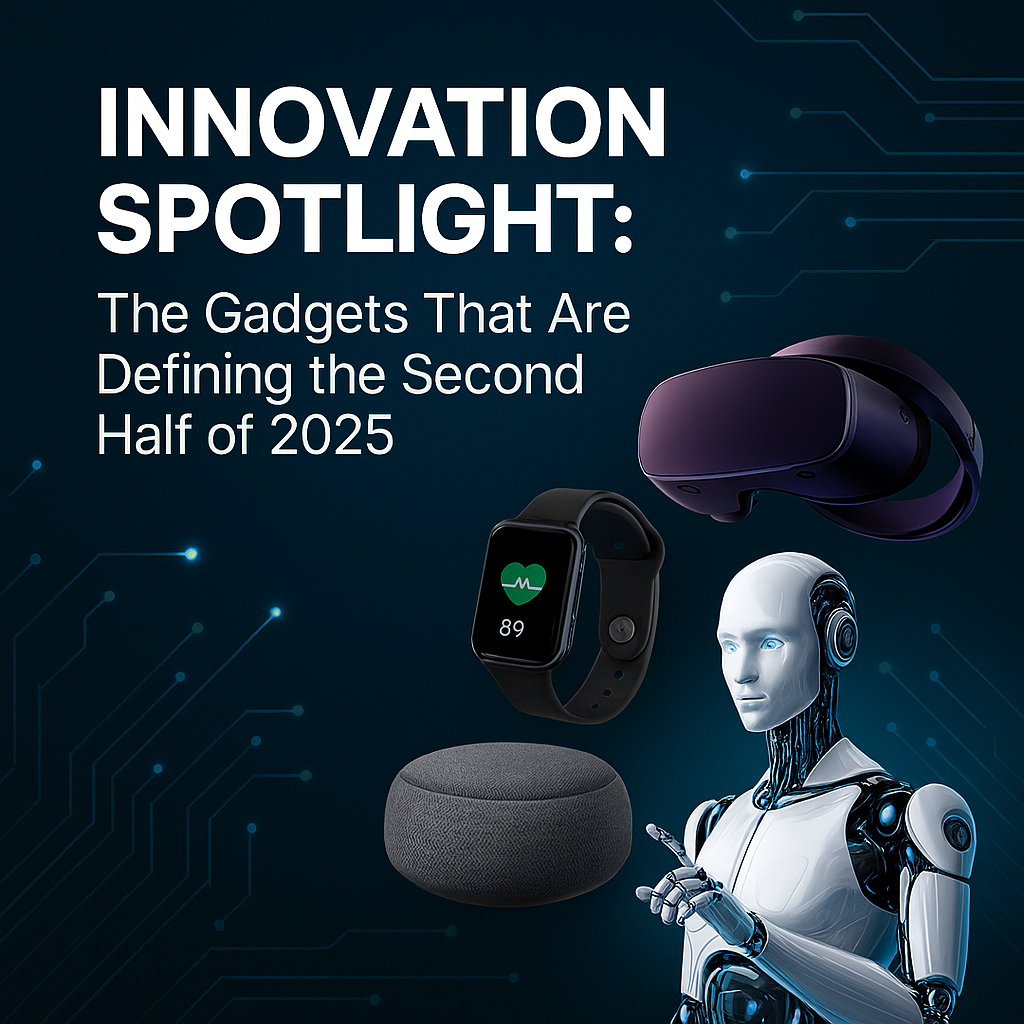
Technology in 2025 has already brought impressive breakthroughs, but the second half of the year is shaping up to be the true turning point for consumer innovation. From powerful AI-driven assistants to wearables that go far beyond step-tracking, the tech landscape is being redefined at a rapid pace. Major players like Apple, Samsung, Meta, and a handful of bold startups are pushing the boundaries of what’s possible, creating a new wave of gadgets that not only look futuristic but also transform how we live, work, and play.
In this article, we’ll shine a spotlight on the most exciting gadgets shaping the latter part of 2025, analyzing why they matter, what makes them different, and how they’re setting the stage for the next era of consumer technology.
1. AI-Powered Wearables: Beyond Fitness Tracking
Wearables are no longer just about counting steps or monitoring heart rate. The new generation of AI-powered devices is turning them into full-fledged personal assistants.
Apple Vision Band
Apple’s newest wearable, the Vision Band, bridges the gap between fitness bands and AR glasses. Unlike bulky headsets, this sleek wrist-worn device uses AI-enhanced micro-projectors to display information directly on your skin or nearby surfaces. Imagine checking your messages, calendar, or even a map projected onto your hand without lifting your phone.
Samsung BioFit+
Samsung has doubled down on health technology with the BioFit+, a smartwatch that uses real-time AI-driven diagnostics. It can analyze breathing patterns, stress levels, and even detect irregularities in blood oxygen to predict potential health risks before they escalate. Doctors are already praising its integration with telemedicine platforms, which could revolutionize preventive healthcare.
Why it matters: Wearables are transitioning into predictive health devices and contextual information hubs, reducing our dependency on smartphones while making health monitoring more proactive than ever.
2. Smart Glasses: The Next Mainstream Platform
If 2024 was the year smart glasses became viable, 2025 is when they’re truly going mainstream. The competition is heating up between Meta, Google, and traditional eyewear brands like Oakley.
Meta Horizon Glasses
Meta’s Horizon Glasses combine ultra-lightweight AR displays with seamless AI integration. They can provide real-time translations, navigation overlays, and productivity tools. A key innovation is the eye-tracking interface, which allows users to interact with menus and select options just by looking.
Oakley AR Fusion
Oakley has taken a different approach, targeting athletes and outdoor enthusiasts with the AR Fusion. These glasses provide performance metrics directly in your line of sight—perfect for cyclists, runners, and even skiers. They also integrate with AR training platforms, making workouts more interactive and data-driven.
Why it matters: Smart glasses are quickly becoming the natural successor to smartphones, offering hands-free access to information in a way that feels organic.
3. AI Companions: From Voice Assistants to Emotional Intelligence
Voice assistants like Alexa and Siri feel primitive compared to the AI companions of late 2025. These aren’t just tools; they’re contextual, adaptive, and even empathetic.
Humane AI Pin 2.0
After a rocky start in 2024, Humane’s second-generation AI Pin 2.0 is making waves. This wearable uses contextual AI to not only answer questions but also anticipate needs. For example, it might remind you to carry an umbrella when you leave the house—not just because it’s raining, but because it knows you have a long outdoor commute planned.
Replika+ Companion Device
AI companion technology has moved from smartphones into dedicated devices. The Replika+ is a pocket-sized gadget with advanced natural language processing and emotional awareness. It doesn’t just respond; it engages in conversations that feel genuinely human.
Why it matters: We’re entering a new age where AI devices are moving from being assistants to companions that adapt to our personalities, routines, and emotions.
4. Smart Home Evolution: The Era of Hyper-Automation
The smart home industry in 2025 is no longer just about controlling lights or thermostats. We’re seeing ecosystems of intelligent, self-optimizing devices that collaborate to create environments tailored to each user.
Amazon Halo Home
Amazon has expanded its smart home empire with Halo Home, a centralized AI hub that doesn’t just respond to voice commands but actively manages household energy, security, and comfort. It learns user patterns and automatically adjusts lighting, heating, and even grocery orders.
Nanoclean Air+
Clean air technology has also leaped forward with Nanoclean Air+, a smart purifier that uses nano-particle sensors to detect pollutants at a molecular level. It can differentiate between harmless dust and harmful airborne chemicals, adjusting purification intensity automatically.
Why it matters: Smart homes are moving toward fully automated living spaces, where personalization and energy efficiency take center stage.
5. Foldable & Rollable Devices: The Future of Portability
Foldables have gone from a gimmick to a serious innovation. But now, rollable devices are stepping into the spotlight.
Samsung Galaxy Z Roll
Samsung’s Z Roll introduces a rollable OLED screen that extends vertically, allowing the device to transform from a phone into a small tablet with a simple swipe. This flexibility makes it ideal for multitasking and content consumption.
Lenovo ThinkBook Roll+
Lenovo has taken the concept to laptops with the ThinkBook Roll+, which features a rollable display that expands the screen when needed but stays ultra-portable when not. It’s a productivity powerhouse for professionals on the go.
Why it matters: The future of portability is about devices adapting to us, not the other way around. Foldables and rollables are bridging the gap between mobility and functionality.
6. Gaming Gadgets: Immersive Experiences at Scale
Gaming continues to push the limits of hardware, and 2025 has brought forward devices that blur the line between reality and virtual environments.
Sony PlayStation StreamX
Sony has unveiled the PlayStation StreamX, a handheld cloud-gaming device that leverages ultra-low latency 6G connections. Players can enjoy console-quality games on the go, without bulky hardware.
HoloDeck Lite
A startup named ImmersiTech has developed the HoloDeck Lite, a compact AR/VR hybrid system that turns any room into an interactive gaming arena. With AI-driven motion tracking, it brings console-level realism to physical spaces.
Why it matters: Gaming devices are evolving into immersive platforms that redefine entertainment, blending the physical and virtual worlds seamlessly.
7. Transportation Gadgets: Smarter, Greener, Faster
Tech innovation is also transforming personal mobility. Compact, AI-driven vehicles and e-mobility solutions are becoming everyday essentials.
Tesla MicroPod
Tesla has shifted gears with the MicroPod, a compact urban vehicle powered by AI navigation. It’s designed for crowded cities, parking itself in micro-spaces and running on sustainable micro-batteries with ultra-fast charging.
Segway AeroBoard
Segway is back in the spotlight with the AeroBoard, a hoverboard-like device using magnetic levitation. Unlike the novelty boards of the past, this one prioritizes safety, stability, and long-distance travel.
Why it matters: Transportation gadgets are focusing on sustainability and urban adaptability, making them ideal for the challenges of modern cities.
8. Health & Wellness Gadgets: Merging Medicine and Lifestyle
Healthcare is one of the fastest-growing sectors for innovation in 2025. Gadgets are moving beyond fitness to become integrated medical companions.
NeuralEase Headband
The NeuralEase Headband uses neurofeedback AI to help users manage stress, insomnia, and even migraines. It monitors brainwaves and applies subtle stimulation to improve focus or relaxation.
BioPatch Pro
This adhesive wearable patch continuously monitors vital signs and delivers real-time updates to healthcare providers. It’s particularly impactful for people with chronic conditions, offering peace of mind and faster medical responses.
Why it matters: Health gadgets are redefining wellness by offering continuous, real-time care instead of occasional monitoring.
Final Thoughts: The Defining Gadgets of 2025
The second half of 2025 is not just about iterative improvements; it’s about transformational gadgets that are pushing technology into uncharted territory. From AI companions that feel human to rollable displays, smart homes that manage themselves, and transport gadgets designed for urban futures, innovation is accelerating at a pace we’ve rarely seen before.
The gadgets of today are shaping the habits, expectations, and lifestyles of tomorrow. As we close out 2025, it’s clear that this year won’t just be remembered for the devices themselves—but for the paradigm shift they represent in how humans and technology coexist.