
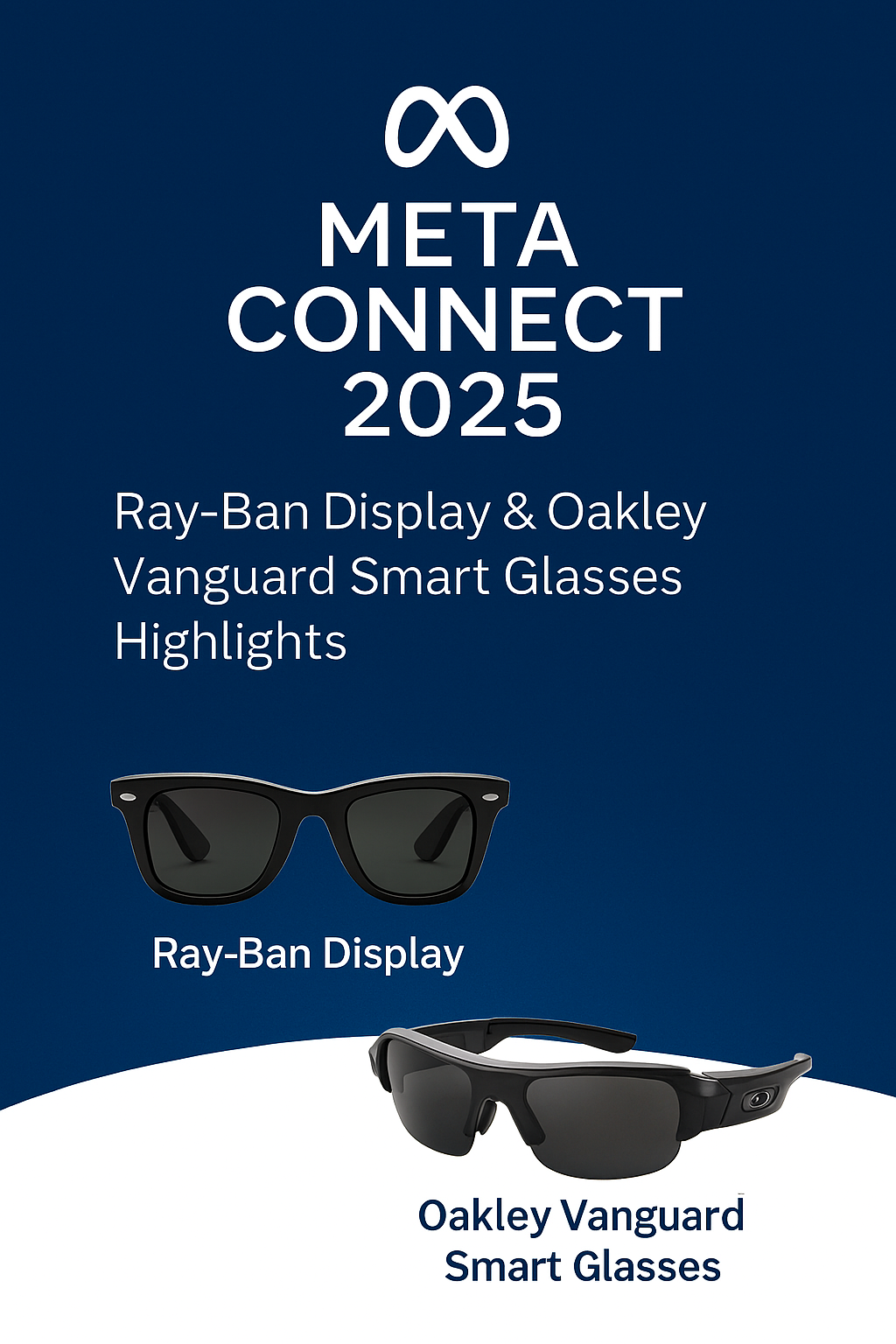
The highly anticipated Meta Connect 2025 event has once again reshaped the conversation around augmented reality (AR) and wearable technology. This year, Meta introduced two groundbreaking smart glasses in collaboration with iconic eyewear brands: the Ray-Ban Display and the Oakley Vanguard. Both models reflect how far the industry has come in merging fashion, performance, and immersive digital experiences.
In this article, we’ll break down the highlights of both devices, compare their unique features, explore their potential impact on the AR market, and analyze what this means for the future of wearable technology.
Meta Connect 2025: A Quick Overview
Meta Connect has become one of the most anticipated events in the tech calendar, rivaling even Apple’s annual product launches. Since Meta shifted its focus from purely social platforms to building the metaverse and immersive digital ecosystems, Connect has been the company’s opportunity to showcase its latest hardware and software innovations.
The 2025 edition was heavily centered on smart glasses, a category that’s been steadily gaining traction since the first Ray-Ban Stories launch in 2021. Unlike previous attempts by tech companies to push AR glasses into the mainstream, Meta’s strategy revolves around making smart eyewear fashionable, practical, and seamlessly integrated into daily life.
The Rise of Smart Glasses in 2025
Before diving into the details of Ray-Ban Display and Oakley Vanguard, it’s important to understand why smart glasses have become such a hot topic.
- Shift from novelty to necessity: Early smart glasses like Google Glass were considered futuristic gimmicks, but today’s consumers expect real utility—hands-free navigation, instant translation, seamless calls, and AR overlays.
- Integration with AI: Generative AI assistants and real-time data processing have made AR glasses smarter than ever.
- Fashion-first approach: Collaborating with Ray-Ban and Oakley ensures these devices look like stylish eyewear rather than bulky gadgets.
- Consumer lifestyle demand: Whether it’s for athletes, travelers, or professionals, smart glasses offer convenience that smartphones can’t always provide.
By 2025, the smart glasses industry is projected to reach $25 billion, and Meta is clearly positioning itself as a leader.
Ray-Ban Display: Everyday Smart AR in Style
The Ray-Ban Display is designed for the everyday consumer who wants smart features without sacrificing style.
Key Features
- Discreet AR Heads-Up Display
Unlike previous versions of Ray-Ban smart glasses, the Display introduces a subtle, high-resolution AR overlay that allows users to see contextual information such as directions, notifications, or real-time translations directly in their field of vision. - Integrated AI Assistant
Users can interact with Meta’s AI assistant using voice or discreet gestures on the temple frame. Whether it’s asking for local restaurant recommendations or controlling smart home devices, the AI feels seamless. - Improved Camera and Streaming
Building on the popularity of Ray-Ban Stories, the Display offers a dual 12MP camera system with improved stabilization for vlogging, live streaming, or capturing photos from your perspective. - Lightweight and Stylish Design
Available in Ray-Ban’s classic Wayfarer, Round, and Aviator frames, the Display looks like traditional eyewear, with only subtle hints of its tech capabilities. - Battery and Charging
With up to 8 hours of use and a redesigned charging case that doubles as a fashionable accessory, the Ray-Ban Display is meant for all-day wear.
Who It’s For
- Urban professionals who want productivity tools.
- Travelers who benefit from instant AR translation and navigation.
- Social media creators who value hands-free photo and video capture.
Oakley Vanguard: Performance Meets AR
While Ray-Ban Display focuses on lifestyle and fashion, the Oakley Vanguard is built for sports, performance, and outdoor adventure.
Key Features
- Immersive AR for Athletes
The Vanguard offers real-time performance metrics displayed directly in the user’s vision—heart rate, pace, lap time, and environmental data—ideal for cyclists, runners, and extreme sports enthusiasts. - Adaptive Lenses
Oakley’s advanced photochromic lenses automatically adjust to lighting conditions, making the glasses equally useful in bright daylight or low-light environments. - Durability & Comfort
Engineered with Oakley’s sports DNA, the Vanguard is sweat-resistant, shock-resistant, and ergonomically designed for long wear during training. - AR Training Coach
Through Meta’s AI integration, the Vanguard can act as a personal coach, providing real-time tips on posture, endurance, or pacing based on live sensor data. - Connectivity with Health Apps
It syncs seamlessly with popular health and fitness apps, ensuring that athletes can track progress and share performance metrics.
Who It’s For
- Professional athletes.
- Fitness enthusiasts.
- Outdoor adventurers and extreme sports fans.
Ray-Ban Display vs. Oakley Vanguard: Head-to-Head
| Feature | Ray-Ban Display | Oakley Vanguard |
| Design | Fashion-focused, classic frames | Sport-focused, durable, ergonomic |
| Display Type | Subtle HUD for notifications & AR | Immersive AR with performance metrics |
| Target Audience | Everyday users, creators, travelers | Athletes, outdoor enthusiasts |
| Battery Life | ~8 hours, charging case included | ~10 hours, rugged power module |
| AI Integration | Smart assistant for lifestyle & work | Real-time AR coach for training |
| Camera System | Dual 12MP with stabilization | 8MP wide-angle, optimized for motion |
Why Meta’s Dual Strategy Matters
Meta’s decision to launch two distinct models with different audiences in mind is a clever move. Previous smart glasses often failed because they tried to be “one size fits all.” By partnering with Ray-Ban for lifestyle and Oakley for sports, Meta is carving out niche markets that can eventually merge into mainstream adoption.
This strategy mirrors how smartphones evolved—early models targeted business users before expanding into consumer-friendly versions. By offering fashion + performance, Meta increases its chances of mass adoption.
The Market Impact
The Ray-Ban Display and Oakley Vanguard could significantly disrupt not just the smart glasses market, but also adjacent industries:
- Fitness wearables: Smartwatches may face competition from AR glasses that provide real-time data without needing to glance at your wrist.
- Travel tech: AR translation and navigation could replace the need for phone-based maps.
- Content creation: Influencers and vloggers may prefer hands-free recording with stylish glasses.
- Metaverse integration: Meta is slowly making AR glasses the entry point to its broader metaverse ecosystem.
If adoption scales, these glasses may become as common as wireless earbuds in a few years.
Challenges Ahead
Despite the excitement, smart glasses still face some challenges:
- Privacy concerns: Hidden cameras may raise issues in public spaces.
- Battery limitations: Even 8–10 hours may not be enough for heavy users.
- Price point: Premium eyewear with AR features may be cost-prohibitive for many consumers.
- Competition: Apple, Samsung, and other players are expected to release their own smart glasses soon.
How Meta addresses these issues will determine if the Ray-Ban Display and Oakley Vanguard become mainstream successes or niche luxuries.
Conclusion: The Future Looks Clear
The Meta Connect 2025 event marks a pivotal moment in the evolution of smart glasses. With the Ray-Ban Display redefining everyday eyewear and the Oakley Vanguard pushing performance boundaries, Meta has shown it understands that fashion, function, and personalization are key to adoption.
Both models reflect a future where digital information blends seamlessly with the physical world, opening doors to new ways of working, creating, training, and exploring.
If Meta can overcome privacy, pricing, and battery hurdles, the Ray-Ban Display and Oakley Vanguard might not just be highlights of 2025—they could represent the start of a new era in wearable technology.