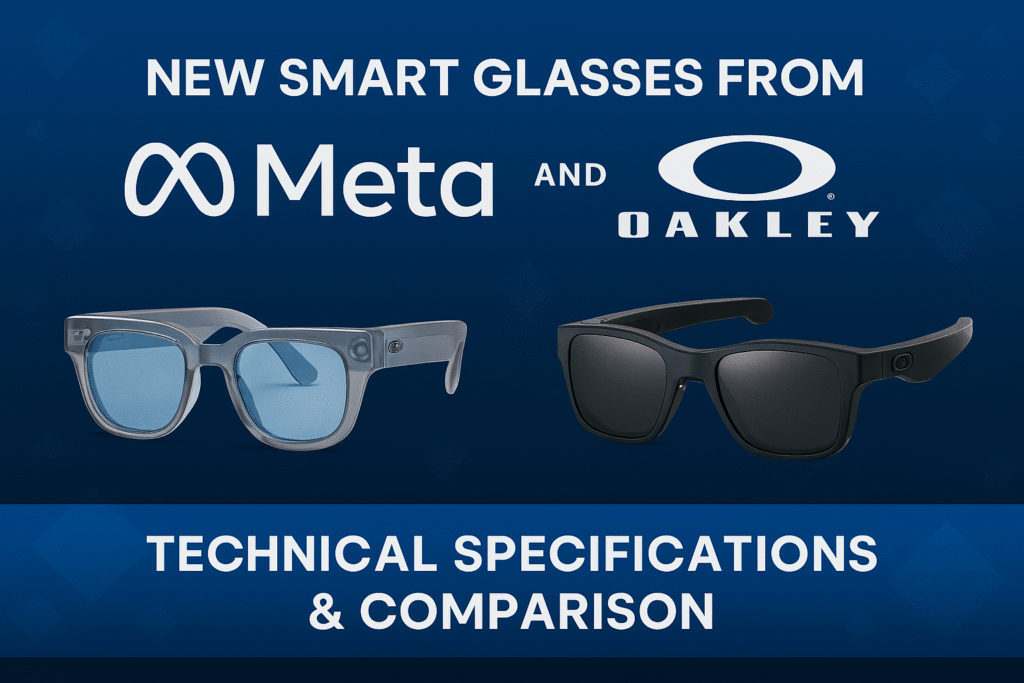
The world of wearable technology continues to evolve rapidly, and smart glasses are once again in the spotlight. In 2025, Meta and Oakley have introduced new iterations of their smart eyewear that aim to push the boundaries of what is possible in augmented reality (AR), hands-free communication, and lifestyle integration.
While Meta positions its smart glasses as part of a broader AR ecosystem, Oakley leverages its iconic brand identity and sports-focused expertise to deliver a different flavor of innovation. Both companies target slightly overlapping but distinct user bases, making a direct comparison valuable for anyone considering an upgrade to smart eyewear.
In this article, we will break down the technical specifications, unique features, and user experience of the new Meta and Oakley smart glasses. By the end, you’ll have a clear picture of how they stack up and which one might be right for you.
The Rise of Smart Glasses in 2025
Before diving into specs, it’s important to understand the current context. Smart glasses are no longer just niche tech accessories. Thanks to advancements in micro-displays, lightweight materials, and AI-driven features, they are becoming mainstream in daily life.
Key drivers of growth include:
- Seamless AR integration for entertainment, navigation, and productivity.
- Hands-free control through voice assistants and gesture recognition.
- Improved battery life compared to earlier models.
- Fashion and design — no longer bulky or “techy,” smart glasses now blend with lifestyle and fashion trends.
This is the landscape where Meta and Oakley are competing head-to-head.
Meta Smart Glasses: Technical Specifications
Meta’s latest smart glasses, part of its AR ecosystem connected to the Meta Horizon platform, focus heavily on mixed-reality experiences and social interaction.
Key Specs:
- Display Technology: Dual micro-OLED displays with 120Hz refresh rate and 1080p resolution per eye.
- Field of View (FoV): 90 degrees.
- Processor: Qualcomm Snapdragon XR2 Gen 2.
- RAM/Storage: 8GB RAM, 128GB storage.
- Audio: Open-ear directional speakers with noise suppression.
- Camera: Dual 12MP wide-angle cameras with 4K video recording at 60fps.
- Battery Life: Up to 6 hours of active use, 48 hours on standby.
- Connectivity: Wi-Fi 7, Bluetooth 5.4, seamless integration with Meta Horizon.
- Weight: 90 grams.
Standout Features:
- AR overlays for navigation and productivity (calendar reminders, to-do lists, live translations).
- Meta AI integration, enabling conversational commands and contextual assistance.
- Advanced video calling with real-time avatars and holographic projections.
- Prescription lens support, making them suitable for everyday wear.
Meta clearly wants its smart glasses to be a gateway into the metaverse, connecting social experiences, productivity tools, and entertainment.
Oakley Smart Glasses: Technical Specifications
Oakley has taken a different route, staying true to its heritage in sports and outdoor performance gear. The new Oakley Radar AR smart glasses are built for athletes, outdoor enthusiasts, and fitness-driven users.
Key Specs:
- Display Technology: Monocular micro-LED projection with adaptive brightness up to 2000 nits.
- Field of View (FoV): 40 degrees (focused on heads-up display).
- Processor: Custom low-power ARM-based chip optimized for real-time data.
- RAM/Storage: 4GB RAM, 64GB storage.
- Audio: Bone conduction audio with ambient sound passthrough.
- Camera: 8MP front-facing camera for quick snapshots and live-streaming.
- Battery Life: 10 hours of continuous fitness tracking or 72 hours on standby.
- Connectivity: Bluetooth 5.3, ANT+ for fitness sensors, GPS.
- Weight: 65 grams (lightweight frame for sports).
Standout Features:
- Sports performance metrics in real time (heart rate, pace, distance, cycling power).
- Augmented training modes, displaying workout targets directly in your field of vision.
- Integration with fitness platforms like Strava, Garmin, and Oakley’s own training app.
- Polarized and photochromic lenses for outdoor visibility.
- Sweat-resistant and ruggedized frame for extreme conditions.
Oakley’s glasses are less about social AR and more about enhancing athletic performance.
Meta vs Oakley: Head-to-Head Comparison
Now let’s break down the key differences between Meta’s smart glasses and Oakley’s new offering.
| Feature | Meta Smart Glasses | Oakley Smart Glasses |
| Target Audience | AR enthusiasts, professionals, social users | Athletes, outdoor enthusiasts, fitness users |
| Display | Dual micro-OLED, 1080p, 120Hz | Monocular micro-LED, adaptive brightness |
| Field of View | 90° wide FoV | 40° focused HUD |
| Processor | Snapdragon XR2 Gen 2 | Custom ARM sports chip |
| Audio | Open-ear directional | Bone conduction |
| Camera | Dual 12MP, 4K60 video | 8MP, photos & basic video |
| Battery Life | ~6 hours active use | ~10 hours tracking |
| Weight | 90g | 65g |
| Specialization | Social AR, productivity, entertainment | Fitness tracking, outdoor visibility |
User Experience & Ecosystem
- Meta shines in social integration. Imagine walking down the street and seeing AR messages from friends pop up, joining a video call with holographic presence, or navigating a city with immersive overlays. These glasses are about blending the digital with the real.
- Oakley, meanwhile, delivers utility-driven performance. A cyclist can see their wattage and heart rate without looking down. A runner can track their pace in real time. And thanks to Oakley’s expertise in lenses, outdoor visibility is unmatched.
Which One Should You Choose?
- If you’re deep into the digital ecosystem, want AR for productivity, entertainment, and social connectivity, Meta is the clear winner.
- If you’re a serious athlete or outdoor enthusiast looking for lightweight, durable, and performance-oriented eyewear, Oakley’s smart glasses are a better fit.
Some users may even find themselves owning both — Meta glasses for daily and professional use, and Oakley glasses for training and outdoor activities.
The Future of Smart Eyewear
Both Meta and Oakley are contributing to the evolution of smart glasses, but from different angles. What we see is a diversification of wearable tech, where smart eyewear is no longer one-size-fits-all. Instead, users can choose based on lifestyle — just as you would pick between a smartwatch optimized for health tracking or one designed for productivity.
Looking ahead, we can expect:
- Lighter, more discreet frames with extended battery life.
- Improved prescription lens integration.
- AI-driven personalization, where your glasses learn from your habits.
- Cross-platform compatibility, bridging fitness, work, and entertainment seamlessly.
Final Thoughts
The release of new smart glasses from Meta and Oakley in 2025 marks a pivotal moment in wearable technology. While Meta focuses on immersive AR and social experiences, Oakley doubles down on athletic performance and outdoor utility.Both approaches demonstrate how wearable technology is diversifying, moving from experimental to essential. Whether you’re a tech enthusiast seeking digital connectivity or an athlete chasing performance, there is now a smart eyewear solution tailored just for you.