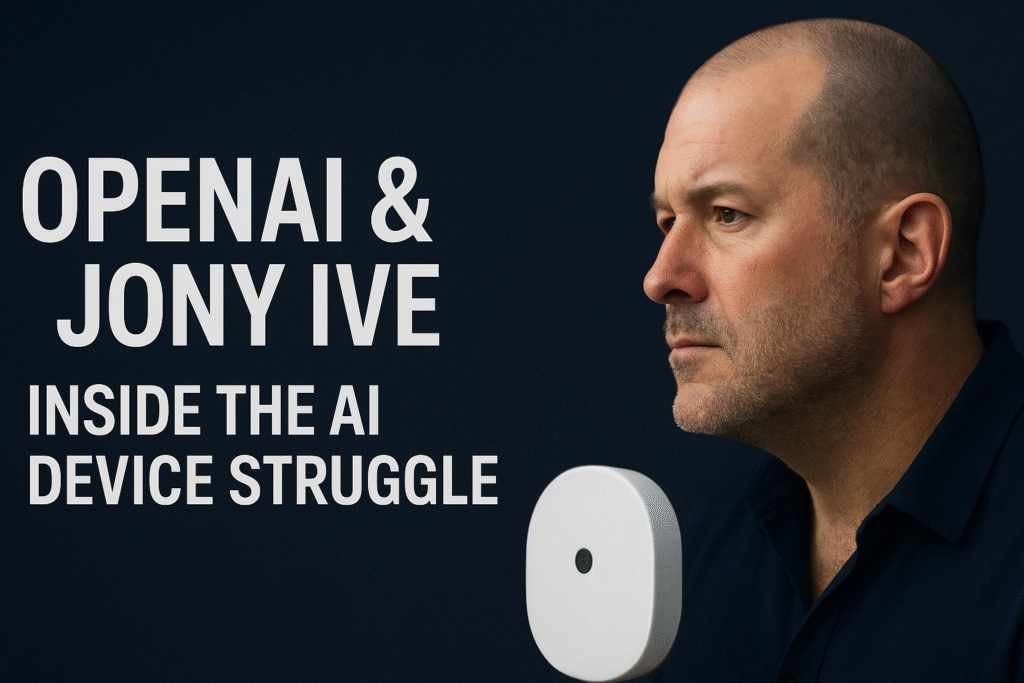
OpenAI’s ambitious partnership with legendary designer Jony Ive aims to redefine how humans interact with artificial intelligence — moving beyond screens and into everyday physical experiences. Yet, despite its potential to reshape the industry, the project is already running into significant technical and design obstacles that threaten to delay its release.
The device, which has been described as a “screenless AI companion”, is meant to blend seamlessly into a user’s environment, always aware, always responsive — but never intrusive. Achieving that balance, however, is proving to be far more complex than anyone anticipated.
In this in-depth analysis, we’ll break down what’s known about the project, the main technical hurdles OpenAI and Jony Ive’s team are facing, and what these challenges reveal about the future of AI-driven hardware.
What We Know So Far
The project came to light after several strategic moves by OpenAI in 2025.
- In May 2025, OpenAI acquired the design startup “io,” founded by Jony Ive through his design firm LoveFrom, in a deal reportedly worth around $6.5 billion. The goal: to create physical AI products that extend OpenAI’s software capabilities into hardware.
- Sources familiar with the matter describe the upcoming device as palm-sized, screenless, and equipped with cameras, microphones, and sensors to interpret its surroundings and respond intelligently.
- Unlike wearables such as smart glasses or earbuds, this device is expected to occupy a new category — not something you wear, but something that exists within your physical space, almost like a digital presence.
- The original target release date was 2026, but internal reports suggest the project might face delays due to unresolved engineering and design challenges.
The Core Technical Challenges
OpenAI’s AI-driven hardware faces a convergence of software, design, and ethical challenges. Here are the most critical ones:
1. Defining the AI’s Personality and Human Interaction
One of the hardest challenges isn’t hardware — it’s human behavior.
OpenAI’s engineers and Ive’s design team are struggling to define what kind of “personality” this AI should have. The goal is to make it warm, helpful, and intelligent — but not creepy, robotic, or overly human-like.
The AI must know:
- When to speak up and when to remain silent.
- How to end conversations gracefully.
- How to sound empathetic without faking emotions.
Finding this delicate balance between emotional intelligence and artificial precision is something no tech company has fully mastered yet. As one insider put it, “You don’t want an AI that feels like your weird digital girlfriend — but you also don’t want it to sound like a customer service bot.”
These subtleties make designing the interaction model a massive challenge, especially in a device that relies solely on voice and environmental sensing — no screen, no visual interface, no fallback cues.
2. Privacy and Always-On Data Collection
Perhaps the most controversial challenge is privacy.
The device is reportedly designed to be always listening and observing, continuously collecting context from its surroundings. It must recognize sounds, faces, objects, and even emotional tone — all without violating user trust.
That’s a monumental task.
To succeed, OpenAI must:
- Guarantee local processing of sensitive data whenever possible.
- Ensure strong encryption and transparent user control.
- Offer clear ways for users to pause or disable recording functions.
- Prevent misuse or unauthorized access, especially since microphones and cameras would be active most of the time.
Any misstep could spark public backlash similar to what Humane’s AI Pin or Amazon’s Alexa faced over privacy concerns.
OpenAI is under pressure to prove that a truly “ambient” AI can exist without becoming a surveillance tool.
3. Computing Power and Real-Time Responsiveness
Building a truly context-aware AI companion means running complex models that can:
- Understand speech instantly.
- Recognize faces, environments, and gestures.
- Respond naturally and quickly — ideally, in under a second.
That requires significant processing power — but fitting that into a small, battery-powered device is extremely difficult.
If the device relies heavily on cloud processing, it introduces latency and potential privacy risks. If it tries to do too much locally, it faces battery drain, overheating, and size constraints.
OpenAI reportedly wants a balance between on-device AI inference (using optimized chips) and cloud assistance for heavy computations — similar to what Apple and Google are doing with their hybrid AI systems.
However, designing such a seamless system for a new hardware platform is a technical mountain to climb.
4. Screenless Design and User Interface Challenges
Without a screen, the device must rely entirely on voice, audio, gestures, and environmental sensing to interact. That’s not just a UI challenge — it’s a complete rethinking of human-computer interaction.
Jony Ive’s design philosophy emphasizes simplicity and “invisible technology,” but even he has admitted that screenless interaction is tricky. How does a user know if the AI understood them? How can it give feedback without becoming annoying or invasive?
Some potential approaches include:
- Subtle sound design (tones, ambient cues).
- Light indicators or minimal haptic feedback.
- Dynamic voice modulation to convey state or emotion.
But every design choice here is critical. Too little feedback, and the device feels unresponsive; too much, and it becomes irritating. Finding that balance is a design problem that blends psychology, ergonomics, and machine learning.
5. Manufacturing and Scalability
Even if OpenAI solves the technical and interaction challenges, manufacturing poses another major obstacle.
The company would need to source specialized sensors, microphones, and processors — all while maintaining the design standards associated with Jony Ive’s products.
Mass-producing such a device at a reasonable cost, while ensuring durability and quality, will test OpenAI’s supply-chain and manufacturing partnerships.
This is especially complex for a company that has never built consumer hardware at scale. OpenAI may need to rely heavily on partners such as Apple’s former suppliers, Foxconn, or other established OEMs, which introduces logistical and strategic dependencies.
Why the Delay Makes Sense
Originally slated for release in 2026, the device now appears to be facing delays — and that’s probably a good thing.
Rushing a product of this magnitude could result in public disappointment, similar to what happened with Humane’s AI Pin or Rabbit’s R1. Both products promised revolutionary AI interactions but ultimately fell short due to technical flaws and poor user experience.
For OpenAI and Ive, expectations are astronomically high. A failed first impression could damage OpenAI’s reputation in the consumer market — something Sam Altman can’t afford as he positions the company as the leader of the “post-smartphone” era.
Taking extra time to refine the AI personality, privacy model, and hardware performance might be the only way to ensure the device feels genuinely magical instead of experimental.
Possible Solutions OpenAI Could Pursue
To overcome these hurdles, OpenAI may pursue several strategic directions:
- User Testing and Iterative Design
- Conducting real-world tests to refine the assistant’s tone, proactivity, and conversational flow.
- Using human feedback to calibrate how “alive” or “passive” the AI should feel.
- Conducting real-world tests to refine the assistant’s tone, proactivity, and conversational flow.
- Hybrid Cloud and Edge Computing
- Running essential AI models locally for speed and privacy, while offloading heavy processing to the cloud.
- Developing custom silicon chips optimized for AI inference, possibly through partnerships with NVIDIA, AMD, or Apple’s chip engineers.
- Running essential AI models locally for speed and privacy, while offloading heavy processing to the cloud.
- Privacy by Design
- Implementing physical privacy switches (like camera shutters or mic cut-offs).
- Providing granular data control — letting users see, delete, or restrict what the device records.
- Implementing physical privacy switches (like camera shutters or mic cut-offs).
- Elegant, Ergonomic Hardware
- Leveraging Jony Ive’s expertise in materials, form, and tactile design to make the device comfortable, beautiful, and discreet.
- Ensuring passive cooling and minimal weight while integrating multiple sensors.
- Leveraging Jony Ive’s expertise in materials, form, and tactile design to make the device comfortable, beautiful, and discreet.
- Strategic Partnerships
- Partnering with manufacturers for mass production.
- Collaborating with other AI ecosystem players for compatibility (e.g., OpenAI’s ChatGPT voice system or GPT-powered API integrations).
- Partnering with manufacturers for mass production.
The Bigger Picture: The Future of Ambient AI
What OpenAI and Ive are building may represent the next major leap after the smartphone — a world where AI exists around us, not confined to screens.
This vision aligns with the growing concept of ambient computing, where technology fades into the background and interactions become fluid, context-driven, and natural.
But such a vision also raises deep questions:
- Can AI exist in our lives without eroding privacy?
- Can it feel “human” without becoming unsettling?
- And can hardware design keep up with the demands of powerful, ever-learning models?
These are not just engineering questions — they’re philosophical ones.
Conclusion
OpenAI and Jony Ive’s portable AI device represents one of the most ambitious intersections of design, ethics, and technology in recent years. The vision is bold: an intelligent, ever-present assistant that transcends screens, built by the world’s leading AI company and one of the greatest industrial designers alive.
Yet, ambition alone isn’t enough. The road ahead is littered with technical challenges — from AI personality tuning and privacy architecture to power efficiency and screenless UX design.
If OpenAI manages to overcome these hurdles, the result could be a revolutionary product category — something that redefines human-AI interaction for the next decade.
But if it fails, it may join a growing list of AI hardware experiments that promised too much, too soon.
Either way, the journey itself marks a pivotal moment in the evolution of technology: where intelligence finally begins to live outside the screen — and, perhaps one day, alongside us.