
The transition to renewable energy is no longer a distant goal—it’s a global necessity. As solar panels and wind turbines become increasingly common, the next challenge is clear: how do we store this clean energy efficiently for times when the sun isn’t shining, or the wind isn’t blowing? Enter redox flow batteries (RFBs), a technology that is emerging as one of the most promising solutions for sustainable energy storage.
In this article, we’ll explore how redox flow batteries work, why they are gaining attention, their advantages over conventional batteries, the latest advancements in efficiency, and their role in creating a more resilient, sustainable energy future.
What Are Redox Flow Batteries?
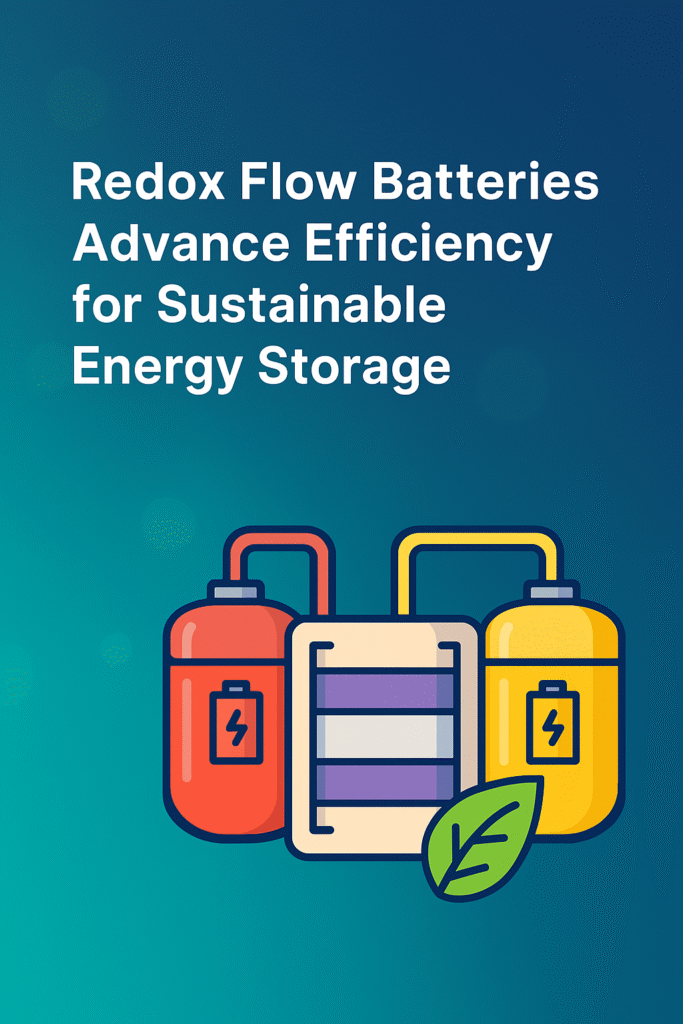
At their core, redox flow batteries are electrochemical energy storage systems. Unlike lithium-ion or lead-acid batteries, which store energy in solid electrodes, redox flow batteries store energy in liquid electrolytes. These electrolytes are typically stored in external tanks and pumped through electrochemical cells where energy conversion takes place.
The term “redox” refers to the chemical reduction and oxidation reactions that occur during charging and discharging. The size of the tanks determines the energy capacity, while the number of electrochemical cells defines the power output. This separation of power and capacity is one of the unique features that sets RFBs apart from other battery technologies.
Why Do We Need Better Energy Storage?
Renewable energy sources like wind and solar are intermittent by nature. While they can generate clean electricity, their output doesn’t always match demand. Effective energy storage systems must:
- Balance supply and demand – Store excess power when generation is high and release it when needed.
- Stabilize the grid – Prevent blackouts and fluctuations.
- Reduce reliance on fossil fuels – Replace backup generators with clean storage.
- Enable long-duration storage – Power communities for hours, days, or even weeks.
Traditional batteries, like lithium-ion, dominate the market today but face challenges such as limited lifespan, safety risks, and high costs when scaled for grid-level applications. Redox flow batteries aim to solve many of these problems.
How Redox Flow Batteries Work
Here’s a simplified breakdown of their operation:
- Electrolyte Storage Tanks: Two large tanks hold liquid electrolytes, often containing vanadium or other redox-active materials.
- Electrochemical Cell Stack: Pumps circulate the electrolytes through cell stacks where redox reactions occur.
- Energy Conversion: When charging, electrical energy drives chemical reactions in the electrolytes. During discharging, the reactions reverse, releasing electricity back to the grid.
This architecture means that scaling energy storage capacity is as simple as increasing the size of the tanks—without modifying the core cell stack.
Advantages of Redox Flow Batteries
RFBs bring several advantages that make them particularly suited for renewable integration and large-scale energy projects:
- Scalability
Capacity can be increased by enlarging the electrolyte tanks, making RFBs highly adaptable to both small and utility-scale needs. - Long Lifespan
Unlike lithium-ion batteries that degrade after a few thousand cycles, redox flow batteries can last for decades with minimal capacity loss. - Safety
The aqueous electrolytes used in many RFBs are non-flammable, significantly reducing the risk of fires and explosions. - Flexible Power and Energy Sizing
Power (cell stacks) and energy (tank size) are independent, allowing tailored designs for specific applications. - Sustainability
Some RFB chemistries, especially those using vanadium or organic electrolytes, offer recyclable and environmentally friendly options.
Recent Advancements in Efficiency
Historically, one of the main criticisms of redox flow batteries was their relatively low energy efficiency compared to lithium-ion systems. However, recent research and innovations are closing that gap.
- Improved Electrolytes: Advances in vanadium and organic-based electrolytes have enhanced conductivity and reduced energy losses.
- Membrane Innovations: Next-generation membranes minimize crossover between electrolytes, improving cycle efficiency.
- Cost Reduction: Researchers are developing cheaper alternatives to vanadium, such as iron or organic compounds, which lower material costs.
- Hybrid Systems: Combining RFBs with other storage technologies allows for optimized energy management.
Today, redox flow batteries are reaching round-trip efficiencies of 75–85%, making them competitive with other long-duration storage solutions.
Applications of Redox Flow Batteries
The versatility of RFBs makes them useful across various sectors:
- Grid-Scale Storage
Utility companies use RFBs to balance renewable generation and ensure consistent electricity supply. - Microgrids and Remote Communities
Off-grid locations benefit from RFBs’ durability and low maintenance, reducing reliance on diesel generators. - Commercial and Industrial Facilities
Businesses adopt RFBs to reduce peak demand charges and increase energy resilience. - Renewable Integration
Solar farms and wind parks can pair with RFBs to provide steady, dispatchable power.
Redox Flow vs. Lithium-Ion Batteries
To understand the growing interest in RFBs, it helps to compare them directly with lithium-ion batteries:
| Feature | Redox Flow Batteries | Lithium-Ion Batteries |
| Scalability | Easy (tank size) | Limited, costly |
| Lifespan | 20+ years, 10k+ cycles | 5–10 years, 2–3k cycles |
| Safety | Non-flammable | Risk of thermal runaway |
| Efficiency | 75–85% | 85–95% |
| Energy Density | Lower | Higher |
| Best Use Case | Grid storage, renewables | Portable electronics, EVs |
While lithium-ion remains ideal for high-energy-density applications like smartphones and electric vehicles, redox flow batteries excel in large, stationary energy storage projects.
Challenges and Limitations
Despite their potential, redox flow batteries are not without challenges:
- Lower Energy Density: RFBs require larger physical footprints compared to lithium-ion.
- High Initial Costs: Vanadium-based systems can be expensive due to raw material costs.
- Technology Maturity: While proven, RFBs are still less commercially established than lithium-ion.
However, ongoing research is addressing these hurdles, making RFBs more competitive each year.
The Future of Redox Flow Batteries
As the world pursues net-zero emissions, the demand for long-duration, safe, and cost-effective energy storage is growing rapidly. Governments, universities, and private companies are investing heavily in RFB research and pilot projects.
The future may include:
- Widespread deployment in renewable-powered grids
- Hybrid storage ecosystems that combine RFBs, lithium-ion, and hydrogen
- Affordable, sustainable chemistries using organic and earth-abundant materials
- Integration with smart grids and AI-driven energy management systems
Redox flow batteries may not replace lithium-ion in every scenario, but they are poised to play a critical role in enabling 24/7 renewable energy.
Conclusion
Redox flow batteries represent a game-changing technology for the clean energy transition. Their scalability, safety, long lifespan, and sustainability make them uniquely suited to address the challenges of storing intermittent renewable power.
While efficiency and costs remain areas of active development, advancements are rapidly pushing RFBs into mainstream adoption. As nations work to decarbonize their power sectors, redox flow batteries could very well become the backbone of a resilient, sustainable, and renewable-driven energy grid.
In short: Redox flow batteries are not just an alternative—they are a cornerstone for the future of sustainable energy storage.