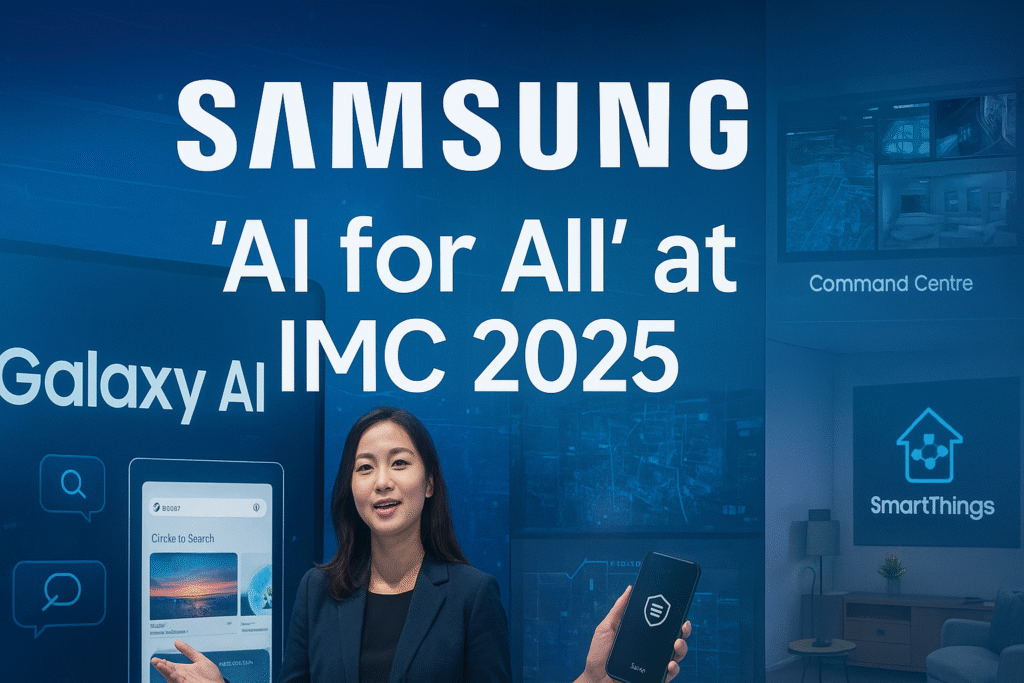
At the India Mobile Congress (IMC) 2025, Samsung unveiled its bold new vision for the future of technology — “AI for All.” This initiative isn’t just about showing off what artificial intelligence can do; it’s about making AI practical, accessible, and meaningful for everyone.
Samsung’s IMC 2025 exhibit emphasized how the company plans to democratize AI across devices, homes, schools, networks, and cities. Through five immersive zones, the company illustrated how AI can enhance human lives at every level — from personal productivity to national infrastructure.
What “AI for All” Really Means
“AI for All” is more than a marketing slogan. It represents Samsung’s long-term mission to bring the power of AI to everyone, regardless of their income, profession, or geography. The goal: make AI intuitive, responsible, and integrated into everyday life — not just an elite technology.
At IMC 2025, Samsung emphasized that true AI innovation isn’t about complex systems, but about useful, secure, and human-centered experiences. From smartphones to classrooms and smart cities, the company showcased how its ecosystem of devices and software collaborate to make AI more inclusive.
The Five Immersive Zones at IMC 2025
Samsung divided its exhibit into five experience zones, each dedicated to a different aspect of its “AI for All” vision.
| Zone | Focus Area | Key Highlights |
| Galaxy AI Zone | Everyday productivity & communication | Features like Live Translate, Note Assist, and Circle to Search showcased on Galaxy S25 Ultra, Z Fold7, and Z Flip7. The Galaxy Watch7 and Buds3 Pro also demonstrated personalized health and audio AI experiences. |
| Command Centre Zone | Smart cities & security | Showcases Samsung’s Knox platform for AI-powered security, urban management, and real-time analytics for safer, more efficient city operations. |
| SmartThings Zone | Smart homes & sustainability | Demonstrates how SmartThings unites home devices, appliances, and sensors to create connected, energy-efficient living spaces. |
| AI for Education Zone | Digital education & inclusivity | Focuses on using Galaxy devices and AI tools to enhance digital literacy, personalized learning, and accessibility in schools. |
| Samsung Network Zone | AI-driven 5G networks | Highlights next-gen telecom solutions using AI for improved connectivity, latency, and scalability — the backbone of Samsung’s AI ecosystem. |
Key Technologies and Products
At IMC 2025, Samsung showcased a lineup of products that bring its AI vision to life:
- Galaxy S25 Ultra, Z Fold7, and Z Flip7: Flagship devices equipped with Galaxy AI features like real-time translation, context-aware assistance, and intuitive search.
- Galaxy Watch7 and Buds3 Pro: Integrate AI to deliver personalized fitness tracking, adaptive sound, and seamless cross-device experiences.
- SmartThings Platform: Acts as the central hub for connected devices, optimizing energy consumption and automating daily tasks with user-friendly AI.
These innovations aren’t isolated; they form a unified AI ecosystem, built to adapt intelligently across every aspect of digital living.
Why “AI for All” Matters Now
Samsung’s timing couldn’t be more strategic. The world is witnessing a major shift toward AI-driven lifestyles, and accessibility is the next frontier. Several factors explain why “AI for All” is relevant today:
- Growing demand for accessible AI:
Consumers expect smarter devices — translators, assistants, automation — but want these features available across all price points, not just premium models. - Advancements in connectivity:
With 5G and edge computing expanding globally, real-time AI interactions are finally practical and scalable. - Sustainability and efficiency:
AI can help optimize energy use, automate home systems, and reduce waste — aligning with global sustainability goals. - Government and educational initiatives:
Countries like India are investing heavily in digital literacy and inclusion. Samsung’s educational AI programs position the brand as a key partner in those efforts. - Competitive ecosystem pressure:
As rivals like Apple, Google, and Huawei push their own AI ecosystems, Samsung aims to differentiate by combining hardware excellence with inclusive, cross-device intelligence.
Challenges Samsung Must Overcome
While the “AI for All” vision is inspiring, it comes with major hurdles:
1. Data Privacy and Security
AI relies heavily on personal data — from voice to health to home activity. Samsung must ensure end-to-end encryption and transparent data policies, especially for SmartThings and health tracking.
2. Accessibility and Affordability
Making AI inclusive means bringing intelligent features to mid-range and budget devices. Otherwise, “AI for All” risks remaining a luxury concept.
3. Infrastructure Gaps
AI-based services need strong internet and 5G support. Many regions still lack consistent coverage, limiting the real-world usability of these innovations.
4. Localization and Language
AI translation, voice recognition, and assistants must work across regional accents, dialects, and languages to be truly inclusive — particularly in multilingual countries like India.
5. Environmental Sustainability
Constantly upgrading devices and servers for AI workloads increases energy use. Samsung’s SmartThings and Galaxy sustainability initiatives will need to balance performance with ecological responsibility.
6. Ethical and Regulatory Compliance
As global AI laws evolve, Samsung will face increasing scrutiny over transparency, explainability, and algorithmic fairness in its AI systems.
The Real-World Impact of “AI for All”
If Samsung successfully delivers on this initiative, its effects could be transformative across multiple sectors:
- Education: Personalized tutoring, real-time translation, and accessibility tools can empower both students and teachers, especially in underserved communities.
- Healthcare and Wellness: AI-driven wearables can detect early signs of health issues, encourage preventive care, and tailor fitness plans to each user.
- Smart Homes: Energy-saving automation, predictive maintenance, and cross-device connectivity create safer, more sustainable living environments.
- Smart Cities: AI-powered traffic control, public safety systems, and waste management could make urban living more efficient and responsive.
- Digital Inclusion: Affordable AI tools can bridge gaps in access to education, employment, and essential services for marginalized populations.
What to Watch Next
To evaluate whether Samsung’s “AI for All” goes beyond the stage demo, these are the key indicators to monitor in the coming months:
- Launch timelines and global availability — Will these AI features expand beyond India into markets like Latin America and Europe?
- Affordability — Can mid-range and entry-level Galaxy devices deliver meaningful AI capabilities?
- Software updates — Will older Galaxy models receive AI updates, extending the ecosystem’s reach?
- Privacy and compliance standards — How will Samsung handle sensitive data in regions with strict AI and data laws?
- Localization — Will AI features adapt to local languages, accents, and user needs in non-English-speaking markets?
- Sustainability metrics — How efficiently will AI features use power, bandwidth, and device resources?
Final Thoughts
Samsung’s “AI for All” initiative at IMC 2025 is a powerful statement about the future of artificial intelligence — one where technology serves people, not the other way around. The company’s approach, spanning personal devices, education, smart homes, and connected cities, positions it as a leader in responsible, inclusive innovation.
But success will depend on how effectively Samsung turns these demos into real, accessible products that respect privacy, operate sustainably, and serve users across all economic levels.
If Samsung delivers on this promise, “AI for All” could redefine the role of technology in society — shifting AI from a luxury feature to a universal tool for empowerment, learning, and human connection.