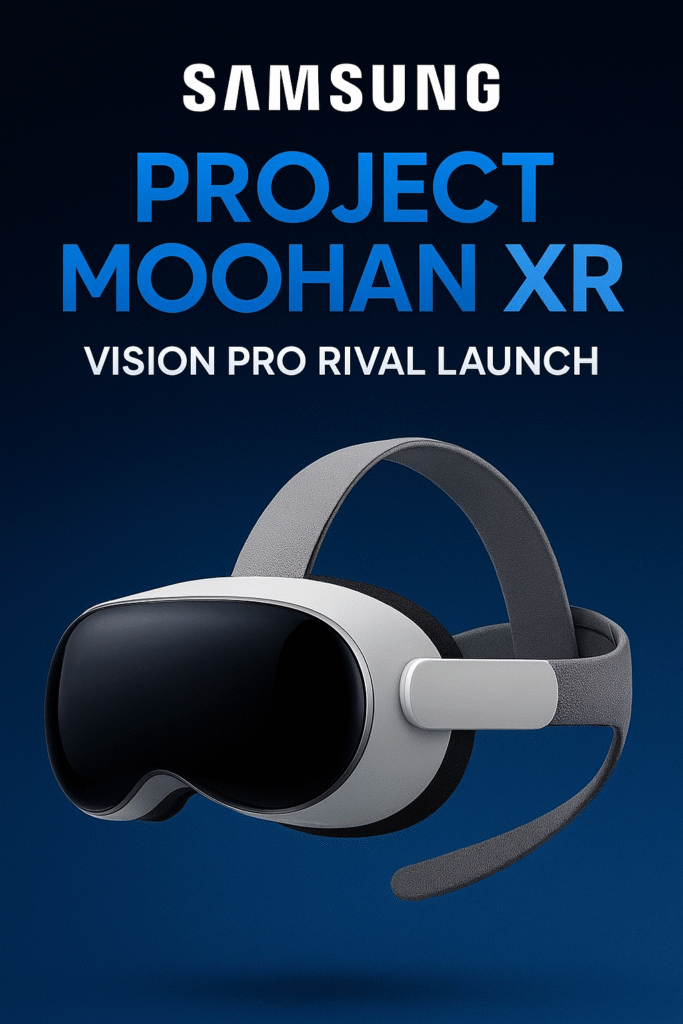
The mixed reality (XR) industry is heating up again—and this time, Samsung is stepping into the ring. After years of anticipation and months of rumors, the tech giant is finally ready to unveil its XR headset, codenamed Project Moohan, on October 21, 2025.
The announcement marks Samsung’s return to immersive technology after its early experiments with Gear VR nearly a decade ago. But unlike those early ventures, Project Moohan is not just another headset—it’s a statement of intent.
This is Samsung’s answer to Apple’s Vision Pro, and it could reshape the XR market. Let’s dive deep into what we know so far about Project Moohan, how it compares to Apple’s headset, and what this means for users and businesses.
A New Era for Samsung XR
Samsung’s upcoming XR headset—believed to launch commercially as the Galaxy XR—has been under development for years in collaboration with Google and Qualcomm.
Internally, it’s known as “Project Moohan”, a Korean word meaning infinite. That name alone hints at Samsung’s vision: a limitless, immersive experience that merges digital and physical realities seamlessly.
But there’s more to Moohan than symbolism. The project represents Samsung’s push into a new category of spatial computing—a market currently dominated by Apple’s Vision Pro and Meta’s Quest line.
Launch Date and Global Event
The official unveiling of Project Moohan will take place at Samsung’s “Worlds Wide Open” event on October 21, 2025, at 10 p.m. ET.
Industry insiders expect this event to showcase not just the headset itself, but also the new Android XR platform, developed jointly by Google, Qualcomm, and Samsung.
According to reports, the device will launch in South Korea on October 22, followed by an international rollout shortly after. Early leaks suggest an initial production batch of around 100,000 units, with a gradual expansion into global markets later this year.
Samsung is clearly taking a measured approach—testing demand and user feedback before scaling up mass production.
The Technology Behind Project Moohan
Though Samsung has kept most details under wraps, a series of leaks, certifications, and developer listings have revealed plenty about what we can expect.
1. Powered by Snapdragon XR2+ Gen 2
The headset will reportedly feature the Snapdragon XR2+ Gen 2, Qualcomm’s latest chipset designed specifically for XR devices. It’s optimized for spatial computing, multitasking, and real-time 3D rendering.
This processor is also said to power Meta’s Quest 3, but Samsung’s integration may go further—taking advantage of AI acceleration and deep learning for gesture recognition, eye tracking, and contextual awareness.
2. Crystal-Clear Visuals with Sony Micro-OLED Panels
Perhaps the most impressive rumored feature of Project Moohan is its display technology.
Samsung is said to use Sony-made micro-OLED panels with a pixel density of around 3,800 PPI (pixels per inch). If true, this would exceed even the Apple Vision Pro’s remarkable display clarity.
Early prototypes reportedly delivered stunning sharpness and vibrant color accuracy—ideal for both productivity and entertainment applications.
3. Seamless Integration with Android XR
Unlike Apple’s closed visionOS, Samsung’s headset runs on Android XR, an open platform built by Google for mixed and extended reality devices.
This gives Moohan a major advantage: access to Android’s massive app ecosystem. Developers can adapt existing mobile and AR apps for XR relatively easily, dramatically increasing potential content availability.
Some XR-labeled apps have already started appearing in the Google Play Store, indicating that developers are preparing for the platform’s debut.
4. Built for AI-Powered Interaction
Samsung’s close partnership with Google means the headset will likely integrate Gemini AI, Google’s powerful multimodal AI system.
Gemini could act as a spatial assistant, understanding voice, gesture, and visual cues simultaneously. Imagine saying, “Show me my schedule on the wall,” and having a holographic calendar appear in your field of view—contextually aware, responsive, and intelligent.
This is where Moohan’s power lies: combining XR immersion with AI adaptability.
5. Lightweight Design and Swappable Battery
Comfort has always been a key challenge for XR headsets. Samsung appears to be addressing that directly.
Reports claim that Project Moohan weighs under 500 grams, with a balanced weight distribution for long wear sessions.
In addition, Samsung may introduce a removable external battery connected via USB-C. This would allow users to swap battery packs instead of waiting for a recharge—an enormous usability improvement over Apple’s fixed external pack.
6. Advanced Sensor Array and Spatial Tracking
Moohan is expected to include a full suite of sensors:
- Eye and hand tracking
- Depth mapping cameras
- Environmental awareness sensors
- Microphone arrays for spatial audio input
Together, these will allow precise movement detection, realistic object rendering, and intuitive control without external controllers.
Project Moohan vs Apple Vision Pro: The Showdown
Let’s compare Samsung’s upcoming headset to the reigning champion, Apple’s Vision Pro.
| Feature | Apple Vision Pro | Samsung Project Moohan (Galaxy XR) |
| OS | visionOS (closed) | Android XR (open platform) |
| Processor | Apple M2 + R1 | Snapdragon XR2+ Gen 2 |
| Display | Dual micro-OLED | Sony micro-OLED (~3,800 ppi) |
| AI Integration | Apple Intelligence (limited availability) | Gemini AI (full multimodal support) |
| Control | Eye + hand tracking | Eye + hand + gesture + voice |
| Battery | External pack (2 hours) | Swappable USB-C battery packs |
| App Ecosystem | Apple-only apps | Android apps + XR apps |
| Estimated Price | $3,499 | $1,800–$2,900 (rumored) |
The most striking difference? Accessibility.
Apple’s Vision Pro remains an ultra-premium, closed device, mainly suited for developers and professionals. Samsung, by contrast, seems to be positioning Moohan as a more open, affordable alternative—without compromising on quality or innovation.
Why Project Moohan Matters
1. It Expands the XR Ecosystem
Until now, XR has been a fragmented market—Apple with its closed ecosystem, Meta focusing on gaming, and smaller players struggling for relevance.
Project Moohan could unify the Android side of the equation. With Android XR, Samsung is helping create a standard foundation for other manufacturers to build on—similar to how Android transformed smartphones in 2008.
This move could finally make XR mainstream.
2. It Puts Pressure on Apple and Meta
Samsung’s entry immediately intensifies competition.
Apple will be forced to lower prices or innovate faster, while Meta may need to rethink its balance between affordability and advanced features.
More competition means better devices, richer app ecosystems, and—most importantly—more options for users.
3. It Blends AI, Productivity, and Entertainment
Samsung isn’t just chasing the gaming crowd. Project Moohan is built with productivity and creative professionals in mind.
Imagine engineers designing prototypes in 3D space, educators using XR classrooms, or artists sculpting digital models mid-air.
With Gemini AI integration, Moohan could also serve as an intelligent assistant, capable of understanding natural commands like “organize my workspace” or “summarize this meeting in AR.”
This blend of AI + XR could make Moohan a tool not only for play—but for real work.
4. It Strengthens Samsung’s Ecosystem
Just as Apple ties Vision Pro into its hardware lineup, Samsung will likely do the same.
Moohan will almost certainly sync with Galaxy smartphones, tablets, and watches, creating a seamless experience across devices.
For example:
- Use your Galaxy phone as a controller or file manager.
- Receive calls and notifications inside your headset.
- Transfer files instantly with Samsung’s Quick Share.
That ecosystem advantage could make the Galaxy XR even more attractive for current Samsung users.
Challenges Ahead for Samsung
As promising as Project Moohan sounds, several challenges remain:
- Content Availability:
A strong launch depends on an engaging catalog of XR apps. Even with Android XR’s openness, Samsung needs developer support to thrive. - Battery Life & Thermal Management:
Extended sessions could still generate heat or battery drain. Balancing performance with comfort will be critical. - Pricing & Market Positioning:
While rumors place the headset below $3,000, any price above $2,000 will still limit mainstream adoption. Samsung must deliver visible value. - Perception Battle:
Apple’s Vision Pro dominates the premium image in XR. Samsung needs to communicate clearly why Moohan isn’t just cheaper—but potentially better.
What to Expect on October 21
The “Worlds Wide Open” launch event is expected to reveal:
✅ The headset’s final commercial name (likely Galaxy XR)
✅ Official specs and demos
✅ Price and global availability
✅ Integration with Gemini AI and Android XR
✅ Pre-order perks (rumors suggest $100 credit for early reservations)
If Samsung delivers on even half of its promises, this event could mark a turning point for XR’s future.
Impact on Users and Businesses
The implications go beyond tech enthusiasts.
For Consumers:
Project Moohan could make immersive experiences—virtual travel, 3D movies, AR gaming—more accessible and more connected to daily devices.
For Businesses:
XR adoption in industries like healthcare, architecture, and training could accelerate, driven by a more flexible and cost-effective device.
For Developers:
Android XR opens a massive opportunity to adapt or build spatial apps, powered by familiar Android tools.
Samsung’s entrance signals that XR is moving from “future tech” to practical, profitable reality.
Conclusion: The XR Revolution Is Just Beginning
Samsung’s Project Moohan isn’t just another headset—it’s a bold declaration that the XR world won’t belong to Apple alone.
By combining Android XR, Gemini AI, and Samsung’s hardware expertise, Moohan could reshape the landscape of mixed reality, driving innovation and accessibility in equal measure.
October 21 will tell us whether Samsung’s ambitious promise turns into a revolution—or just another impressive prototype.But one thing is certain: the competition for the future of reality has officially begun.