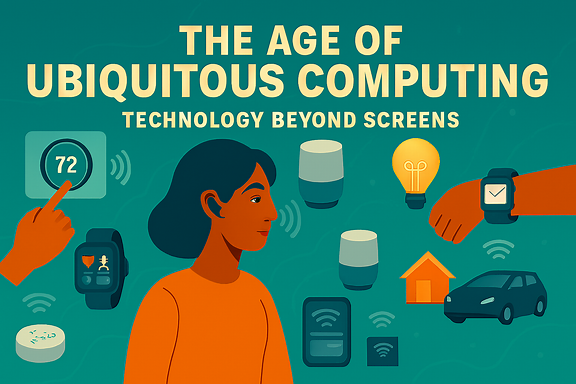
Technology is becoming so integrated into our lives that we often forget it’s there. The smartphone, once a revolutionary interface, now feels bulky compared to what’s coming next. The era of ubiquitous computing—where devices blend seamlessly into our surroundings—is no longer a distant dream.
From smart mirrors that analyze your skin to chairs that adjust automatically to your posture, the next digital revolution is about making technology invisible yet omnipresent.
In this article, we’ll explore what ubiquitous computing means, how it’s being implemented, and why it’s set to redefine human interaction with machines.
What Is Ubiquitous Computing?
Ubiquitous computing (often shortened as ubicomp) refers to the embedding of computing capabilities into everyday objects and environments.
The term was coined in the late 1980s by Mark Weiser, a researcher at Xerox PARC, who envisioned a world where computers would “weave themselves into the fabric of everyday life until they are indistinguishable from it.”
Unlike traditional computing—where devices like PCs, smartphones, or tablets are central—ubiquitous computing hides the technology in plain sight.
That means no more staring at screens; instead, the environment itself becomes your interface.
From Devices to Experiences
Today, we’re witnessing the early stages of ubiquitous computing through the Internet of Things (IoT) and ambient intelligence.
But the future goes far beyond smart thermostats or connected speakers.
In the coming decade, you won’t use technology—it will simply be part of your environment.
For example:
- Your desk will recognize your presence and adjust the lighting and temperature automatically.
- Your clothes will monitor your health in real-time.
- Your home will anticipate your needs without you having to ask.
The result is a world where technology adapts to humans, not the other way around.
Invisible Computing in Everyday Spaces
Let’s explore where this quiet technological revolution is already unfolding:
🛋️ Smart Furniture
Imagine a sofa that senses your posture and adjusts its firmness, or a coffee table that wirelessly charges your devices.
Companies like IKEA and Samsung are already experimenting with tech-integrated furniture designed to blend function and form.
- Smart Desks: Adjust height automatically based on user preference.
- Connected Beds: Track sleep patterns and wake you at the optimal moment.
- Interactive Mirrors: Display news, weather, or health metrics while you get ready.
These designs don’t scream “technology.” Instead, they quietly enhance daily comfort and productivity.
👕 Smart Clothing
Wearable technology is evolving beyond fitness trackers. The next step? Smart fabrics.
Researchers and brands are embedding micro-sensors, flexible circuits, and conductive threads into textiles, making the clothes themselves intelligent.
- Health Monitoring: Shirts that measure heart rate, breathing, and body temperature.
- Adaptive Comfort: Jackets that adjust insulation based on outdoor conditions.
- Gesture Controls: Gloves that can control devices with hand movements.
For instance, Google’s Project Jacquard, developed with Levi’s, integrates touch and gesture interactivity into denim fabric. You can answer a call, skip a song, or check navigation simply by touching your sleeve.
This is technology that you wear, not carry—a step closer to the dream of ubiquitous computing.
🌆 Ambient Technology
Ambient technology focuses on creating environments that respond intelligently to human presence and behavior.
Think of a smart home that senses your mood through lighting, temperature, and sound.
Or a city that adjusts traffic flow based on real-time data from vehicles and pedestrians.
Some real-world examples include:
- Philips Hue lighting systems that adjust to natural daylight cycles.
- Amazon Astro and Alexa Ambient Intelligence, which learn user routines to automate daily actions.
- Smart buildings that reduce energy consumption automatically.
The goal is not just automation—it’s contextual awareness.
These systems learn from your habits, predicting your needs without requiring direct input.
The Technological Backbone: IoT, AI, and Edge Computing
For ubiquitous computing to function smoothly, several technologies must work together behind the scenes:
1. Internet of Things (IoT)
IoT is the foundation that connects all devices—big and small—into a unified network.
From sensors in clothing to microchips in light bulbs, these nodes gather data continuously to understand user patterns.
2. Artificial Intelligence (AI)
AI is the brain of ubiquitous computing.
It interprets the data collected by sensors and acts accordingly—like adjusting lighting when you look tired or suggesting a break based on posture analysis.
3. Edge Computing
Instead of sending all data to distant servers, edge computing processes it locally (e.g., inside a smart device or router).
This reduces latency, enhances privacy, and ensures real-time responsiveness—crucial for invisible technology that must act instantly.
Together, these systems make environments intelligent, adaptive, and discreet.
Human-Centered Design: Making Tech Disappear
For ubiquitous computing to succeed, it must be invisible and intuitive.
The best technology doesn’t draw attention—it simply works.
Designers are focusing on human-centered experiences, ensuring that digital systems enhance our lives without overwhelming us.
Some guiding principles include:
- Simplicity: No cluttered interfaces or unnecessary notifications.
- Privacy: Transparent data usage and strong local encryption.
- Sustainability: Energy-efficient designs and recyclable materials.
As Mark Weiser said, “The most profound technologies are those that disappear.”
That’s the ethos driving this new wave of invisible computing.
Challenges on the Path to Ubiquity
Despite its promise, ubiquitous computing faces major challenges:
🔐 Privacy and Security
When everything is connected, everything can be hacked.
Smart homes, wearable devices, and sensor-rich environments raise concerns about data collection and surveillance.
Striking a balance between convenience and privacy will be key to public trust.
⚙️ Interoperability
Different brands and ecosystems often struggle to communicate.
A future of invisible tech requires standardized protocols so all devices work together seamlessly.
⚡ Energy Efficiency
Embedding computing power everywhere could strain global energy resources.
Developing low-power chips and sustainable energy sources is essential to make this model viable.
🧩 User Acceptance
People must feel comfortable with invisible technology.
If users sense they’re being watched or manipulated, adoption will stall.
Thus, transparency, consent, and control will be fundamental design values moving forward.
The Future: A World That Thinks With You
Imagine walking into a room that immediately knows who you are, what you need, and how you feel.
- The lights adjust to your mood.
- Your playlist continues from where it left off.
- Your digital assistant updates you silently through subtle ambient cues.
That’s not science fiction—it’s the direction technology is heading.
Tech giants like Google, Apple, Samsung, and Amazon are already investing heavily in ambient computing ecosystems that merge hardware, software, and AI into unified experiences.
In the near future, the line between human and machine interaction will blur completely, making the technology disappear into the background—powerful, but invisible.
A Shift in Philosophy: From Tools to Companions
Ubiquitous computing changes the way we view machines.
Instead of being mere tools, they become companions that understand and anticipate our needs.
This shift isn’t just technological—it’s philosophical.
It challenges our ideas about privacy, autonomy, and even consciousness.
As we delegate more decision-making to invisible systems, we’ll need to redefine what it means to be in control.
But if implemented thoughtfully, ubiquitous computing could enhance human creativity, productivity, and well-being—turning everyday life into a seamless flow of experiences.
Conclusion: Living in a World That Disappears
We are on the cusp of an era where technology will vanish from view—not because it’s gone, but because it’s everywhere.
From intelligent furniture to responsive clothing and context-aware environments, ubiquitous computing represents a leap toward a world that works with us, not for us.
As screens fade into the background and interfaces become invisible, humanity will enter a phase where technology feels less like a tool and more like an extension of life itself.
The future of computing isn’t in our hands—it’s in the air around us.