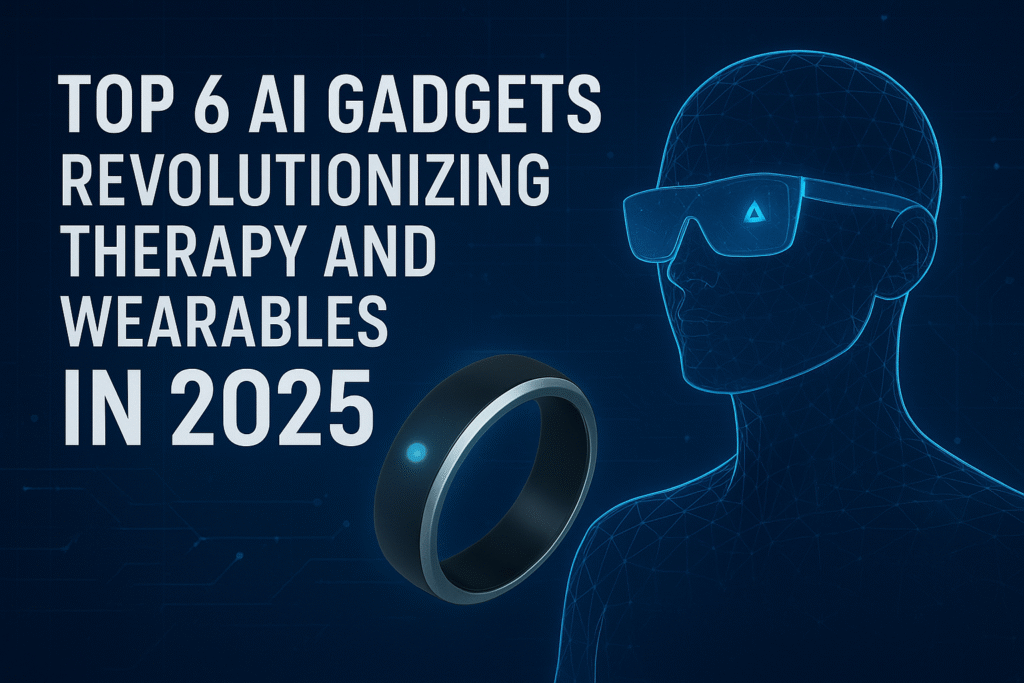
In 2025, AI is no longer confined to software — it’s making its way into devices we wear, hold, or interact with daily. These gadgets blend artificial intelligence, biosensors, and therapeutic capabilities to transform our health, productivity, and habits. In this post, we’ll explore the Top 6 AI Gadgets You Should Know About in October 2025, focusing especially on therapies and wearables that are pushing boundaries. Whether you’re a tech enthusiast, health aficionado, or just curious, these devices offer a glimpse into the near future.
Why AI Gadgets (Especially Wearables & Therapy Devices) Matter in 2025
Before diving into specific products, it helps to understand the larger trends driving this wave of innovation.
- From trackers to health coaches: Wearables are evolving beyond step counters. With generative AI and advanced algorithms, they now interpret your data, suggest interventions, and even detect anomalies in real time.
- On-device intelligence & privacy: More devices are doing AI processing locally (on-device) rather than sending everything to the cloud, improving responsiveness and reducing privacy risks.
- Therapeutic augmentation: AI isn’t just about monitoring — it’s being combined with interventions (e.g. mental health, movement therapy) to deliver support, nudges, or real-time feedback.
- Regulation catches up: Recognizing both promise and risk, regulatory bodies are debating how to oversee AI-powered mental health or therapeutic gadgets.
Given that backdrop, here are six standout AI gadgets (or classes of gadgets) to keep on your radar.
Top 6 AI Gadgets in October 2025
Below is a curated list — some are commercially available, some in early rollout or crowdfunding stage. The key is that each embodies a trend or breakthrough worth noting.
| # | Name / Category | What It Does | Why It’s Noteworthy | Challenges & Caveats |
| 1 | AI-Powered Smart Ring / Health Strategist | Combines biometric sensors (HR, SpO₂, HRV, sleep metrics) + AI that not only shows trends but strategizes what actions to take. | For instance, the Circular Ring 2 uses an AI “health strategist” (Kira) to learn patterns and offer personalized advice. | Many such rings are in preorder or early phase — full FDA-level validation and battery tradeoffs remain a challenge. |
| 2 | AI Wearable Therapy / Mood Integration Devices | Wearables that monitor physiological markers (e.g. stress, mood) and integrate with AI-driven mental health tools or nudges. | AI in therapy is growing: devices now can feed mood data to AI systems, which in turn suggest coping strategies or alert care providers. | Ethical, privacy, and safety concerns are high. As regulatory scrutiny increases, users must verify data security and clinical backing. |
| 3 | AI Smart Glasses / AR Eyewear | Glasses with embedded AI, voice assistants, visual overlays, translation, or context-aware support. | Meta’s Ray-Ban Display (2025) introduces a color display in lens, enabling visual responses and private messaging.Also, Meta & Oakley’s AI-powered sport glasses launched in 2025. | Battery life, comfort, and social acceptance (someone wearing “smart glasses”) remain design challenges. |
| 4 | Wearable Conversation / Ambient AI Devices | Devices that constantly listen, transcribe, summarize, or assist conversation — think of “air assistants” that live on the body. | Bee (a wrist-worn device) was acquired by Amazon; it records audio, transcribes, and offers suggestions.Humane’s AI Pin (although recently acquired/taken over) also aimed in this space. | This is the space with the most privacy concerns. Differentiating voice vs. ambient noise, ensuring user control, and encryption are critical. |
| 5 | Gesture / Thought-Assisted Wearables | Devices that detect hand gestures or neurological signals to control other devices — almost a “silent interface.” | Helios 2.0 is a gesture-recognition system optimized for wearables (6–8 mW power), enabling natural hand gestures to operate smart glasses or other gadgets.Alterego’s “Silent Sense” wearable claims near-telepathic communication by sensing brain-to-speech signals before words are spoken. | These are cutting-edge, experimental tech. Reliability, calibration across individuals, and safety are big hurdles. |
| 6 | Multimodal Biosensing Platforms / Edge AI Wearables | Devices that combine multiple signals (EEG, ECG, EMG, PPG) and run AI at the edge to detect anomalies, make predictions, or interface with therapeutic systems. | BioGAP-Ultra is a modular edge-AI platform that supports multiple physiologic signals and enables flexible integration into wearables (eeg headband, chest band, etc.).Another is the “AI on the Pulse” framework: anomaly detection on continuous data streams from wearables to detect health risks in real time. | Complexity of hardware integration, power consumption, and interpreting ambiguous signals are ongoing research challenges. |
Let’s dig deeper into a few of these to show what’s compelling (and what to watch out for).
Deep-Dive: Highlights & Use Cases
Smart Ring Meets AI Health Coaching
Imagine a discreet ring that does more than count steps — it learns your patterns, knows when you’re trending toward fatigue or stress, and suggests micro-actions like adjusting sleep, hydration, or light exposure. That’s the vision behind AI-driven smart rings such as the Circular Ring 2. Its embedded AI (Kira) doesn’t just present metrics — it forms a health strategy, something closer to a lightweight digital coach.
These help fill a gap: traditional wearables often leave users data-rich yet insight-poor.
Therapy + Wearable Fusion
Mental health is one of the most promising (and most challenging) domains for AI gadgets. Devices that monitor physiological signals — heart rate variability, galvanic skin response, sleep disturbance — can feed into AI models that infer stress or mood states. Those systems can then deliver therapeutic nudges, prompts, or feed into teletherapy ecosystems.
One trend: AI chat or coaching systems will increasingly rely on live biometric data, making the “therapist assistant” device more personalized, context-sensitive, and timely. However, as the FDA recently flagged, regulation around AI-driven mental health tools is heating up.
AR / Smart Glasses as Contextual Assistants
Smart glasses are now evolving from notifications to contextual AI companions. Meta’s Ray-Ban Display glasses, launched in 2025, integrate a tiny color display into the lens, enabling visual answers, navigation overlays, and messaging. Meanwhile, the Oakley Meta HSTN — a partnership between Meta and Oakley — brings open-ear audio, camera, and AI integration to sport-style frames.
This form factor allows “eyes-up” assistance: imagine walking directions, translation, or real-time context insights within your field of vision, without reaching for a phone.
Gesture & Silent Interfaces
Gesture and neurosignal devices represent the frontier of “invisible control.”
- Helios 2.0 enables very low-power gesture recognition (pinch, swipes) that can operate smart glasses, eliminating touch or voice control.
- Alterego’s Silent Sense claims to interpret pre-speech neural signals (before you vocalize) allowing silent communication or control of devices.
If successful, these can reset how we interact: silent inputs, hands-free control, and seamless device orchestration.
Multimodal Biosensing + Edge AI
One of the biggest shifts is combining multiple bio-modalities (EEG, ECG, PPG, EMG) and processing them locally (on-device) to avoid latency or privacy compromises.
- BioGAP-Ultra, for example, is designed as a modular platform: it can be embedded in a chest band, headband, or sleeve, and supports synchronized acquisition of multiple biosignals with embedded AI.
- The “AI on the Pulse” framework, by contrast, focuses on continuous anomaly detection (e.g. irregular heart rhythms or stress signatures) from consumer wearable data, with interpretability built-in.
Such systems can serve as real-time health sentinels, alerting you or your clinician when something deviates significantly.
Considerations Before You Buy or Use
These gadgets are exciting, but you should weigh the risks and practicalities:
- Clinical validation: Many devices are early stage or experimental. Check whether a gadget has undergone clinical trials or peer-reviewed studies.
- Privacy & data ownership: Devices collecting audio, neurological, or physiological signals need rigorous encryption and transparent policies.
- Regulation & liability: AI in mental health or medical diagnostics is under growing scrutiny. Be cautious with claims of diagnosis or therapy.
- Battery vs. features tradeoff: More sensors and processing often mean more power draw — balance what you need vs how often you’ll recharge.
- User comfort & ergonomics: Wearables must be comfortable, nonintrusive, and socially acceptable for sustained use.
- Interoperability: Look for gadgets that can integrate (or at least export) data to other health platforms or EHRs.
- Updates & support: AI models evolve — you want a device that supports firmware updates, model improvements, and security patches.
What to Watch for in the Coming Months
- Mainstream adoption by big brands: As Apple, Google, Meta, and others scale wearable AI, price points and user trust will improve.
- Therapy & digital drug regulation: The FDA and other agencies are actively exploring standards for AI-powered health and mental health gadgets.
- Better sensor fusion: Merging signals (e.g. combining EEG + HR + movement) will yield more accurate inferences, with fewer false positives.
- Simpler interfaces: Gesture, silent-input, and voice control will mature, reducing friction in interactions.
- Edge AI breakthroughs: More capable models that run locally (without cloud) will unlock better privacy and responsiveness.
Conclusion
The world of AI gadgets in 2025 is electrifying — we’re moving past novelty into devices that understand, assist, and even intervene. Among them, therapy-adjacent wearables and integrated health systems stand to make the deepest impact.If you had to track just one or two from the list above, I’d recommend a smart ring with AI coaching and a multimodal biosensing wearable with edge AI — their balance of usability and insight makes them particularly compelling today.