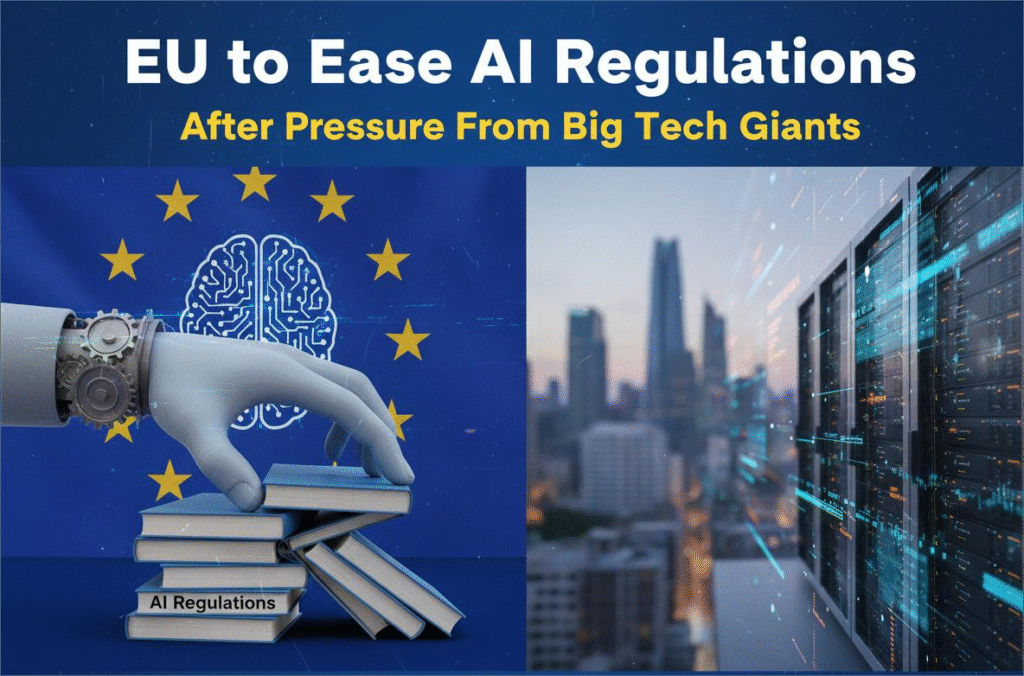

In 2025, the geopolitical and regulatory landscape for technology is shifting dramatically. The United States is reportedly pressuring the European Union to loosen its digital regulations, signaling a potential realignment in global tech policy. For Big Tech companies — particularly American giants like Google, Apple, Meta, and Amazon — this push could unlock fresh opportunities in Europe. But the move also raises fundamental questions: What does “loosening” mean in practice? What are the risks — and rewards — for innovation, competition, and data privacy? And how might this pressure reshape the regulatory future for Big Tech across the Atlantic?
The Context: Why the U.S. Is Pushing
The U.S. government’s push to ease digital regulations in Europe is motivated by several interlinked strategic considerations:
- Economic Interests & Tech Investment
American technology companies have long been dominant players in Europe. Looser regulation could reduce compliance costs and barriers to entry, making European markets more attractive for U.S. firms. This could boost investment in European “deep tech,” cloud infrastructure, AI, and data centers. - Geopolitical Competition
The digital regulation debate is not just about business — it’s also geopolitical. By influencing European regulation, the U.S. may aim to counter China’s growing influence in advanced technologies and to ensure that European digital markets remain aligned with transatlantic interests. - Innovation vs. Regulation Trade-Off
U.S. policymakers often argue that heavy-handed regulation stifles innovation. By advocating for lighter digital rules, they hope to preserve a more dynamic, entrepreneurial ecosystem where U.S. tech giants can continue to scale globally.
What “Easing Digital Regulations” Could Mean in Practice
When the United States calls for a relaxation of digital rules, it’s not just rhetoric — it could lead to concrete policy shifts. Here are several regulatory areas where changes may be pushed:
- Antitrust & Competition Law
- The EU has aggressively pursued antitrust enforcement and competition law reforms targeting platform dominance. Easing could mean less aggressive scrutiny or delaying new digital competition laws, giving Big Tech more breathing space.
- For U.S. firms, this could translate into fewer fines, less forced divestment, and more favorable treatment in European markets.
- The EU has aggressively pursued antitrust enforcement and competition law reforms targeting platform dominance. Easing could mean less aggressive scrutiny or delaying new digital competition laws, giving Big Tech more breathing space.
- Data Protection
- One of the EU’s strongest regulations is the General Data Protection Regulation (GDPR). Calls to weaken or reinterpret data regulations may revolve around balancing personal data rights with innovation needs.
- Looser data restrictions could allow U.S. companies to use European data more freely, particularly for AI training and analytics — increasing their competitive edge in the machine-learning space.
- One of the EU’s strongest regulations is the General Data Protection Regulation (GDPR). Calls to weaken or reinterpret data regulations may revolve around balancing personal data rights with innovation needs.
- Digital Services Act (DSA) / Digital Markets Act (DMA)
- The EU’s Digital Services Act (DSA) and Digital Markets Act (DMA) impose strict obligations on large platforms (e.g., content governance, gatekeeper behavior). Easing these could mean lighter obligations on what Big Tech must do to comply, or slower roll-out of certain rules.
- This would affect how platforms moderate content, how they treat third-party businesses (e.g., smaller app developers or sellers), and how much control regulators have over their business practices.
- The EU’s Digital Services Act (DSA) and Digital Markets Act (DMA) impose strict obligations on large platforms (e.g., content governance, gatekeeper behavior). Easing these could mean lighter obligations on what Big Tech must do to comply, or slower roll-out of certain rules.
- Cloud & Infrastructure Regulation
- European regulation for data centers, cloud sovereignty, and cross-border data flows could be softened, enabling U.S. cloud providers to operate more freely and to scale more aggressively in Europe.
- Such a change would be beneficial for companies like Amazon Web Services, Google Cloud, and Microsoft Azure, which are heavily invested in European infrastructure.
- European regulation for data centers, cloud sovereignty, and cross-border data flows could be softened, enabling U.S. cloud providers to operate more freely and to scale more aggressively in Europe.
Implications for Big Tech in 2025
1. Increased Investment and Growth
If regulation eases, U.S. Big Tech firms are likely to increase investment in European markets. More relaxed rules could mean more capital flowing into Europe’s tech infrastructure, such as data centers, R&D labs, and AI hubs. This could accelerate innovation and create a more favorable environment for scaling.
2. Strategic Advantage Over Local Competitors
U.S. firms may gain a significant advantage over European or non-U.S. competitors. If compliance burdens drop, American companies could more quickly launch new services, optimize data-driven products, and dominate certain high-growth segments like generative AI or autonomous systems.
3. Data Access & AI Innovation
Easier data regulation would directly benefit companies using large datasets to train AI. Big Tech could use European data more freely, fueling advances in AI models, predictive analytics, and personalized services. This could reinforce existing leadership in AI innovation.
4. Regulatory Risk & Reputation Management
While regulatory easing is appealing, Big Tech will also need to manage the reputational risk. Critics may argue that this kind of diplomacy undermines consumer protections, privacy rights, and fair competition. Companies will have to carefully navigate not just the financial opportunity, but also the political and public-relations fallout.
5. Shift in Regulatory Balance
If the U.S. is successful, the balance of power in digital regulation could shift significantly. Europe has long positioned itself as a global leader in tech regulation (e.g., GDPR), but American pressure could push the EU to compromise. That could reshape future EU regulatory frameworks, not just for 2025 but for decades to come.
Risks and Challenges
- Public Backlash
European citizens and civil society groups may see U.S. pressure as a threat to consumer rights and data protection. Any perceived erosion of digital rights could trigger protests, political resistance, or legal challenges. - Regulatory Fragmentation
If the EU loosens rules in some areas but maintains strict standards in others, it might result in a fragmented regulatory environment that still complicates operations for Big Tech. - Short-Term Gains vs Long-Term Stability
While deregulation may boost investment in the short term, overly lax regulation could backfire: data breaches, unfair market practices, or monopolistic behavior could prompt a backlash and eventual rollback of concessions. - Geopolitical Tensions
The push by the U.S. may exacerbate geopolitical tensions, especially with European leaders who prioritize data sovereignty and digital sovereignty. It could also feed into broader transatlantic tensions over trade, defense, and technological leadership. - Regulatory Credibility
For the EU, yielding to pressure from the U.S. could undermine its regulatory credibility. If Europe is seen as bowing to U.S. interests, it could weaken its standing in future international regulatory negotiations.
Possible Scenarios for 2025 and Beyond
Let’s explore three plausible scenarios, depending on how the pressure plays out.
| Scenario | What Happens | Impact on Big Tech |
| Regulatory Easing | EU rolls back or softens key digital rules | U.S. tech firms scale faster, increase R&D, gain market share |
| Compromise / Hybrid | EU relaxes some rules, but keeps core protections | Big Tech wins some freedoms, but still faces significant compliance obligations |
| Regulation Holds | EU resists U.S. pressure and maintains strong regulation | Little change in current dynamics; Big Tech may need to continue operating under strict rules and regulatory uncertainty |
Strategic Advice for Big Tech Companies
Given this environment, what should Big Tech do to navigate 2025 and beyond?
- Advocacy & Diplomacy
Continue engaging with EU institutions, but also diversify influence through trade associations, think tanks, and multilateral forums. Influence regulation before it’s set. - Local Partnerships
Partner with European startups, cloud providers, and research institutions. By embedding more deeply in the European ecosystem, U.S. tech companies can build goodwill and reduce regulatory risk. - Transparent Data Practices
Strengthen data governance and privacy practices. Demonstrating responsibility may help mitigate public and political concerns about regulation loosening. - Invest in Compliance Infrastructure
Even if regulation loosens, doing so doesn’t mean the rules vanish. Big Tech should maintain compliance teams ready to adapt to hybrid regimes or rapid regulatory shifts. - Prepare for Backlash
Develop crisis-communication plans to respond to public or political pushback. Proactively highlight benefits like job creation, innovation, and data security.
Conclusion
The reported effort by the United States to pressure the European Union into easing its digital regulations in 2025 represents one of the most significant potential shifts in global tech governance in recent years. For Big Tech — especially U.S.-based firms — the stakes are huge: lighter regulation could unlock new investment, accelerate innovation, and deepen their dominance in Europe.
But the risks are real. Public backlash, geopolitical friction, and reputational damage could all undermine the potential benefits. Whether the EU ultimately gives in to American pressure, strikes a compromise, or holds firm will shape not just the fate of Big Tech — but the future of digital regulation worldwide.
In a world increasingly defined by data, AI, and platform power, the regulatory decisions made in Brussels (under U.S. scrutiny) may well determine who leads the next decade of technological innovation.