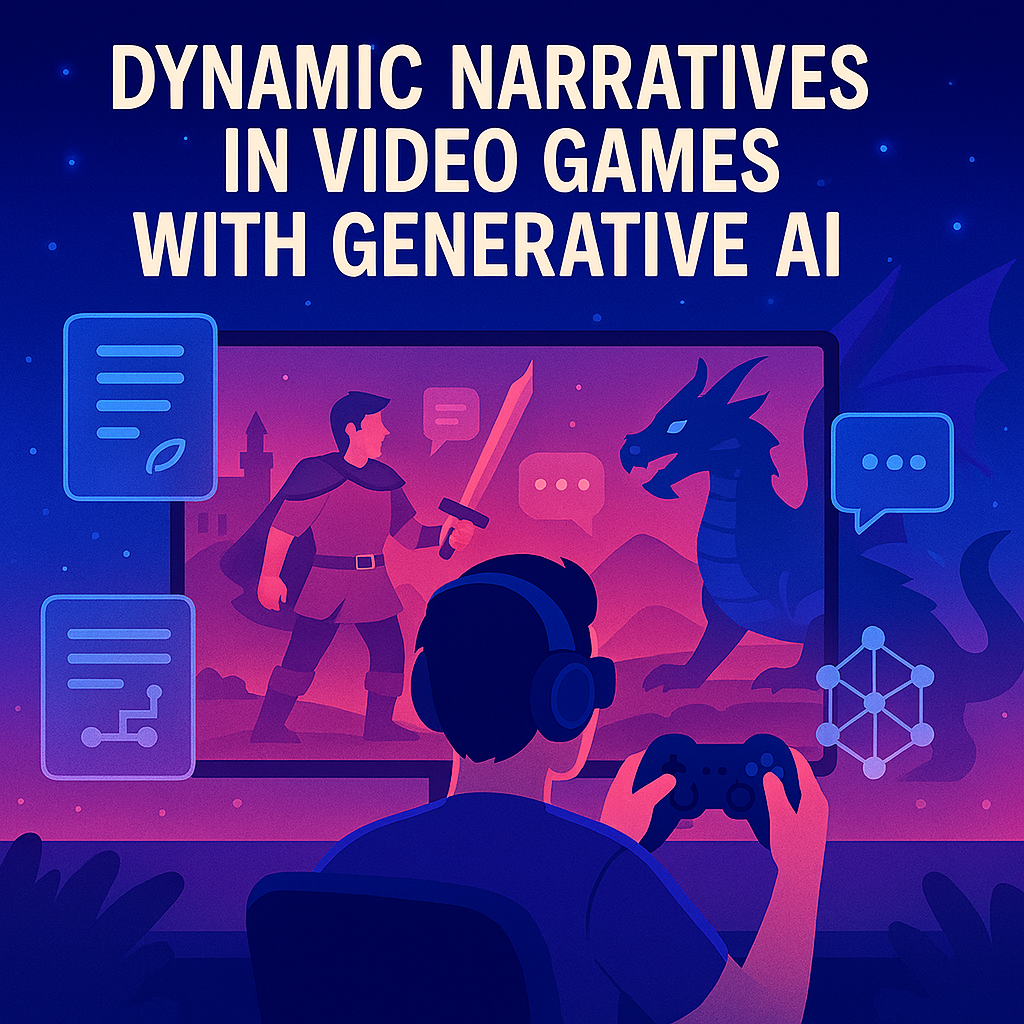
The gaming industry has always pushed the boundaries of storytelling. From the text-based adventures of the 1980s to cinematic open-world blockbusters, developers have constantly experimented with ways to make stories more immersive and personal. Now, generative AI promises to take narrative design to an entirely new level — one where every player experiences a unique, adaptive story crafted in real time.
In this article, we’ll explore how generative AI works in the context of video games, its benefits, current examples, challenges, and what the future might hold for this exciting fusion of technology and creativity.
1. Understanding Generative AI in Games
Generative AI refers to artificial intelligence models capable of creating original content — be it text, images, music, or even game environments. In narrative-driven games, generative AI can analyze player actions, decisions, and interactions to craft unique dialogue, plot twists, and world events.
Instead of relying solely on pre-scripted storylines, dynamic narratives generated by AI can evolve unpredictably, ensuring that no two playthroughs are the same.
Key Features in Gaming Context:
- Procedural Storytelling – Plot points and character arcs that adapt based on player choices.
- Real-Time Dialogue Generation – NPCs responding intelligently to conversations and events.
- Adaptive World Events – The game world evolves dynamically according to player behavior.
- Personalized Quests – Missions crafted based on the player’s style and in-game history.
2. How Generative AI Creates Dynamic Narratives
Traditionally, branching narratives in games are designed manually, with developers mapping out possible story routes. Generative AI changes this by using natural language processing (NLP) and machine learning models to create content on the fly.
The Process:
- Player Input – The game tracks decisions, movements, and interactions.
- Data Analysis – The AI interprets this behavior, looking for narrative opportunities.
- Content Generation – Dialogue, events, or world changes are generated in real time.
- Seamless Integration – The AI-generated narrative blends into the core storyline without breaking immersion.
A key advantage is that AI doesn’t just follow a predefined “decision tree” — it can create brand-new narrative branches based on context.
3. Current Examples in the Industry
While fully AI-driven narratives are still emerging, some studios and indie developers are experimenting with the concept.
- AI Dungeon – A text-based adventure game entirely powered by AI, generating limitless narrative possibilities.
- Hidden Door – A platform using generative AI to create interactive stories that adapt to players’ input.
- Ubisoft’s Ghostwriter – An AI tool designed to help scriptwriters create more diverse and reactive NPC dialogue.
- Inworld AI – Used in games to build NPCs with persistent personalities and memory, allowing dynamic conversations.
These are early examples, but they hint at the massive potential of AI in gaming storytelling.
4. Advantages of AI-Powered Dynamic Narratives
The integration of generative AI into gaming narratives brings multiple benefits:
a) Infinite Replayability
With AI crafting unique storylines each time, replaying a game becomes endlessly engaging.
b) True Player Agency
Instead of “illusion of choice,” where outcomes are limited, AI can genuinely respond to unexpected decisions.
c) Lower Development Bottlenecks
Writing branching narratives manually is resource-heavy. AI can ease the workload for writers and designers.
d) Enhanced Immersion
Dynamic world events and realistic NPC responses make the game world feel alive and responsive.
5. Challenges and Limitations
While promising, generative AI in games is far from perfect. Challenges include:
- Quality Control – AI-generated content can be incoherent or break the game’s tone.
- Ethical Concerns – AI may unintentionally generate inappropriate or biased content.
- Performance Costs – Real-time AI generation can demand significant computing power.
- Loss of Authorial Control – Developers may find it harder to ensure a consistent vision.
Balancing creative freedom with narrative consistency remains a key challenge.
6. The Future of Dynamic AI Narratives
Looking ahead, several trends suggest where this technology might go:
- Hybrid Storytelling Systems – Combining AI generation with human-written anchor points for balance.
- Persistent Universes – Game worlds that continue evolving even when the player is offline.
- Collaborative Play – Multiplayer games where AI adapts the story to the actions of an entire group.
- Cross-Media Integration – AI could connect narratives across games, books, and other media for a truly unified storytelling experience.
As generative AI models improve, we may see fully living worlds where player actions create ripple effects across hundreds of interconnected characters and events.
7. Conclusion
Generative AI is not just a technical upgrade for video games — it’s a storytelling revolution. By enabling dynamic narratives, AI offers games that are deeply personal, unpredictable, and endlessly replayable. While challenges like content quality and ethical safeguards remain, the potential is too great to ignore.
In the near future, you might not just play a story — you’ll co-create it with an AI storyteller that knows you as well as your closest gaming allies.