
The way we collaborate is evolving rapidly. With hybrid work becoming a norm, organisations are turning to next-gen solutions that go beyond traditional video conferencing. Software leveraging 3D avatars, immersive environments and holographic telepresence are no longer science fiction—they’re becoming key enablers of meaningful remote interaction. In this article we dive into the concept of holographic collaboration—what it means, why it matters for hybrid meetings, the software and platforms involved, benefits & challenges, and practical considerations for adoption.
What is Holographic Collaboration?
Holographic collaboration refers to the use of 3D avatars, spatial environments (often in virtual reality (VR), augmented reality (AR) or mixed reality (MR)), and holographic-style telepresence to bring remote participants into a shared space that approximates physical co-presence.
Key components include:
- 3D avatars: Representations of participants in a virtual or mixed setting, often with body or gesture tracking.
- Immersive environments: Virtual meeting rooms, 3D workspaces, spatial audio and interaction models that mimic physical presence.
- Holographic telepresence / volumetric capture: Capturing people or objects in 3D and projecting them into the remote user’s space to feel present. E.g., Microsoft Mesh and its predecessor Holoportation. Wikipedia+1
- Shared 3D content & spatial collaboration: 3D models, CAD/BIM data, immersive whiteboards and spatial annotation tools integrated into the meeting environment. For example, the platform HoloMeeting supports sharing various 3D models, documents, and collaborative tools. Microsoft Marketplace
In short: Participants may join from different locations (office, home, remote site) but step into or view the same virtual-physical hybrid space, interact via avatars or holograms, and work on shared spatial content together.
Why Hybrid Meetings Are Ready for This
Hybrid work—where some participants are remote and others in-office—has revealed limitations of legacy video and audio only meetings. Some of the pain points: feeling disconnected, difficulty in maintaining engagement, challenges collaborating on spatial or visual content, lack of casual “side-chat” interaction or body language, and travel costs for physically co-located teams.
Holographic collaboration addresses many of these by:
- Enhancing presence: When you see a lifelike avatar or hologram instead of a small video tile, you feel more “there”. For example, Cisco’s announcement of Webex Hologram describes “photorealistic, real-time holograms of actual people” to simulate being in the same space. newsroom.cisco.com
- Enabling spatial collaboration: 3D objects, models and shared interactive environments let teams show, discuss and manipulate things as if side-by-side. The solution from Hololight + MATSUKO explicitly targets “immersive face-to-face interactions over long distances” for design teams. hololight.com
- Reducing travel and logistical friction: Remote participants can join from anywhere, yet feel more engaged.
- Promoting engagement and creativity: Immersive environments often support richer interaction, spatial audio, avatars, movement, so participants are more active than passive viewers. According to analysis of XR video conferencing, features like “spatial avatars & holograms … turn flat 2D meetings into spatial, interactive collaborations.” Rishan Solutions
With these capabilities, hybrid meetings become less of a compromise compared to physical co-location, and more of a strategic advantage.
Key Software Platforms & Technologies
Let’s look at some representative software/technologies that enable holographic collaboration:
1. HoloMeeting
The HoloMeeting platform from Kazendi supports mixed-reality collaboration across devices: headset (e.g., Microsoft HoloLens), desktop, Surface Hub. Users can share 3D models (Revit, SolidWorks, Navisworks), documents, and collaborate in a “holographic room” that persists between sessions. Microsoft Marketplace
2. XR Meeting Platforms & Virtual Meetings
Platforms such as Virtual Z provide browser-based immersive meeting experiences with avatar-based interaction, digital twins of spaces and no download required. virtualz.co.uk
3. Enterprise XR / Holographic Streaming
Hololight and MATSUKO’s partnership aims to empower 3D collaboration in industries like automotive and construction, by combining holographic communication & XR streaming. hololight.com
4. Research Prototypes & Emerging Systems
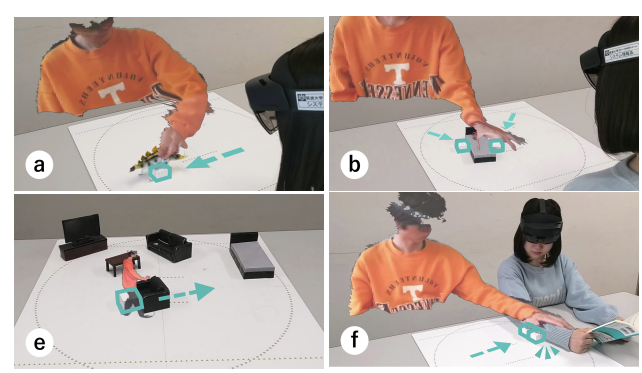
Academic systems such as VirtualCube and HoloDevice highlight emerging capabilities: volumetric capture, holographic cross-device interactions, remote proxemics. arXiv+1
Together, these show the state of the art—from commercial enterprise solutions to research prototypes—pointing to a rich ecosystem developing around holographic/hybrid collaboration.
Benefits of Holographic Collaboration for Hybrid Meetings
Here are some of the major value propositions:
- Improved sense of presence and connection: By enabling spatial audio, lifelike avatars or holograms, and shared physical context, participants feel more immersed and connected, reducing “remote fatigue”.
- Enhanced collaboration on 3D/spatial content: Teams working on engineering, design, architecture, manufacturing benefit from sharing 3D models, visualising changes spatially, annotating in context.
- Better engagement and participation: Immersive environments motivate interaction; avatars can move, gesture, and participants can navigate the space rather than remain static.
- Reduced travel / cost savings: Some meetings that would require physical co-location (e.g., design reviews, site visits) can be virtualised with similar effectiveness. Cisco’s example: technicians using hologram technology instead of flying out. newsroom.cisco.com
- Flexibility for hybrid teams: Teams distributed across locations, time zones, devices (desktop, headset, mobile) can join and engage in the same shared virtual space.
- Persistent virtual rooms / spaces: Some software allows creating virtual meeting environments that persist between sessions (e.g., 3D rooms stay in state). HoloMeeting mentions that rooms are “automatically saved”. Microsoft Marketplace
Challenges and Considerations
While the promise is compelling, there are important practical and strategic challenges to address:
- Hardware & accessibility: Some solutions require AR/MR headsets, holographic displays, or specialized sensors. This raises cost, provisioning and user-ease issues.
- Interoperability & devices: Participants might join from a standard laptop, tablet or phone. Ensuring a seamless experience across devices is non-trivial.
- User experience design: Navigating 3D environments, controlling avatars, dealing with spatial audio—these must be intuitive. Poor design can lead to frustration or distraction rather than productivity.
- Network bandwidth & latency: Real-time holographic interaction, volumetric capture or large 3D models demand high-performance networks. Latency impacts presence and collaboration fluidity. Research such as VirtualCube discusses the real-time rendering challenge. arXiv
- Content preparation and modelling: For 3D collaboration to be effective, content (models, CAD/BIM, virtual spaces) must be prepared, optimised, and integrated with the meeting tool. Organisations may need new workflows.
- Adoption & change management: Users are familiar with 2D video calls; moving to immersive environments is a behavioural shift. Training, cultural adaptation and clear value-prop are key.
- Privacy, security and data governance: Capturing avatars, spatial audio, shared 3D content may raise concerns around confidentiality, IP, data residency and access control.
- ROI and measurement: Quantifying productivity gains, engagement improvements or travel savings to justify investment may be complex.
Practical Steps for Adoption
If an organisation is considering implementing holographic collaboration software for hybrid meetings, here are some recommended steps:
- Define use-cases
Choose high-impact scenarios where spatial collaboration or enhanced presence matters — e.g., design review, engineering walkthroughs, remote training, global team co-creation. - Evaluate hardware/devices & access
Determine whether to support headsets (AR/MR/VR) or only desktops/mobile. Choose tools that support mixed devices to minimise friction. - Select software/platform
Review platforms that support avatars, immersive environments, 3D model sharing, cross-device access and persistent spaces—e.g., HoloMeeting, VirtualZ, Hololight/MATSUKO partnership. - Pilot with a small team
Run a pilot with early adopters to test hardware, network performance, user experience and content workflows. Gather feedback and refine. - Prepare content and workflows
Ensure that 3D models, virtual meeting spaces, annotation tools and collaboration workflows are set up ahead of time. Train participants. - Integration with existing tools
Seamlessly integrate with current meeting platforms (calendar invites, identity, SSO), and ensure fallback to standard video for participants without immersive devices. - Measure outcomes
Define metrics: meeting engagement, duration, travel cost savings, speed of design sign-off, user satisfaction. Evaluate pilot and make business case. - Scale and govern
Based on pilot results, scale to more teams, standardise hardware/software, establish governance (who uses it, how, security), run training and support programmes. - Continuous improvement
Gather feedback, iterate on meeting room design, avatar behaviour, interaction workflows, accessibility for mobile/laptop users and optimise content preparation.
The Future Outlook
Looking ahead, several trends suggest holographic collaboration will become increasingly mainstream:
- Advances in volumetric capture & holography: As systems become cheaper and more automated, capturing people in 3D and streaming them into shared spaces will improve in fidelity and drop in cost.
- Cross-device and browser support: Research such as HoloDevice (holographic cross-device interactions) suggests more seamless integration between physical devices and shared environments. arXiv
- Expanded use-cases in industry: Beyond general meetings, sectors such as manufacturing, construction, real estate, healthcare and education will adopt immersive collaboration for spatial content, training and simulation. The Hololight/MATSUKO partnership specifically targets automotive and construction. hololight.com
- Hybrid human-agent avatars: Combining 3D avatars with AI agents or digital twins (e.g., virtual humans) will enable new modes of collaboration, assisted meetings and automation.
- Improved UX, realism & presence: As avatar realism, gesture tracking, full-body motion capture and spatial audio evolve, the “feeling of being there” will get stronger, reducing the barrier between remote and in-person.
- Inclusive device access: Updates to platforms will allow wider access via desktop, mobile, web browsers—so participants without headsets aren’t excluded. For example, XR-enhanced video conferencing analysis emphasises supporting remote participants anywhere. Rishan Solutions
Conclusion
The hybrid-work era demands more than just video conferencing. To truly collaborate across locations, teams need tools that mimic physical presence, enable sharing of spatial/3D content, and support immersive, engaging interactions. Holographic collaboration software—using 3D avatars, immersive environments and holographic telepresence—represents a powerful evolution in remote collaboration.
For organisations willing to invest in the right use-cases, hardware, workflows and user adoption, the benefits are real: better presence, improved collaboration on complex content, cost savings and differentiated team experiences. However, this is not a plug-and-play replacement for standard video calls—successful adoption requires thoughtful planning, pilot testing, training and integration.
As the technology matures and becomes more accessible, holographic collaboration may well become a standard component of how hybrid teams meet, innovate and create together. The future of meetings isn’t just flatter—it’s spatial, three-dimensional, avatar-led and holographic.