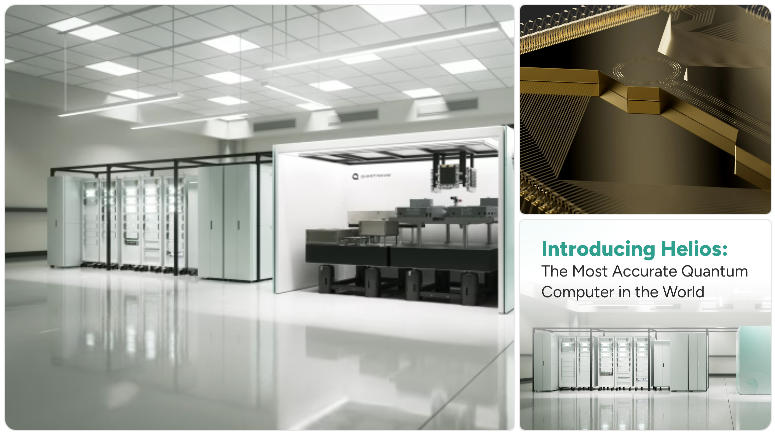
In a landmark move for the quantum computing industry, Quantinuum has officially announced the commercial launch of its new quantum computer system, Helios. According to its press release, Helios is “the world’s most accurate general-purpose commercial quantum computer,” designed to accelerate enterprise adoption of quantum technologies and enable a new class of hybrid classical–quantum workflows—especially in the domain of generative quantum artificial intelligence (GenQAI). Quantinuum+3PR Newswire+3Quantinuum+3
This article delves into what Helios brings to the table: its architecture, fidelity milestones, industry implications, use-cases, and how this fits into the broader quantum computing and AI landscape.
1. What is Helios? A Technical Overview
1.1 Key Specifications
- Helios features 98 physical qubits (PQ) in a fully connected architecture, using barium ions in a junction ion-trap design. Quantinuum+2The Quantum Insider+2
- Gate fidelities are extremely high: ~99.9975 % for single-qubit gates and ~99.921 % for two-qubit gates across all pairs. Quantinuum
- On the logical qubit front (i.e., error corrected or error-detected qubits):
- 50 logical qubits (LQ) error-detected with better-than-physical performance in a magnetism simulation. Quantinuum+1
- 48 logical qubits error-corrected at an encoding ratio of ~2:1 (i.e., 2 physical per logical) — a milestone that industry previously considered very difficult. Quantinuum
- 50 logical qubits (LQ) error-detected with better-than-physical performance in a magnetism simulation. Quantinuum+1
1.2 Architecture Highlights
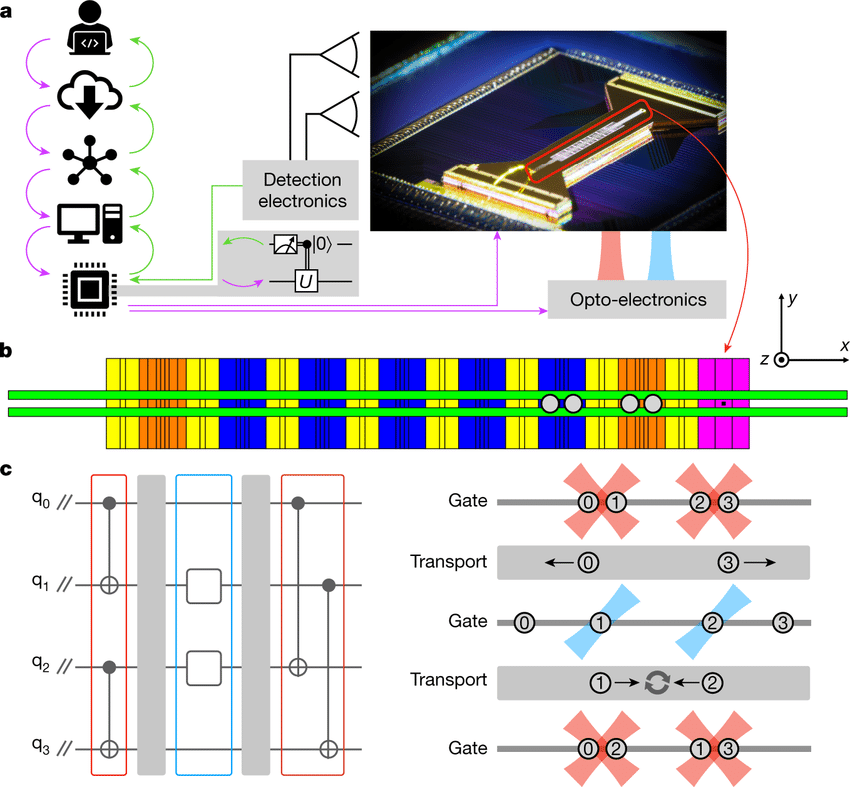
- Helios uses an ion-trap “junction” design: a rotatable storage ring of ions with gating legs and a junction where routing, cache, logic zones take place. This is unlike many superconducting qubit fixed-array architectures. Quantinuum
- Full all-to-all connectivity: any qubit can entangle with any other via ion movement, avoiding many of the swap-gate overheads common in fixed qubit systems. Quantinuum
- Real-time classical-quantum control engine: Helios integrates classical processing (via NVIDIA GPUs and NVLink) to perform error-decoding in real time, enabling dynamic circuits, hybrid loops, and improved throughput. The Quantum Insider+1
1.3 Programming and Ecosystem
- A new Python-based high-level quantum programming language called Guppy allows developers to write code that interleaves quantum and classical operations, loops, dynamic control flow — making quantum programming feel more like conventional software development. The Quantum Insider+1
- Helios is available via cloud access and on-premises deployment, making it a general-purpose quantum compute platform for enterprises. PR Newswire
2. Why Helios Matters: Beyond Qubit Counts
2.1 Fidelity and Logical Qubits — What’s the Big Deal?
Until recently, one of the major obstacles in quantum computing was error rates and scaling: physical qubits are inherently noisy, and one logical, fault-tolerant qubit often required tens or hundreds of physical qubits. Helios claims to invert that by delivering logical qubits with better-than-physical performance and a 2:1 physical-to-logical ratio. Quantinuum+1
This matters because fidelity (accuracy) is arguably more important than sheer qubit number when real-world application comes into play. Helios’ fidelity claims set a new benchmark for commercial systems.
2.2 Hybrid Quantum-Classical and GenQAI
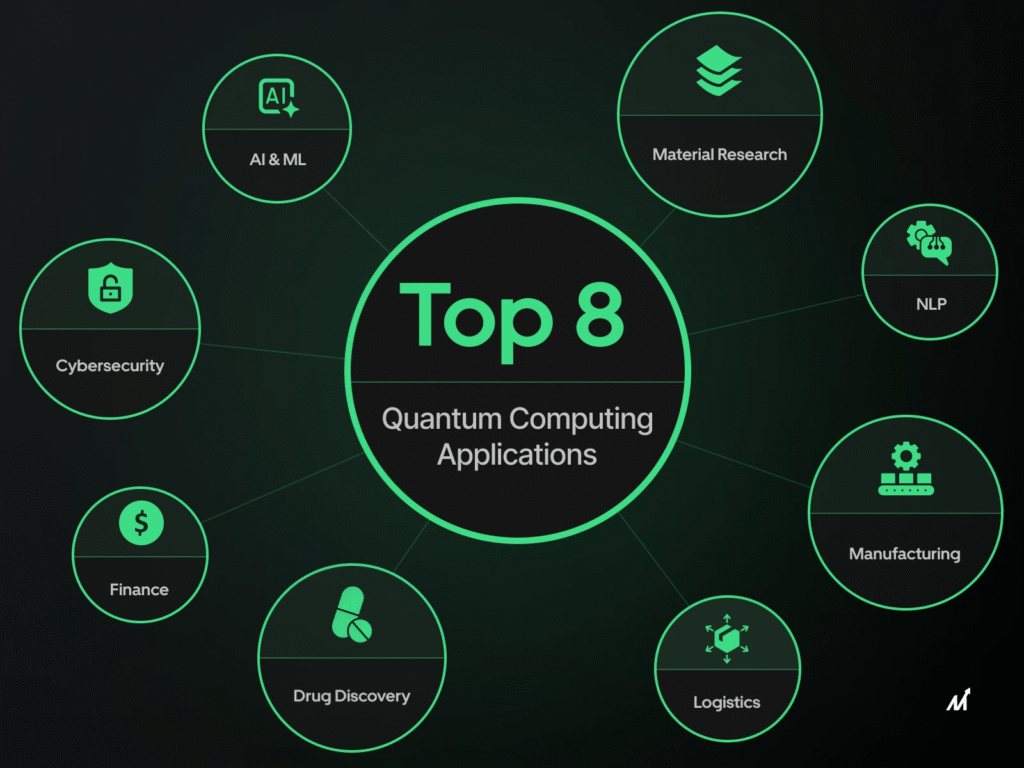
Helios is explicitly aimed at accelerating generative quantum AI (GenQAI)—the blending of quantum computing with AI workflows to generate, analyse, optimise, or simulate data in ways classical systems struggle with. PR Newswire+1
By integrating classical GPU-accelerated compute with quantum logic in the same circuit (via NVLink and real-time control), Helios bridges a long-standing gap between the quantum research lab and enterprise applications.
2.3 Industry Applications
Quantinuum lists early collaborators and domains including:
- Life sciences / biologics: Amgen exploring hybrid quantum-machine learning for drug discovery. The Quantum Insider
- Materials & mobility: BMW Group leveraging Helios for sustainable materials research (e.g., fuel-cell catalysts). The Quantum Insider
- Finance / analytics: JPMorgan Chase using it for advanced financial modelling. The Quantum Insider
- Strategic national deployment: The partnership with National Quantum Office (Singapore) marks one of the earliest infrastructure-level commercial quantum installations. The Straits Times+1
2.4 Competitive Landscape and Implications
Many organisations announce increasing qubit numbers, but fewer deliver logical qubit performance and error-correction at commercial scale. Helios’ launch signals a step beyond “quantum hope” and into “quantum utility.”
Analysts will watch how well Helios delivers on claimed advantages and whether enterprise use-cases scale in a cost-effective, reliable way.
3. Use-Case Scenarios: What Can Helios Enable?

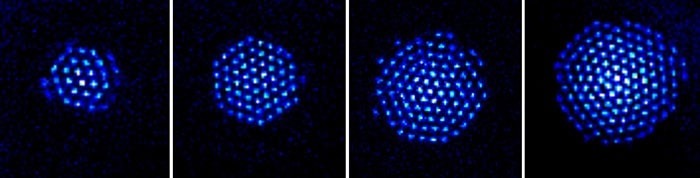
Image: Real image of 98 single Barium atoms (atomic ions) used for computation inside Quantinuum’s Helios quantum computer.
3.1 Materials Science & Chemistry
Helios has already been used to simulate the Fermi-Hubbard model and detect superconducting pairing correlations — something that classical computers struggle to handle at scale. arXiv+1
In practice, companies working on battery materials, catalysts, and optical devices could feed quantum-driven simulation outputs into AI pipelines, gaining an edge in R&D cycles.
3.2 Generative AI + Quantum Data
Generative AI models (e.g., large language models, image generators) rely on large datasets and are increasingly costly to train. Helios promises to generate or transform data quantum-native — for example, by synthesising “quantum enhanced” features, boosting model variety or enabling novel architectures.
While this is still nascent, Helios being marketed explicitly for GenQAI suggests Quantinuum expects enterprises to build quantum-augmented AI workflows soon. PR Newswire+1
3.3 Financial Modelling & Optimisation
In finance, quantum algorithms can explore large combinatorial spaces (e.g., portfolio optimisation, derivative pricing) more efficiently than classical heuristics. With the high fidelity of Helios, firms like JPMorgan Chase can test whether quantum advantage begins to emerge in commercially-relevant workflows.
Also, the real-time integration with classical compute means quantum sub-routines can become part of a broader pipeline rather than isolated experiments.
3.4 National/Enterprise Infrastructure
The Singapore partnership shows that Helios is being used not only by private firms but also by national quantum programmes. This signals that quantum hardware is shifting from experimental labs toward infrastructure use. The Straits Times+1
4. Challenges & What to Watch
No technological leap is without caveats. Here are areas to monitor in the coming months:
4.1 Actual Application vs Hype
While Helios’ fidelity specs are impressive, actual enterprise deployments will face hurdles: algorithmic maturity, cost and integration complexity, and ROI for quantum workflows.
The question will be: can Helios move beyond “interesting proof-of-concepts” into sustained production workloads?
4.2 Software & Ecosystem Maturity
Guppy and hybrid workflows are promising, but quantum software stacks remain rapidly evolving. Developers will need tooling, best practices, and interface stability.
Enterprises may need to invest significantly in talent, workflow redesign, and co-development to utilise Helios effectively.
4.3 Economic & Energy Efficiency
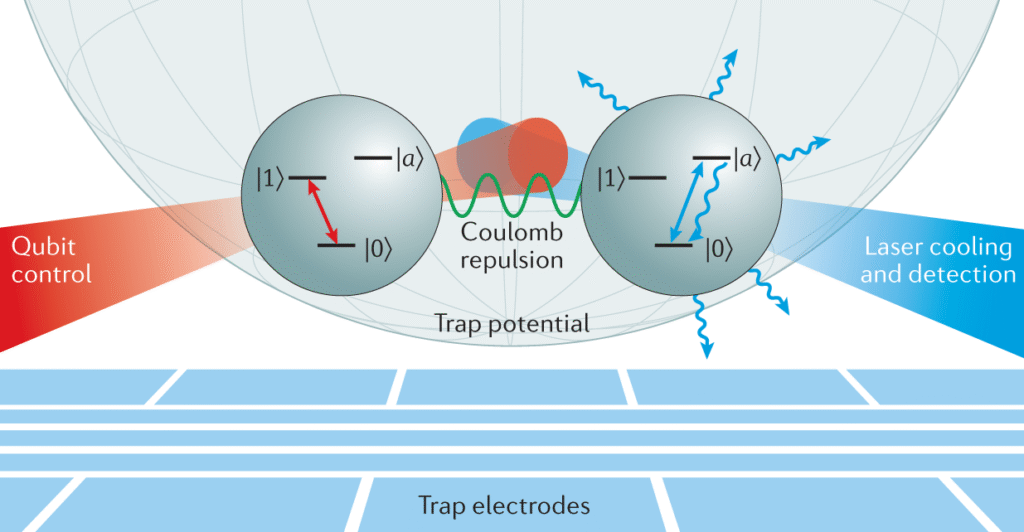
Quantum hardware—especially ion-trap machines—requires specialized infrastructure (vacuum systems, laser cooling, cryogenics). Enterprises will want to understand the total cost of ownership, energy efficiency, and scalability (hardware maintenance, error-correction overhead).
Helios claims that some of the classical simulation tasks would require more energy than the Sun, but the real-world economics remain to be seen. Quantinuum
4.4 Competitor Response & Roadmap
Other quantum hardware vendors (superconducting qubits, photonics, neutral atoms) are also pushing scaling and fidelity. Helios must maintain its lead in accuracy and programmability.
Quantinuum’s roadmap (e.g., future system “Apollo” or others) will be important for sustaining momentum. PR Newswire+1
5. Implications for Your Tech Blog & Audience
Since your blog (bytenest.tech) targets a global tech audience — especially U.S. and international readers interested in new launches and trends — here are some suggestions to align your article content and amplify its SEO impact:
5.1 Angle & Headline Suggestions
- “How Quantinuum’s Helios is Putting Quantum AI in the Enterprise”
- “From Labs to Clouds: Helios Signals Quantum Computing’s Commercial Dawn”
- “Generative AI Meets Quantum: A Deep Dive into Helios’ Launch”
5.2 Key SEO Keywords to Incorporate
- Quantum computer
- Generative quantum AI (GenQAI)
- Quantum fidelity / logical qubits
- Enterprise quantum applications
- Hybrid quantum-classical computing
- Ion-trap qubits / barium ions
- Quantum hardware launch 2025
5.3 Structure & Subheadings for Your Article
- Introduction – why this launch matters
- What is Helios? (Technical overview)
- Key performance milestones (fidelity, logical qubits)
- Architecture innovations (junction trap, real-time control)
- Use-cases & early collaborators
- Implications for quantum + AI convergence
- Challenges ahead and what to watch
- Why this matters for enterprises and developers
- Conclusion – next steps & roadmap
5.4 Visual & Media Suggestions
- Include images of the Helios hardware, ion-trap diagram, the programming stack (Guppy + NVLink)
- Consider embedding a simplified infographic: “Quantum vs Classical computing – where Helios stands”
- Use alt-text with keywords like “Helios quantum computer fidelity 99.9975%” for better SEO image indexing
5.5 Internal & External Linking Strategy
- Link to the Quantinuum press release and blog for credibility (e.g., via turn0search4 / turn0search5)
- Link to a primer article on quantum computing (from your own previous posts) for context
- Use external links to reputable sources (e.g., academic arXiv papers turn0academia15/turn0academia14) for tech-savvy readers
5.6 Call to Action
Encourage readers to subscribe for future updates on quantum computing hardware and to follow how Helios is used in real enterprise workflows. If you cover case-studies later (Amgen, BMW, Singapore NQO), link back to this article as a foundational reference.
6. Conclusion
The launch of Helios by Quantinuum marks a bold step toward commercial, high-fidelity quantum computing. With record-setting fidelities, logical qubit performance, a hybrid quantum-classical architecture, and explicit support for generative quantum AI, Helios is positioned not just as a research platform but as a general-purpose enterprise system.
For your blog, this is an excellent story: a convergence of quantum hardware, software, and AI into a market-ready product. Write it not just as a technical release, but as a narrative of the “inflection point” into quantum-enabled business computing.
The best time to publish is now, to ride the first-wave interest. You may also consider follow-up articles: e.g., “How BMW and Amgen are using Helios”, “Generative Quantum AI: use-cases emerging in 2026”, or “Comparing Helios to competitor systems”.